
Hornet mimic hoverfly
Volucella zonaria
Description
How to identify
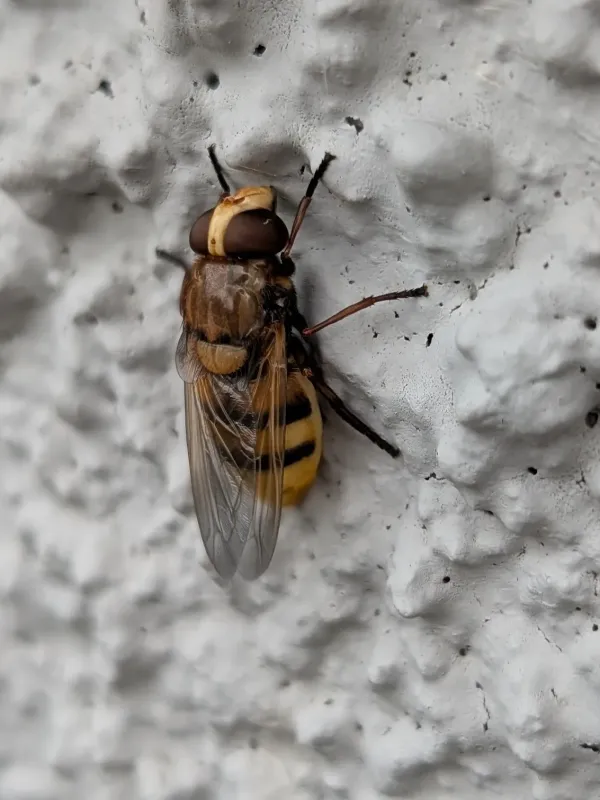
The Hornet mimic hoverfly (Volucella zonaria) is a member of the Syrphidae family, order Diptera. It is famous for its striking resemblance to the European hornet, featuring yellow and black abdominal bands and reaching up to 20 mm in length.
The fly has large eyes, with those of the males meeting at the top of the head. Its wings are clear with a slight brownish tint, helping to distinguish it from the stinging Hymenoptera it mimics.
The larvae are specialized, legless, and covered in short bristles. A key feature is the posterior breathing tube, which they use to respire while living inside the debris-filled nests of social wasps.
Despite their threatening appearance, these insects do not possess a stinger. They are completely harmless to humans and are valuable visitors to gardens and agricultural landscapes.
As hoverflies, they are highly capable flyers, often seen hovering in place over flowers before landing to feed on nectar and pollen.
What it damages
Volucella zonaria is not considered a crop pest. It does not feed on living plant tissue, seeds, or fruits, making it a neutral or beneficial member of the agro-ecosystem.
The larvae act as scavengers within the nests of social wasps (such as Vespula species), feeding on organic detritus, dead wasp larvae, and unconsumed food remnants.
By cleaning out wasp nests, they contribute to the hygiene of these natural habitats, without interfering with the surrounding crop production or quality.
There is no economic damage threshold for this species, as it does not pose a threat to plant health, growth, or yields in any field or orchard environment.
Mistaking this insect for a pest can lead to the inappropriate application of insecticides, which harms the balance of beneficial insects and pollinators on the farm.
When it appears
Adults are typically active during the warm months, peaking from June through September when nectar-rich flowering plants are most abundant in the landscape.
The life cycle is tightly coupled with that of host wasps. Females search for wasp nests to lay eggs, ensuring their offspring have access to food and shelter.
Overwintering occurs at the larval or pupal stage in sheltered locations, such as rotting logs, tree hollows, or even in the soil near the nest sites.
Adult emergence occurs in the spring, with subsequent generations appearing throughout the summer, depending on local temperatures and nest availability.
High temperatures during the larval stage accelerate their development, allowing for a quicker transition to the pupal stage before the onset of autumn.
Signs of infestation
The presence of this species is easily noted by the appearance of large, hornet-like insects hovering around flowers, gardens, or near old structures and trees.
No damage signs, such as chewed leaves or wilted stems, will be observed on crops because the insect is not a herbivore.
If you see these insects, you may notice them entering cracks in trees or walls; this behavior is typically related to the search for suitable wasp nests for oviposition.
Monitoring the fields will reveal no larvae or feeding damage on plant parts, confirming that the Hornet mimic hoverfly is not affecting the crop health.
The primary sign is simply the sightings of the adults on flowering borders, hedgerows, or among cultivated crops during sunny weather.
Control measures
No control measures are necessary for Volucella zonaria, as it is a beneficial pollinator and a harmless commensal of social wasps.
Integrated Pest Management (IPM) guidelines advocate for the protection of such species, as they contribute to the overall biological diversity and pollination efficiency of the farm.
Avoid broad-spectrum insecticide use during bloom to protect this and other pollinators. Protecting hoverfly populations can help ensure successful pollination of crops.
If wasp nests near infrastructure become a nuisance, they may be removed, but this is a management decision related to wasps, not the hoverfly larvae.
Correct identification is the most effective management tool, ensuring resources are focused on real threats while preserving helpful ecological companions.
Taxonomy
- Latin name
- Volucella zonaria
- Order
- Diptera (flies)
- Family
- Syrphidae
- EPPO code
- VOLUZO
Discussion
No discussions yet — be the first.