
Baccha hoverfly
Baccha
Description
How to identify
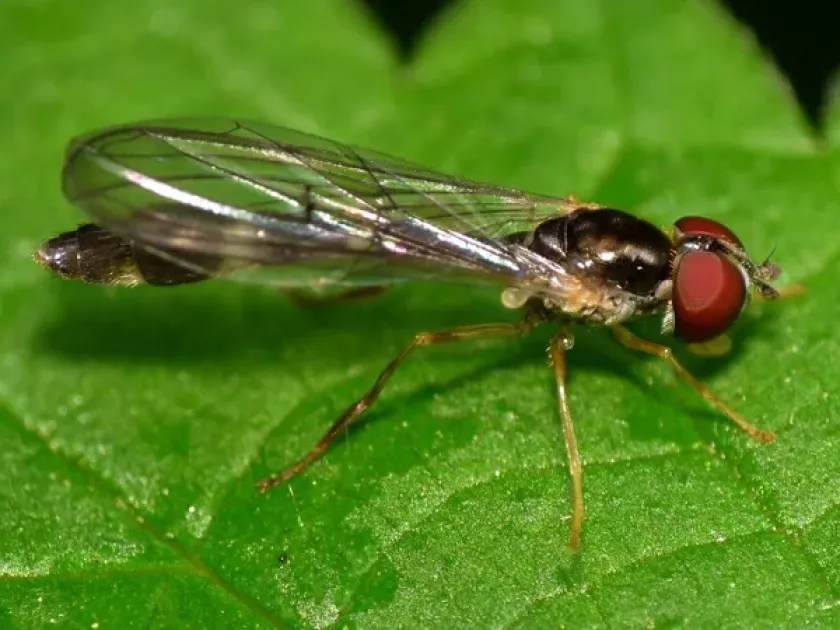
The genus Baccha belongs to the Syrphidae family. Adults are easily recognized by their extremely slender, elongated abdomen, which makes them look like small wasps or flies.
The coloration of the imago is typically dark with yellow markings. Their wings are transparent and powerful, allowing for the precise, hovering flight characteristic of this family.
Larvae are worm-like, usually pale green or translucent, and lack a distinct head. They are often found moving among aphid colonies on leaves.
The life cycle consists of four stages: egg, larva, pupa, and adult. Pupae are often attached to leaves or stems and can be quite inconspicuous.
These flies undergo complete metamorphosis and are highly adapted to finding aphid-infested plants for egg-laying.
What it damages
Baccha larvae are predatory and feed primarily on aphids, meaning they do not damage plants but rather protect them from sap-sucking pests.
They are considered important natural enemies of aphids in both agricultural and garden settings, significantly reducing the pest population.
Adult flies feed on nectar and pollen, contributing to the pollination process, which makes them doubly beneficial for crop productivity.
There is no direct damage caused by this insect to cultivated plants; hence, they are not categorized as pests in agronomic manuals.
Farmers should consider these insects as allies rather than threats and adjust pest management strategies to protect their populations.
When it appears
Adults emerge in late spring as temperatures rise, signaling the start of their active season and reproductive phase.
The population peaks during the summer months, correlating with the rapid multiplication of aphid colonies on various vegetable and ornamental crops.
As autumn approaches, activity declines as the insects prepare for diapause or overwintering, depending on the climatic zone.
In greenhouses, Baccha can remain active and continue their development throughout the year if conditions remain stable.
Their presence is highly dependent on the availability of flowering plants that provide the nectar necessary for adult survival.
Signs of infestation
The most common sign of their presence is seeing adult flies hovering near blossoms or hovering over aphid-infested leaves.
A reduction in aphid colony density without chemical intervention is a strong indicator of the presence of Baccha larvae.
Pupae attached to plant foliage are a sign that the life cycle is proceeding successfully within the crop area.
Farmers might observe the larvae directly by carefully inspecting the undersides of leaves where aphids typically aggregate.
The lack of characteristic pest damage despite high aphid density initially often suggests that natural predators like hoverflies are at work.
Control measures
No control measures are needed for Baccha, as they are beneficial insects that assist in natural pest suppression.
The primary strategy should be to protect them by avoiding broad-spectrum insecticides that may kill non-target beneficial species.
Integrating flowering strips or "insectary" borders near fields helps to support the populations of adult hoverflies throughout the season.
If chemical pest control is absolutely required, select products that are least harmful to natural enemies and pollinators.
Monitoring populations through regular crop scouting allows producers to assess the efficiency of natural biocontrol before deciding on interventions.
Taxonomy
- Latin name
- Baccha
- Order
- Diptera (flies)
- Family
- Syrphidae
- EPPO code
- BCCHSP
Discussion
No discussions yet — be the first.