
Allograpta
Allograpta
Description
How to identify
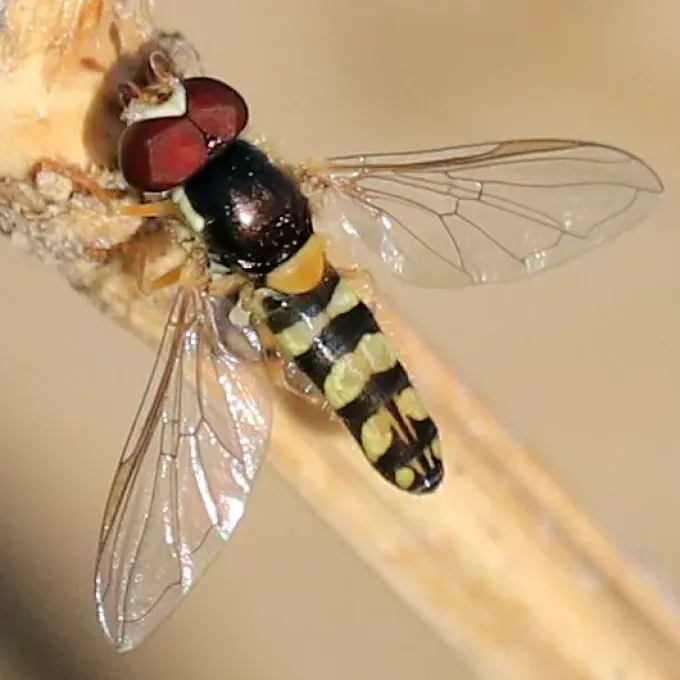
Allograpta is a genus of hoverflies belonging to the family Syrphidae. These insects are well-known for their mimicry, as their yellow and black abdominal patterns closely resemble those of wasps.
Adults are expert fliers, capable of hovering stationary in the air before darting to flowers or aphid colonies to feed or lay their eggs.
The larvae are typically maggot-like, legless, and often feature green or brownish coloration that allows them to blend in seamlessly with vegetation and aphid colonies.
The lifecycle consists of four distinct stages: egg, larva, pupa, and adult. This complete metamorphosis allows the insect to adapt to various environmental conditions.
In professional agronomy, Allograpta is recognized as a vital beneficial insect rather than a pest, playing a key role in natural pest suppression.
What it damages
Allograpta larvae do not cause damage to crops. They are specialized predators that feed extensively on various species of aphids (Aphididae), protecting the plants from infestation.
By consuming hundreds of aphids during their development, the larvae act as a biological control agent, reducing the need for chemical intervention in fields.
Adult flies are important pollinators. While they feed on pollen and nectar, they facilitate fertilization in many vegetables, fruits, and grain crops.
There is no record of Allograpta species damaging plant tissues, as their entire life strategy is built around hunting prey and seeking floral resources.
Their presence is considered a sign of a healthy ecosystem and balanced agricultural land where predatory-prey ratios are maintained naturally.
When it appears
The active season for Allograpta begins in late spring, as temperatures rise and aphid populations start to establish themselves on host plants.
Peak abundance is usually reached in mid-summer, correlating directly with the massive outbreaks of aphids that provide a steady food supply for the larvae.
Females are highly efficient at locating aphid clusters, where they deposit eggs to ensure that the newly emerged larvae have immediate access to food.
Depending on the climatic zone, the genus can produce several generations per season, with development times shortening significantly during warmer periods.
As autumn progresses, the insects transition into overwintering stages, typically pupating in protected areas like soil crevices or accumulated plant litter.
Control measures
Control measures against Allograpta are unnecessary and even detrimental, as the insect provides valuable free-of-charge pest control services to farmers.
The primary strategy should be the conservation of these flies through the judicious use of pesticides. Avoiding broad-spectrum insecticides is crucial for their survival.
Promoting a diversified landscape is recommended, which includes planting flower strips with nectar-rich plants like buckwheat, coriander, or dill to attract adult hoverflies.
Maintaining hedgerows and unsprayed field margins provides critical shelter for both larvae and adults, supporting a larger population of natural enemies.
- Avoid the use of toxic chemicals when possible.
- Establish floral strips for adult nectar sources.
- Preserve field borders to provide overwintering sites.
Taxonomy
- Latin name
- Allograpta
- Order
- Diptera (flies)
- Family
- Syrphidae
- EPPO code
- ALLGSP
Discussion
No discussions yet — be the first.