
Hornet mimic hoverfly
Volucella inanis
Description
How to identify
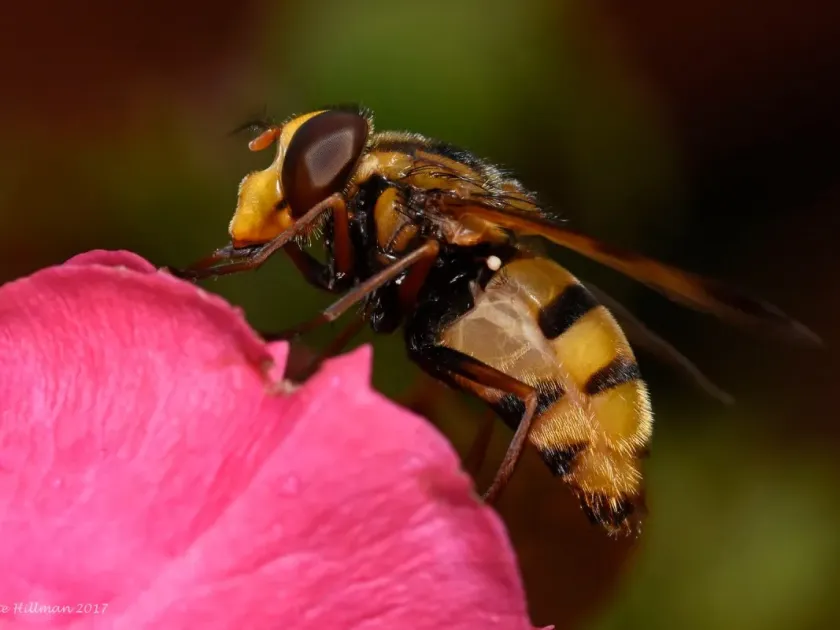
Volucella inanis, commonly known as the hornet mimic hoverfly, belongs to the family Syrphidae. Its striking yellow and black pattern mimics the appearance of a hornet, which is a classic example of Batesian mimicry in the insect world.
Adult flies measure between 15 and 18 mm. They feature clear wings with subtle dusky patches and a robust body structure, making them easily distinguishable from smaller hoverfly species.
The larvae are greyish and have a distinct, wrinkled body structure. They spend most of their life cycle as scavengers or commensals within social wasp nests, which is a key aspect of their life history.
Although adult hoverflies are significant pollinators, the larvae's association with wasp nests means they can be found in close proximity to trees, shrubs, and even human structures where wasps dwell.
Understanding their lifecycle is crucial for farmers and gardeners, as the presence of Volucella inanis is almost always linked to the presence of wasps in the immediate environment.
What it damages
The damage caused by Volucella inanis is generally indirect. The larvae do not typically feed on healthy plant tissue, but they can damage soft tissues if a wasp nest is located within a tree cavity or root zone.
Fruit trees that suffer from mechanical damage or wood rot are particularly susceptible. The larvae may utilize these weakened areas to inhabit the tree, further aggravating existing structural issues.
When larvae develop in large numbers, they can disrupt the bark and cambium layers of trees, potentially hindering the flow of water and nutrients throughout the host plant.
The presence of larvae and their associated waste products can create conditions suitable for the growth of opportunistic fungal pathogens, leading to secondary infections.
While not a primary agricultural pest in the traditional sense, their ability to colonize weakened plants makes them a factor to consider in integrated pest management for orchards.
When it appears
Adult flies are typically observed during the summer months, specifically from June through August, which coincides with the period of peak wasp activity.
There is usually one generation per year. The species overwinters as larvae or pupae, often tucked away in protected sites like wasp nests or organic debris.
Their flight activity is most intense during warm, sunny weather, as these conditions favor their dispersal and the search for suitable nesting sites for their offspring.
As autumn approaches and temperatures drop, the adult population declines rapidly, and the insect enters a dormant state until the following year.
Monitoring for this species is most effective during the mid-summer peak, when adults are actively visiting flowers and nesting locations.
Signs of infestation
The primary indicator of the species' presence is the detection of active social wasp nests within or near the woody stems or cavities of garden trees.
Visual observation of large, hornet-like flies hovering near trees or structures is a strong indicator that a population may be present in the local area.
Signs of larval presence include sap flow, dark staining around tree cavities, or unexplained wilting of parts of the tree canopy that might be linked to internal damage.
Examination of the base of trees or hollow trunks may reveal the presence of larval debris or the insects themselves if a nest is located within the tree cavity.
Declining vigor in older trees, characterized by chlorosis or branch dieback, should prompt an investigation into whether internal nesting activity is occurring.
Control measures
The most effective management strategy is to practice good tree hygiene, which includes sealing cavities and pruning diseased branches to minimize suitable nesting sites for wasps.
Removing old or abandoned wasp nests during the late autumn or early spring can significantly reduce the number of potential overwintering sites for the hoverfly.
While chemical control is rarely required, maintaining tree health through proper fertilization and watering makes trees less attractive to nesting insects.
Physical barriers or screens can be used in sensitive areas to prevent both wasps and the mimic hoverflies from accessing vulnerable parts of fruit trees.
- Fill and seal tree hollows with appropriate materials.
- Conduct regular pruning to remove deadwood.
- Monitor for wasp activity early in the season to prevent nest establishment.
Taxonomy
- Latin name
- Volucella inanis
- Order
- Diptera (flies)
- Family
- Syrphidae
- EPPO code
- VOLUIS
Discussion
No discussions yet — be the first.