
Small Indian civet
Viverricula indica
Description
How to identify
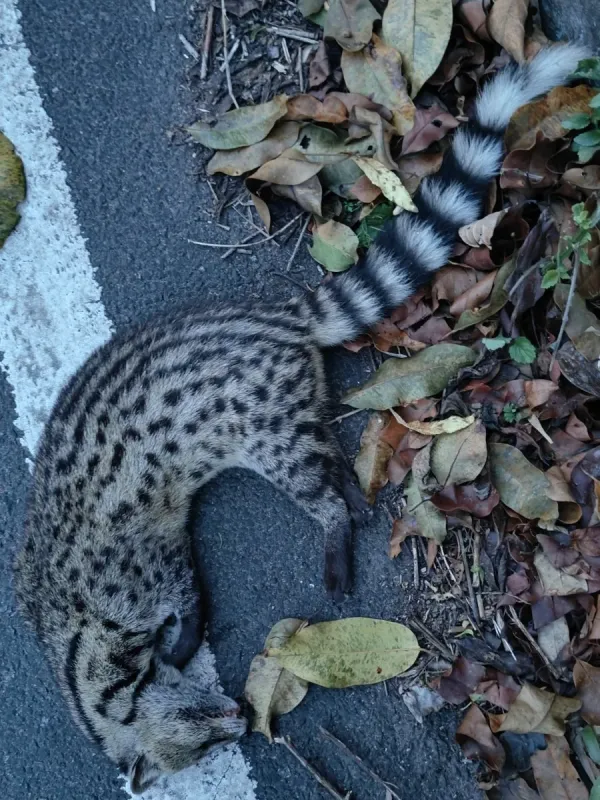
The Small Indian civet (Viverricula indica) belongs to the order Carnivora and the family Viverridae. It is a small mammal, resembling a cat in size with an elongated body and a long, banded tail.
The coat color ranges from grayish to yellowish-brown, featuring longitudinal dark stripes on the back and spots on the flanks. The tail is marked with distinct dark and light rings.
An adult typically measures about 50–60 cm in body length, with a tail reaching up to 40 cm. Their weight usually ranges between 2 to 4 kilograms.
This species is predominantly nocturnal and crepuscular, possessing an acute sense of smell and hearing. They prefer dense cover but frequently adapt to living near human agricultural lands.
By nature, the animal is an opportunistic omnivore, which allows it to thrive in anthropogenic landscapes and near large-scale plantations.
What it damages
The primary damage caused by the Small Indian civet in the agricultural sector involves the destruction of fruit and berry crops. They actively consume ripe fruits, severely impacting the marketability of the harvest.
The animal causes significant economic losses to coffee plantations, as they feed on ripe coffee cherries, rendering them unsuitable for further processing.
Civets also damage maize crops and other cereals during the ripening stage, breaking open the husks to consume the grain, which creates entry points for fungal infections.
In regions where oilseeds are grown, the pest can consume the produce, thereby reducing the overall yield for farming operations.
Beyond plant-based diets, civets frequently raid chicken coops, killing domestic poultry, which inflicts additional financial burdens on agricultural enterprises.
When it appears
The peak activity and damage by the Small Indian civet coincide with the ripening seasons of various agricultural crops.
The animal's activity increases during periods when natural food sources are scarce, compelling them to migrate toward accessible human-made food supplies.
The most critical period is the time just before the coffee harvest, when individuals congregate around plantations to forage for ripe berries.
In tropical climates, the animal remains active year-round; however, the intensity of their attacks on fields correlates with the fruiting phenology of key regional crops.
Increased activity is often observed during drought periods when natural water and food sources within forested areas become severely limited.
Signs of infestation
A key indicator of a civet's presence on a property is the discovery of partially eaten fruits showing distinct teeth marks on the surface of the skin.
Field surveys often reveal droppings containing undigested seeds and plant fibers, which are indicative of the animal's diet.
Damaged corn cobs or broken crop stems serve as evidence of mechanical disturbance, often accompanied by flattened vegetation around feeding spots.
A specific, pungent musky odor near dens or along the boundaries of plantations is another indirect sign of the species' territory and activity.
At night, the presence of the pest can be detected by their glowing eyes under spotlights and specific vocalizations made while moving through tall grass or crops.
Control measures
An effective control measure is the installation of physical barriers, such as robust wire-mesh fencing around the perimeter of fields and produce storage facilities.
The use of ultrasonic deterrents and motion-activated lighting systems can effectively reduce the frequency of nocturnal visits by predators to plantations.
Sanitary management of areas adjacent to fields, specifically clearing dense brush and tall vegetation, eliminates comfortable daytime shelters for the animals.
Employing humane live-trapping methods allows farmers to relocate individual animals causing significant damage without the use of harmful chemical agents.
Adhering to proper crop rotation and maintaining clean field borders helps in discouraging the animal from nesting and foraging near valuable agricultural investments.
Taxonomy
- Latin name
- Viverricula indica
- Family
- Viverridae
- EPPO code
- VIVRMA
Discussion
No discussions yet — be the first.