
African civet
Civettictis civetta
Description
How to identify
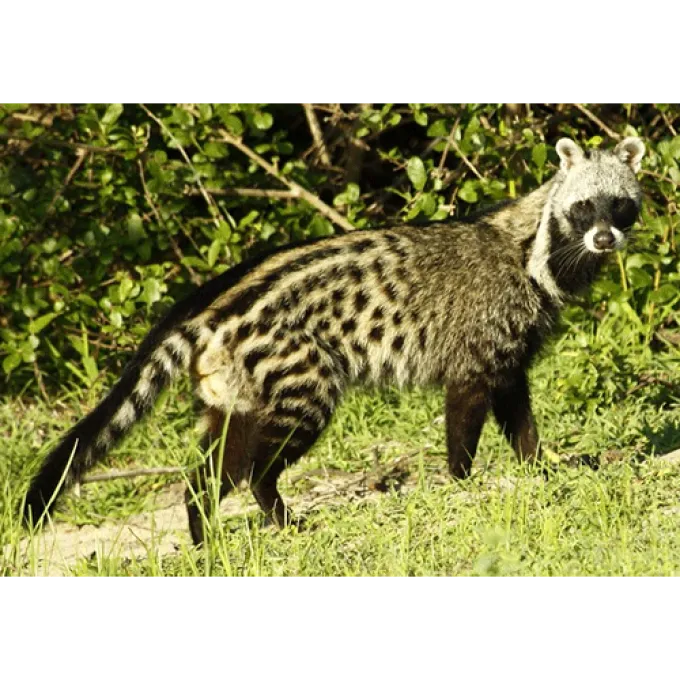
The African civet (Civettictis civetta) belongs to the Viverridae family, representing a medium-sized carnivore with a distinctive spotted pattern and a coarse, dark dorsal mane.
Physically, the animal resembles a cross between a cat and a hyena, reaching body lengths of up to 90 centimeters. Its robust paws are designed for roaming across varied terrain to forage for food.
Being strictly nocturnal, these animals are difficult to observe during daylight hours. They prefer dense vegetation and tall grasses, which provide excellent camouflage near agricultural lands.
A key identifying feature is their strong musk odor, used for marking territory. This secretion can often be found on stones, trees, or fencing around agricultural areas.
While biologically classified as a carnivore, the African civet is highly opportunistic and omnivorous, making it a regular visitor to farmland in search of fruit and crops.
What it damages
The African civet causes significant damage to various crops, with a particular fondness for fruit plantations, melons, and certain vegetable fields.
Maize crops, melons, and various tropical fruits are among the most frequently attacked items. Civets consume large quantities of ripe produce, causing substantial economic losses.
Beyond direct consumption, their movement through fields results in mechanical damage to plants, stems, and leaves. In their search for food, they often dig up soil, affecting the root systems of young crops.
The damage caused to the fruits often renders them unmarketable, as bites and physical trauma invite secondary infections or rot.
Their presence on farms can also pose a threat to poultry, forcing farmers to implement comprehensive protective strategies to mitigate losses across the entire farm ecosystem.
When it appears
African civets show increased activity during the harvest and fruit ripening season when food sources are highly abundant and easily accessible.
During the dry season, these animals frequently migrate toward irrigated fields. The availability of water and moisture-rich crops during droughts makes these areas hotspots for civet activity.
The animal remains active throughout the year as it does not hibernate, but the intensity of its raids strictly correlates with the phenological stage of the crops.
Since they are nocturnal, farmers and agronomists note that the majority of field damage occurs under the cover of darkness, requiring specific nighttime monitoring.
As harvest approaches, the accumulation of ripening produce serves as a powerful attractant, increasing the frequency of visits and potential damage to the crops.
Signs of infestation
Bite marks on ripening fruits, such as maize cobs or melons, are a primary indicator of civet activity. These marks differ significantly from those left by insect pests.
Footprints in loose soil at the edges of fields provide evidence of movement routes. These signs are often easier to identify following light rain or morning dew.
Fecal matter containing undigested plant seeds, skins, and fruit fibers confirms that the animal is feeding directly on the cultivated crops in the vicinity.
A persistent, strong musky odor lingering around the perimeter of the field is a clear sign that the area has been marked as a foraging territory by a civet.
Flattened stems in tall crops like corn, along with disturbed soil near the base of plants, are reliable physical markers of civet activity within the field.
Control measures
The installation of secure, mesh fencing is the most effective way to physically limit access for civets. Barriers should be tall and potentially buried to prevent digging.
Ultrasonic deterrents and motion-activated lights or sound systems are useful for repelling nocturnal animals from agricultural plots during the night.
Cultural practices, such as clearing tall weeds and dense brush from field edges, help eliminate potential daytime hiding spots, making the area less hospitable to them.
Repellents based on strong scents or natural deterrents can create a psychological barrier, discouraging civets from entering sensitive areas of the plantation.
In cases of high population density, humane live-trapping is recommended. Captured animals can be relocated to wild areas far from agricultural sites to prevent further damage.
Taxonomy
- Latin name
- Civettictis civetta
- Family
- Viverridae
- EPPO code
- VIVECI
Discussion
No discussions yet — be the first.