
Nandinia
Nandinia
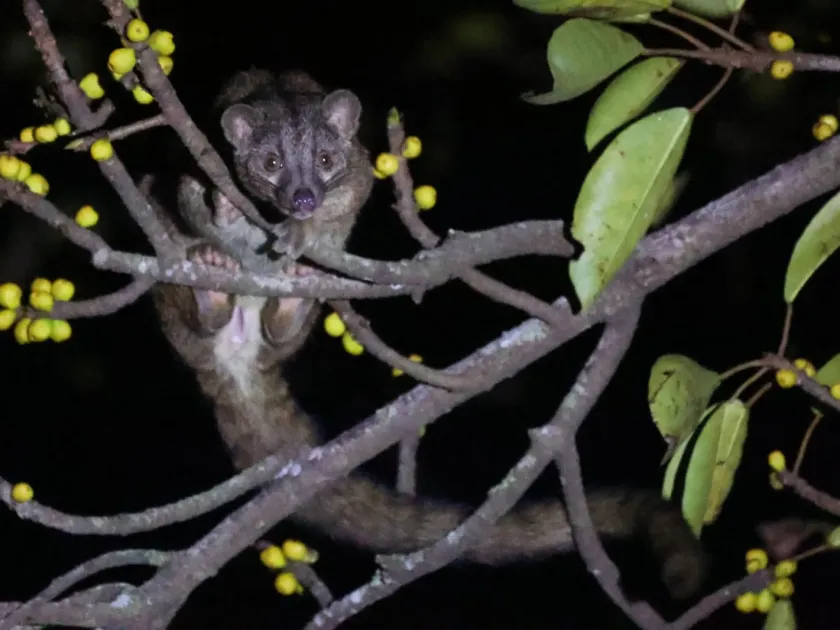
Description
How to identify
The Nandinia (Nandinia binotata), commonly known as the African palm civet, belongs to the family Nandiniidae within the order Carnivora. It is a small, arboreal mammal with a cat-like appearance, adapted for climbing.
The animal is covered in soft, mottled fur ranging from gray to brown, providing excellent camouflage against tree branches and dense canopy. This coloration makes it very difficult to spot during the day.
Being nocturnal and strictly arboreal, the civet spends most of its time in the upper canopy. It is highly agile, capable of leaping between branches with great precision to navigate through plantations.
The biology of the Nandinia is intrinsically linked to wooded habitats. It relies on its sharp senses, particularly smell and sight, to locate ripe fruit over significant distances, making it an efficient opportunistic feeder.
Reproductive patterns involve nesting in tree hollows or high foliage, which makes it challenging for farmers to identify specific breeding sites near agricultural land.
What it damages
Nandinia poses a significant threat to commercial orchards and tropical plantations. It is primarily known for causing extensive damage to fruit-bearing trees by feeding on ripening produce.
The diet includes a variety of fruits, such as mangoes, bananas, papayas, and coffee cherries. They often prefer the ripest fruits, causing significant economic losses by damaging or consuming marketable harvest.
Besides fruit consumption, the physical presence of the civet leads to branch breakage and bark abrasion. As they move through the trees, they crush or break small twigs, which affects the tree's health and yield potential.
In coffee plantations, Nandinia feeding habits are particularly detrimental. They consume the coffee berries, leading to a direct decrease in crop yield and potentially damaging the structural integrity of the coffee bushes.
The damage caused by these animals often leaves the plant susceptible to secondary infections from fungi and pathogens, which can exacerbate the impact on long-term tree health.
Signs of infestation
Signs of Nandinia activity include partially eaten or bitten fruits scattered on the ground beneath trees. These fruits often bear distinct tooth marks, which are indicative of the civet's feeding behavior.
Damaged branches, especially broken twigs at the top of the crown, point toward the civet's frequent movement patterns through the orchard canopy.
The presence of feces on the ground containing undigested seeds is a reliable indicator that the animal has been visiting the trees for food.
Nocturnal activity, such as rustling in the canopy or specific vocalizations, can indicate that the pests are actively feeding, especially when the fruit is nearing maturity.
Visible claw marks on the bark of trunks are another indicator, as the animal repeatedly uses the same routes to ascend and descend the trees during its nightly foraging.
Control measures
Controlling Nandinia requires a non-lethal, preventative approach, as these animals often inhabit areas where ecological balance is important and local regulations protect wildlife.
The most effective physical control measure involves installing smooth metal collars or cones around the trunks of fruit trees to prevent the civets from climbing into the crown.
Sanitation practices play a key role; farmers should ensure that fallen, overripe fruits are collected and disposed of promptly to avoid attracting the animals to the plantation.
The use of motion-activated lighting or acoustic deterrents can create an environment that the civets find unappealing, discouraging them from entering the orchard at night.
- Install metal tree collars to block climbing paths.
- Remove fallen fruit from the ground regularly.
- Use motion-sensor lights to deter nocturnal visitors.
- Maintain pruned canopy structures to minimize hiding spots.
Taxonomy
- Latin name
- Nandinia
- Family
- Viverridae
- EPPO code
- NANDSP
Discussion
No discussions yet — be the first.