
African palm civet
Nandinia binotata
Description
How to identify
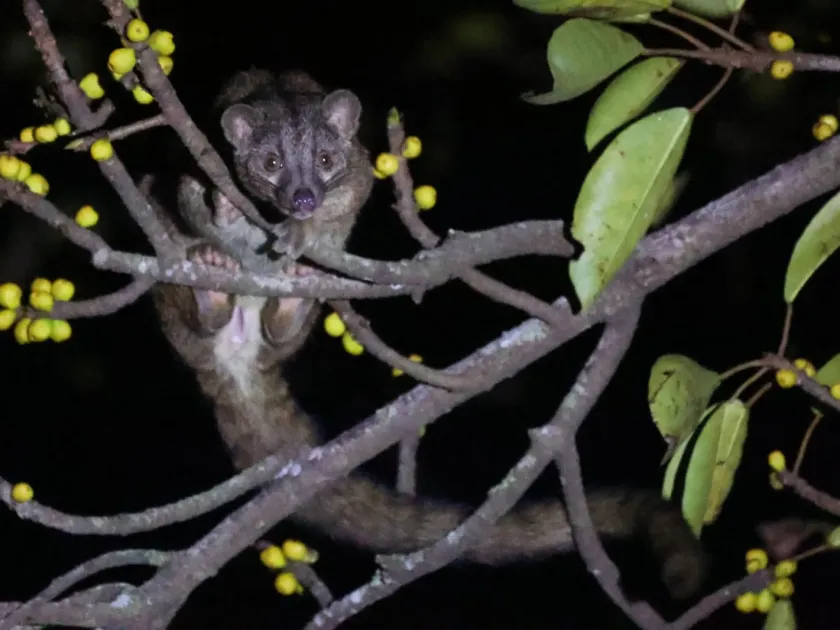
The African palm civet (Nandinia binotata) is a carnivorous mammal belonging to the family Nandiniidae. It is a solitary, arboreal creature that resembles a small cat with an elongated, ringed tail.
These animals are strictly nocturnal, which allows them to bypass many surveillance measures implemented by farmers during the day. Their agility in trees is exceptional, making them highly effective at reaching fruits in the upper canopy.
Adult civets typically weigh between 1.5 and 3 kilograms. Their physical structure is optimized for climbing, allowing them to traverse long distances between trees without touching the ground.
Their coat is mottled with spots, providing excellent camouflage against the foliage of tropical trees, which makes visual identification during night patrols extremely difficult.
While they are biologically classified as carnivores, they have a highly opportunistic diet that includes fruit, making them a recurring problem for tropical fruit and coffee farmers.
What it damages
The primary agricultural impact of the African palm civet is the consumption and destruction of fruit crops, particularly on coffee and oil palm plantations. They selectively harvest the ripest fruits.
In cocoa plantations, these animals can damage large numbers of pods, leading to significant yield loss and economic damage for the producer.
Physical damage to trees, such as scratched bark and broken twigs, is common as they move through the canopy. This structural damage can lead to secondary infections or pest infestations.
Besides fruit damage, civets have been known to raid poultry facilities near plantation houses, creating secondary issues for farm management and livestock security.
The cumulative damage often leads to reduced quality of the remaining harvest, as partially eaten fruit is susceptible to rapid decay and pathogen spread.
When it appears
The civet's activity peaks during the ripening and harvest seasons of plantation crops. Their presence is highly correlated with the availability of preferred food sources.
During the dry season, when natural food in the forest becomes scarce, civets are significantly more likely to migrate toward agricultural lands to feed on irrigated crops.
These animals are most active during the middle of the night, between midnight and dawn. Monitoring efforts should be focused on these hours to accurately assess the population.
Year-round presence is possible, but they are most troublesome when plantations enter the fruiting stage, which serves as a beacon for the local civet population.
Professional agronomists note that once a civet identifies a consistent food source in an orchard, it will habitually return until the fruit is exhausted or deterrents are applied.
Signs of infestation
Signs of infestation include half-eaten fruits found on branches or littered on the orchard floor, often with characteristic bite marks that differ from those of insects or birds.
Scratches on the bark of trees, particularly near the base and along main branches, are indicative of regular movement paths used by the civets to navigate the canopy.
Fecal matter, containing seeds from the plantation crops, is a diagnostic sign of their presence. These droppings are often found on branches or near their nesting sites.
The use of motion-activated trail cameras is the most effective way to confirm the presence of this pest, as their nocturnal behavior makes direct observation nearly impossible.
A sudden decline in harvest volume, when no major disease or insect infestation is evident, is a strong indicator of nocturnal mammal activity within the plantation.
Control measures
Installing smooth metal bands or plastic collars around the trunks of trees is a highly effective way to prevent civets from climbing up to the fruit-bearing canopy.
Motion-sensor lighting and acoustic deterrents can create a hostile environment for the civets, forcing them to move away from the plantation toward less sensitive areas.
Proper orchard sanitation is essential; collecting fallen fruit removes the primary attractant that keeps the civets returning to the plantation area.
Live-trapping is recommended in cases of high economic impact, allowing farmers to relocate the animals humanely to areas where they pose no threat to agriculture.
Maintaining a clean perimeter around the plantation and using sturdy fencing can further discourage civets from entering the orchard from adjacent forest lands.
Taxonomy
- Latin name
- Nandinia binotata
- Family
- Viverridae
- EPPO code
- NANDBI
Discussion
No discussions yet — be the first.