
Small Indian civet
Viverricula
Description
How to identify
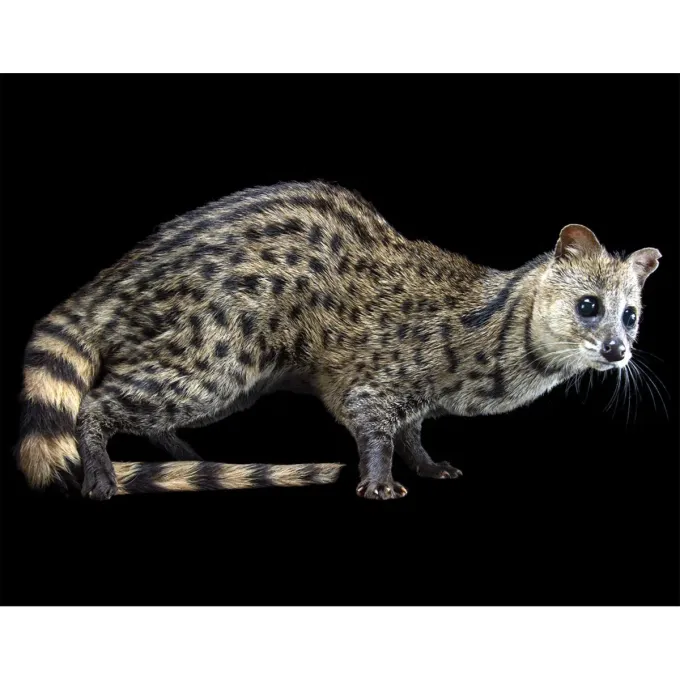
The small Indian civet (Viverricula indica) belongs to the order Carnivora and the family Viverridae. It is a small, slender mammal with a long, ringed tail that resembles a cat in its general silhouette.
Its coat varies in color from grey to brownish-yellow, adorned with black or dark brown spots and stripes along the body, which provides effective camouflage in varied environments.
These animals are primarily nocturnal and crepuscular, relying on their keen sense of smell and hearing to navigate through plantations and human-modified landscapes.
Civets are opportunistic omnivores, showing high adaptability in both their dietary habits and their ability to reside in thickets or near man-made structures.
Due to their elusive behavior and high reproductive potential, managing these populations requires consistent attention from farm operators to prevent long-term damage.
What it damages
Small Indian civets cause significant economic loss by raiding plantations and consuming valuable crops such as coffee berries, mangoes, grapes, and various tropical fruits.
Beyond direct consumption, their movement through the canopy and across fields results in the breaking of delicate branches and the trampling of standing crops, leading to yield reduction.
In grain-growing areas, they may inadvertently damage crops while hunting for ground-dwelling rodents, which are a part of their opportunistic carnivorous diet.
The presence of civets near poultry farms is a major concern, as they often target poultry pens, creating substantial financial losses and requiring the reinforcement of livestock housing.
Contamination of harvested fruits by fecal matter is a significant issue, as it compromises quality standards and marketability, often rendering produce unfit for export.
Control measures
The primary control strategy involves physical exclusion; erecting high-quality, fine-mesh fencing that extends below the ground surface effectively prevents civets from entering cultivation zones.
Integrating modern deterrent technologies, such as motion-activated lighting or acoustic alarms, proves successful in deterring these nocturnal creatures from entering protected areas.
Field maintenance, particularly the removal of dense brush and tall weeds along field perimeters, denies the animals the necessary cover to hide during the day.
Biological and mechanical control programs, including the use of live traps and population monitoring, help maintain civet numbers below a damaging threshold in vulnerable regions.
- Installing perimeter fencing with subterranean barriers.
- Deployment of motion-activated lighting and sound alarms.
- Regular clearance of brush and vegetation cover.
- Implementation of live-capture trapping programs.
Taxonomy
- Latin name
- Viverricula
- Family
- Viverridae
- EPPO code
- VIVRSP
Discussion
No discussions yet — be the first.