
Villa morio
Villa morio
Description
How to identify
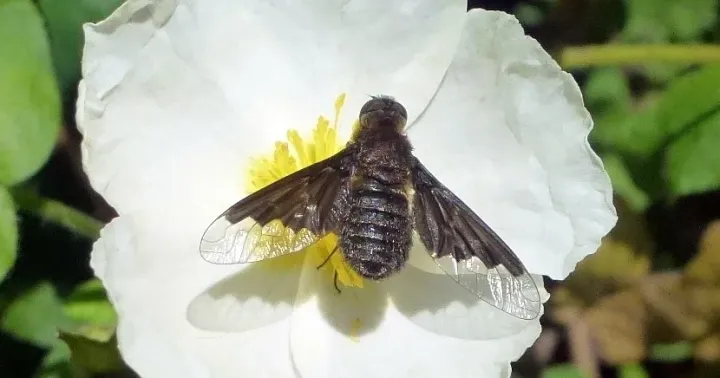
Villa morio is a species of bee fly belonging to the family Bombyliidae, order Diptera. Adult flies are characterized by a dense covering of hair, which gives them a distinct resemblance to bees or bumblebees.
These flies have a black body and often display dark patterns on their wings. They are agile fliers, capable of hovering over flowers to feed on nectar, which makes them effective pollinators in some environments.
The larval stage of Villa morio undergoes hypermetamorphosis. Unlike the adults, the larvae are parasitic, typically targeting the nests of solitary bees or other insects living in the soil.
Systematically, this species belongs to a group of entomophagous insects that play a complex role in the ecosystem, acting both as beneficial pollinators and as parasites.
Identification in the field involves examining the wing venation and the hair pattern on the thorax, as many species within the Bombyliidae family share similar morphological traits.
What it damages
The damage caused by Villa morio is indirect. The flies do not consume plant tissues, roots, or fruits; they do not possess mouthparts capable of damaging agricultural crops.
The negative impact occurs through their larval stage, which parasitizes beneficial pollinators. By reducing the population of solitary bees, Villa morio can inadvertently lower the pollination efficiency of orchards.
In high-intensity agriculture, the reduction of natural pollinator populations can lead to reduced fruit set and lower crop yields, making this species a concern for orchard management.
The larvae are parasitoids that invade nests and consume the host's eggs or larvae, disrupting the reproductive cycle of beneficial insects.
While not a primary pest of plants, their role in upsetting the balance of local pollinator populations makes them an object of interest in integrated pest management programs.
When it appears
The flight period of adult Villa morio usually occurs during late spring and early summer, coinciding with the flowering phase of many fruit and berry crops.
They are most active on warm, sunny days, often congregating in dry areas or bare soil where potential host nests are located.
The species typically completes one generation per year. The larvae overwinter within the host nest or soil, pupating when temperatures rise in the spring.
The mass emergence of adults corresponds with the availability of nectar sources, emphasizing the importance of monitoring during the early growing season.
The adult lifespan is relatively short, focusing primarily on feeding and finding suitable sites for oviposition near host nesting colonies.
Signs of infestation
Presence is typically identified by observing hairy, bee-like flies hovering persistently over soil patches that may host solitary bee nests.
A decline in the number of visiting bees on flowers may serve as an early indicator of parasitic activity in the local environment, although this is not conclusive.
Finding empty pupal casings protruding from the soil surface after the emergence period is a strong sign of a successful life cycle for the fly.
Direct monitoring of bee nesting sites during the spring can help determine if Villa morio is present in significant numbers.
The specific hovering behavior of the adults over the ground is the most common diagnostic sign for field agronomists.
Control measures
Direct chemical control is generally not recommended, as broad-spectrum insecticides would devastate the population of beneficial pollinators that are already under threat.
The best management approach involves promoting habitat diversity to ensure that pollinator populations remain robust and capable of resisting parasitic pressure.
Preventative measures include protecting nesting sites of beneficial bees and minimizing the use of synthetic pesticides during the crucial pollination period.
- Maintain patches of undisturbed soil to support native pollinator health.
- Avoid the use of toxic pesticides during the peak bloom and flight periods.
- Increase planting of diverse flower species to strengthen the local insect community.
Implementing ecological farming practices, such as maintaining hedgerows and wildflower borders, creates a more resilient system where natural controls can function effectively.
Taxonomy
- Latin name
- Villa morio
- Order
- Diptera (flies)
- Family
- Bombyliidae
- EPPO code
- HEMNMO
Discussion
No discussions yet — be the first.