
Anthrax distigma bee fly
Anthrax distigma
Description
How to identify
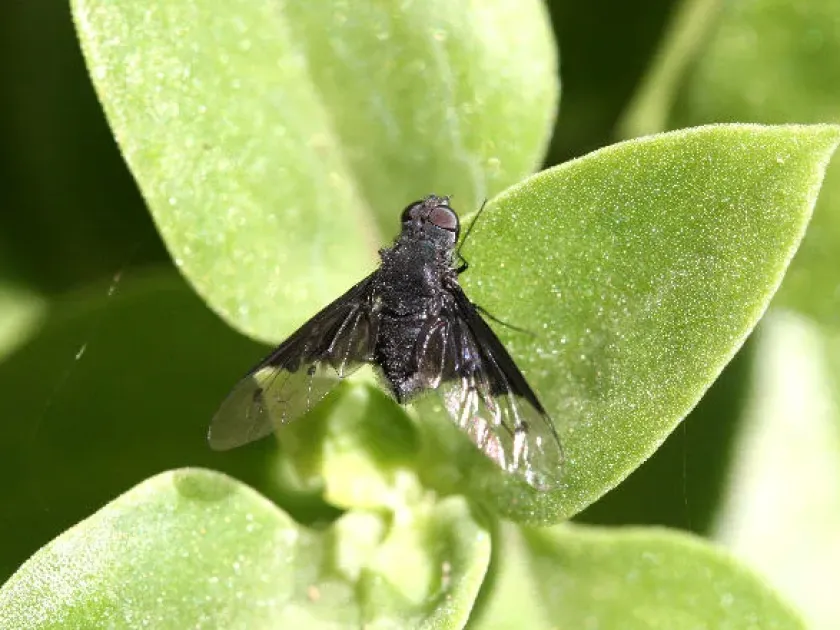
Anthrax distigma is a species of bee fly belonging to the family Bombyliidae, which closely resembles a small bumblebee or honeybee due to its hairy appearance.
Adult flies are easily identified by a distinct wing pattern featuring two dark spots, which differentiates them from other species within the genus.
The body is stout and ranges from 10 to 15 mm in length, covered in dense hairs with color patterns that provide camouflage among floral environments.
The head is highly mobile with large eyes, and the mouthparts form a long, rigid proboscis used for feeding on nectar from a variety of flowers.
As part of the Diptera order, this insect plays a specialized role as a parasitoid in various natural and agricultural ecosystems.
What it damages
It is important to clarify that Anthrax distigma does not consume plant tissues, stems, or leaves, so it is not a direct threat to crop health.
The economic impact arises from its life cycle, as the larvae are parasitoids that prey on the larvae of solitary bees, which are essential pollinators.
By reducing the populations of ground-nesting bees, the fly can indirectly contribute to reduced crop yield, particularly in orchards requiring cross-pollination.
In regions where agricultural production depends heavily on native pollinators, the proliferation of this parasite is viewed as a negative ecological factor.
Therefore, damage control focuses on preserving the bee population rather than eliminating the fly itself as a plant-eating pest.
When it appears
The adult Anthrax distigma is typically active during mid-to-late summer, corresponding with the peak bloom period of many nectar-producing plants.
These flies are most active during warm, sunny weather conditions, which are ideal for their flight patterns and mating behavior.
They frequent open, sunny habitats, forest edges, and grasslands, where they locate the nesting sites of host bees for egg-laying.
The seasonal cycle is synchronized with the activity of their hosts, ensuring that larvae have enough time to develop before the winter period.
The larvae overwinter in the soil or within the host's nest, emerging as adults in the following year once temperature thresholds are met.
Signs of infestation
A primary indicator of their presence is observing adults hovering over patches of bare soil where solitary bees are known to nest.
One may notice empty pupal casings protruding from the ground after the adults have emerged, providing clear evidence of successful development.
A noticeable decline in the number of solitary bees visiting flowers in the vicinity of their nesting sites suggests high parasitism rates.
Females may be seen performing rhythmic, hovering motions over nesting holes before depositing their eggs into the host's burrow.
- Hovering behavior over bee nesting sites.
- Presence of pupal skins near the soil surface.
- Decreased pollinator activity in the field.
Control measures
Applying broad-spectrum insecticides is highly discouraged, as such chemicals would cause more harm to essential pollinators than to the parasites.
The most effective strategy is to protect the nesting grounds of wild bees by avoiding deep soil tillage and soil compaction in those specific areas.
Maintaining floral diversity ensures that both pollinators and their natural enemies have sufficient resources, stabilizing the ecosystem's natural balance.
Farmers are encouraged to use integrated pest management strategies that favor the conservation of native beneficial insect populations.
Education on the distinction between beneficial insects and pests is vital to prevent unnecessary eradication efforts that disrupt local biodiversity.
Taxonomy
- Latin name
- Anthrax distigma
- Order
- Diptera (flies)
- Family
- Bombyliidae
- EPPO code
- ANHXDI
Discussion
No discussions yet — be the first.