
Small bee fly
Bombylius minor
Description
How to identify
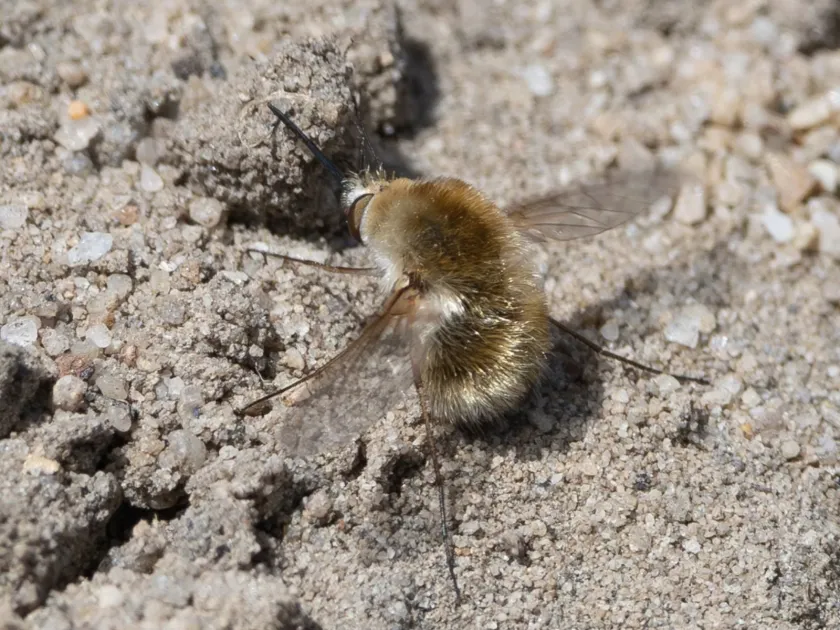
The small bee fly (Bombylius minor) belongs to the family Bombyliidae and is characterized by its dense, fur-like hair, giving it the appearance of a small bumblebee.
Adult flies possess a long, rigid proboscis used to feed on flower nectar while hovering in mid-air, a behavior that closely resembles that of hummingbirds.
The body is typically yellowish-brown, and the wings display a distinct spotted pattern, which acts as camouflage against the soil and foliage.
Unlike many other insects, the larvae of this species are specialized parasites that develop within the nests of solitary bees.
Identification is based on the specific wing venation and the length of the proboscis relative to the body size, distinguishing it from other Bombylius species.
What it damages
Bombylius minor is not considered a crop pest because adults feed exclusively on nectar and pollen, causing no harm to plant tissues.
The primary interaction with the environment is the larval parasitism of solitary bee larvae, which may indirectly influence the local pollinator population.
In agricultural settings, their presence is often neutral, as they do not consume foliage, fruits, or roots of cultivated crops.
They are not involved in transmitting plant diseases or causing physical injury to agricultural produce.
Therefore, any efforts to control this species are generally unnecessary and could be detrimental to the ecosystem if non-selective pesticides are used.
When it appears
Adult flies are active during the late spring and early summer, typically when temperatures are sufficient for sustained flight and flower blooming.
The peak activity period occurs between May and June, aligning with the nesting season of their bee hosts.
The life cycle is univoltine, meaning there is only one generation per year, with the larvae spending the winter in a state of diapause.
Pupation occurs in the spring, allowing the adult to emerge exactly when environmental conditions and host availability are optimal.
Observation of flight patterns shows a preference for warm, sun-exposed areas where both flowers and nesting sites are abundant.
Signs of infestation
A key indicator of their presence is a high-pitched, steady humming sound produced by the rapid wing beats while hovering over blossoms.
Visual identification is easiest on sunny days when flies are observed hovering near sandy, well-drained soil where solitary bees build nests.
Empty pupal cases protruding from the soil or abandoned bee nesting holes are physical signs that the cycle has been completed.
A reduction in the number of nesting solitary bees in an area can sometimes suggest the presence of a parasitic population of bee flies.
For research or monitoring purposes, entomologists use specialized netting during peak morning hours to assess population density.
Control measures
No specific control measures are recommended for Bombylius minor, as it does not present a threat to agricultural productivity.
Avoid the use of broad-spectrum insecticides, as these will kill vital pollinators alongside the flies, leading to yield loss.
Maintaining ecological corridors and diverse plant habitats promotes a healthy balance between solitary bees and their natural regulators.
Agricultural practices that protect undisturbed soil patches help sustain local biodiversity, ensuring that no single species dominates to an harmful extent.
In garden environments, manual removal of adults is possible if their presence is undesirable, but this is rarely necessary given their non-pest status.
Taxonomy
- Latin name
- Bombylius minor
- Order
- Diptera (flies)
- Family
- Bombyliidae
- EPPO code
- BOMIMI
Discussion
No discussions yet — be the first.