
Bee fly
Anthrax
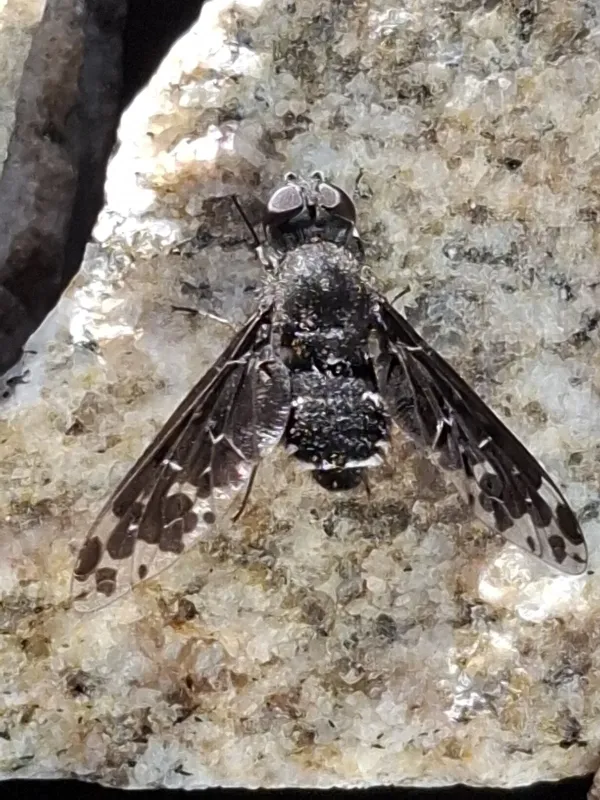
Description
How to identify
The bee fly, belonging to the genus Anthrax, is part of the Bombyliidae family within the order Diptera. These insects are well-known for their mimicry, often resembling bees or bumblebees due to their dense, fuzzy bodies.
Adults possess a characteristic long proboscis used for sipping nectar from flowers. They are famous for their unique ability to hover mid-air, often accompanied by a distinct buzzing sound, which makes them easy to spot in a garden.
Their bodies are typically robust and spherical, covered in grey, brown, or black hairs. The wing pattern is often spotted or clouded, which serves as a key identification feature for the Anthrax genus.
The life cycle involves hypermetamorphosis, where the larvae change their physical form significantly as they develop, allowing them to adapt to life inside the nests of their host insects.
While they are fascinating to observe, their presence is often an indicator of the complex ecological interactions occurring beneath the surface of the soil.
What it damages
Bee flies of the Anthrax genus are not direct plant pests as they do not consume vegetation. In fact, adult bee flies are considered efficient pollinators of various flowering plants.
However, their larvae are parasitoids that develop within the nests of solitary bees and wasps. By consuming the host larvae or their food supplies, bee flies can significantly reduce the populations of essential garden pollinators.
A reduction in solitary bee populations can lead to lower fruit and vegetable yields for crops that rely heavily on insect pollination, particularly in home gardens and orchards.
Therefore, their damage is indirect, manifesting as a disruption of the local pollinator ecosystem and a decrease in natural biodiversity on the site.
In environments where bee populations are already stressed, the presence of large numbers of Anthrax flies can exacerbate the difficulty of achieving optimal crop fertilization.
When it appears
The activity period for adult bee flies is mainly during the spring and summer months, coinciding with the peak blooming season of major melliferous plants.
These insects prefer warm, sunny weather and are most active in open areas where the soil is well-warmed, providing ideal conditions for their hovering and egg-laying habits.
The development cycle is strictly synchronized with that of their host insects, ensuring that larvae emerge at the exact time when host nests are being constructed and provisioned.
Weather factors, such as soil temperature and moisture levels, heavily influence the survival rate of the larvae and the timing of the adult fly emergence each season.
Year-to-year population fluctuations are common and are often driven by the success of the host population and the suitability of climatic conditions for the Anthrax life cycle.
Signs of infestation
The primary sign of bee fly activity is observing them hovering consistently above small holes in the ground or dead stems, which serve as entrances to solitary bee nests.
During the egg-laying phase, females can be seen flicking their eggs into these small entrance holes with remarkable precision while remaining in flight.
A noticeable decrease in the number of foraging solitary bees in your garden, despite an abundance of blossoms, can be a sign that a parasitoid population is impacting the local bee nest density.
The appearance of empty pupal cases protruding from soil holes at the end of the summer provides definitive proof that the bee flies have successfully completed their development.
- Persistent hovering over soil nesting sites;
- Observing flies flicking eggs into nest entrances;
- Decline in solitary bee activity;
- Reduced fruit set in pollinator-dependent crops.
Control measures
There are no chemical control measures specifically targeting bee flies, as they are not traditional agricultural pests, and their role as pollinators must be weighed against their parasitic nature.
The use of insecticides is strongly discouraged, as it would cause more damage to the beneficial bee and wasp populations than the bee flies themselves ever could.
The best management approach is to foster a diverse garden environment that provides ample resources for both the pollinators and their natural enemies, maintaining an ecological balance.
Minimizing intensive soil tillage in nesting areas can help preserve the habitat for both bees and their associated parasitoids, ensuring that neither population is wiped out.
By promoting biodiversity, you create a robust ecosystem that can tolerate the presence of Anthrax flies without suffering significant losses in pollination efficiency.
Taxonomy
- Latin name
- Anthrax
- Order
- Diptera (flies)
- Family
- Bombyliidae
- EPPO code
- ANHXSP
Discussion
No discussions yet — be the first.