
Dark-edged bee fly
Bombylius major
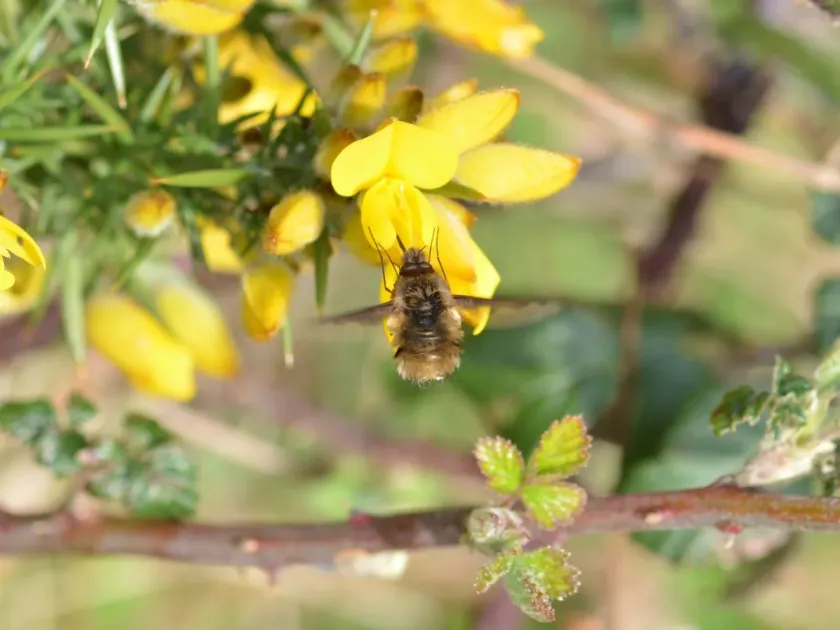
Description
How to identify
The Dark-edged bee fly, known scientifically as Bombylius major, is a member of the Bombyliidae family, often mistaken for a bumblebee due to its furry appearance.
Adults feature a long, rigid proboscis used for feeding on nectar while hovering, which is a signature behavior of this species.
The body is covered in dense, yellow-brown hair, and the wings display a distinct dark band along the leading edge, providing a reliable identification marker.
As a dipteran insect, it undergoes complete metamorphosis, with larvae developing as parasitoids within the nests of solitary mining bees.
Its mimicry of bees is highly effective, allowing it to move near bee nesting sites without provoking aggressive defense from the host colonies.
What it damages
While adult flies serve as incidental pollinators, they are detrimental to agriculture by preying on populations of solitary bees, which are essential for crop yields.
Larvae feed on the provisions and developing larvae of solitary bees like Andrena species, which are critical for pollinating fruit and vegetable crops.
A decline in solitary bee populations directly correlates with reduced fruit set and lower quality yields in various horticultural and field crops.
The economic impact is primarily indirect, manifesting as a deficit in the pollination services required for high-intensity agricultural production.
Consequently, the fly is often managed as a threat to the biological infrastructure supporting sustainable farming practices.
When it appears
The emergence of adults occurs early in the spring, typically coinciding with the blooming of early-season forage plants like willows and primroses.
Peak activity is observed during the months of April and May, during which time mating and egg-laying processes are at their maximum intensity.
The life cycle involves a single generation per year, with the insect overwintering as a larva within the protected chambers of the host bee's nest.
Environmental temperature is the primary driver of their flight activity, with warm, sunlit conditions being optimal for foraging and reproduction.
Monitoring seasonal patterns is essential for agriculturalists to understand when pollination pressure is highest in their specific regions.
Control measures
Chemical control measures are generally discouraged because they pose a severe risk to the populations of wild bees that the fly parasitizes.
Integrated Pest Management strategies should focus on maintaining habitat diversity to support resilient populations of both pollinators and their predators.
Avoiding the use of broad-spectrum insecticides during the flight period of solitary bees is the most effective way to maintain ecological balance.
Promoting non-crop vegetation around field borders helps provide refuge for solitary bees, offsetting the impact of parasitism by bee flies.
- Refrain from using insecticides during peak bloom periods.
- Plant floral strips to enhance biodiversity for pollinators.
- Monitor bee nesting sites to ensure population stability.
Taxonomy
- Latin name
- Bombylius major
- Order
- Diptera (flies)
- Family
- Bombyliidae
- EPPO code
- BOMIMA
Discussion
No discussions yet — be the first.