
Bee fly
Villa brunnea
Description
How to identify
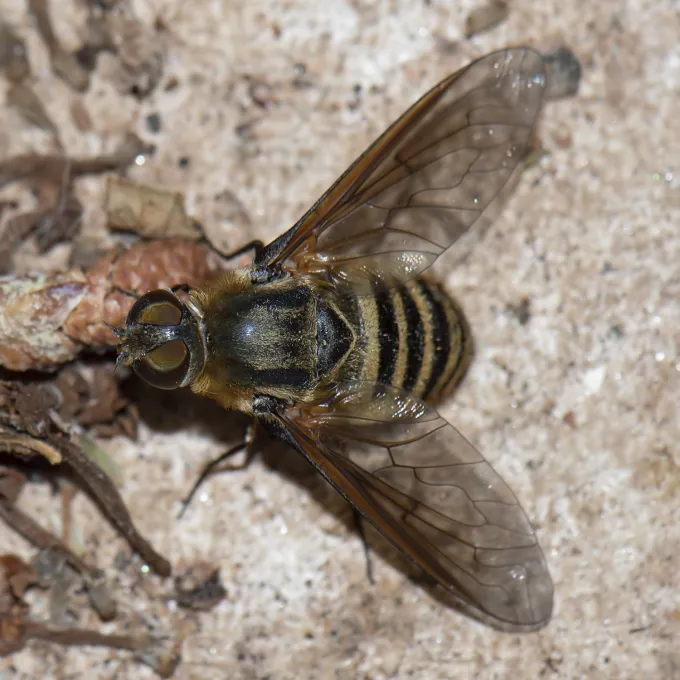
The bee fly (Villa brunnea) is a species within the Bombyliidae family, known for its remarkable mimicry of bees. These insects are characterized by a dense covering of golden or brown hairs, providing a defensive advantage.
Adults exhibit a distinctive flight pattern, often hovering over plants or soil, which makes them easy to spot on sunny days. Their wings are transparent, frequently featuring dark patterns near the wing base.
Belonging to the order Diptera, these flies possess a complete life cycle. Unlike many agricultural pests, the adult stage primarily relies on nectar for sustenance, making them occasional visitors to flowering crops.
The morphology of Villa brunnea is perfectly adapted to simulate the appearance of stinging insects, which helps protect them from predation while they forage.
It is important to distinguish this species from true bees, as the former does not collect pollen, despite its superficial physical resemblance to bumblebees.
What it damages
The harmful aspect of Villa brunnea is associated with its larval stage, which acts as a parasitoid. The larvae develop by feeding on the pupae or larvae of other insects residing in the soil.
In agriculture, the primary damage caused is the disruption of local pollinator populations. By parasitizing wild bees or other beneficial insects, they indirectly impact the success of crop pollination.
While they do not consume leaves or stems, the reduction in beneficial insect activity can lead to a significant decline in fruit and vegetable yields for sensitive crops.
In greenhouses or controlled environments where managed bees are essential for pollination, the presence of these parasitoids can lead to measurable economic losses.
The larvae are particularly efficient at locating the nests of solitary bees, which are key pollinators for many horticultural plant species.
When it appears
The flight period of adult bee flies occurs during the late spring and early summer months. This timing allows them to synchronize their lifecycle with the flowering of primary nectar sources.
Larvae remain in the soil for the majority of their developmental stage, adapting to soil moisture and temperature fluctuations across the growing season.
Overwintering typically happens in the larval or pupal stage, often sheltered within the soil or the remnants of abandoned nests of their hosts.
The annual cycle is strictly regulated by seasonal temperature patterns, with adults emerging as soon as favorable thermal conditions are met in the spring.
Monitoring for adults should be focused on the peak blooming period of the farm's main crops, as this is when their activity is most visible.
Signs of infestation
Detection is often based on identifying the characteristic hovering flight of bee-like insects above the ground, especially near potential host nest sites.
Small circular emergence holes on the soil surface are clear indicators that larvae have successfully completed their development and transitioned into adulthood.
A noticeable decline in the population of wild bees or other beneficial insects in a specific area can serve as an indirect sign of high parasitoid pressure.
Visual inspections during warm, sunny weather are the most effective way to identify the presence of these flies in an agricultural setting.
Since the damage is not mechanical (like that caused by beetles or moths), the absence of chewed foliage combined with a decrease in pollinator activity is a key diagnostic sign.
Control measures
Management strategies for Villa brunnea prioritize ecosystem stability rather than direct eradication, as they play a niche role in the environment.
The main goal is to protect and support primary pollinator populations, which can often naturally resist or withstand low levels of parasitoid activity.
- Minimize the use of broad-spectrum insecticides during crop flowering periods.
- Create habitats that support robust populations of beneficial insects.
- Avoid excessive mechanical soil disturbance in areas known to house solitary bee nests.
If bee fly pressure becomes significant, relocation of hives or managed bee colonies to areas with lower parasitoid presence is recommended.
Sustainable agricultural practices that favor biodiversity help keep populations of Villa brunnea in check, preventing them from becoming a major issue for crop production.
Taxonomy
- Latin name
- Villa brunnea
- Order
- Diptera (flies)
- Family
- Bombyliidae
- EPPO code
- VILLBR
Discussion
No discussions yet — be the first.