
Villa
Villa
Description
How to identify
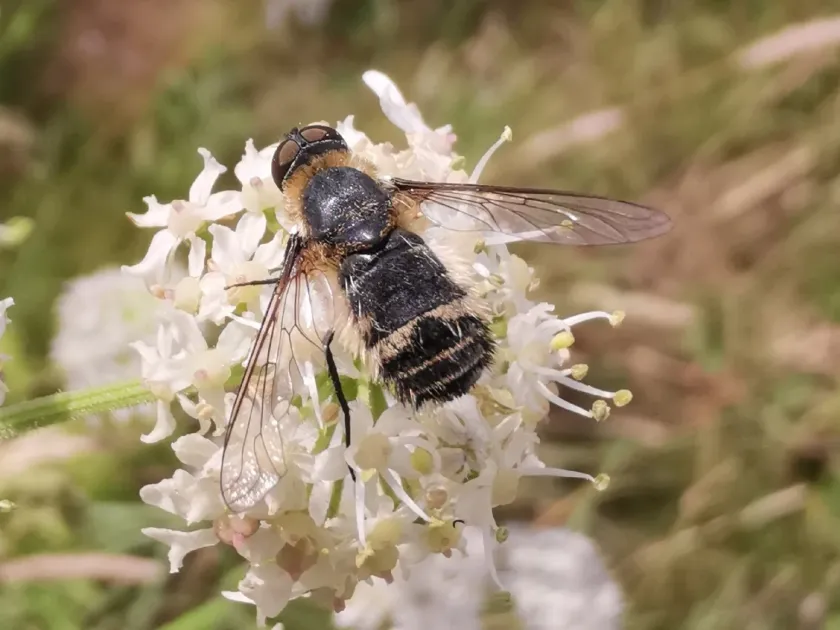
The genus Villa belongs to the family Bombyliidae (bee flies), order Diptera. These are robust, mobile flies, with bodies covered in dense, often bumblebee-like, hairs.
Adults possess a characteristic proboscis and are capable of hovering mid-air over flowers, moving in swift, darting flights. Their appearance often mimics stinging Hymenoptera as a defensive strategy.
The larvae of this genus are parasitic. They feature an elongated body structure and specialized mouthparts adapted for feeding on the tissues of their hosts within soil or nests.
The genus contains numerous species distributed globally. Accurate identification of specific species typically requires microscopic examination of wing venation and hair patterns.
It is crucial to note that the Villa fly is not a primary agricultural pest but a parasitoid, playing a dual role in the agroecosystem by influencing both pests and beneficial insect populations.
What it damages
Plants are not a direct food source for these flies. The main impact on agriculture stems from the larvae's predation on beneficial insect populations.
Villa larvae act as parasitoids. They feed on the pupae and larvae of other insects residing within the soil substrate.
Populations of beneficial insects, including predatory ground beetles or certain parasitic wasps that regulate pest numbers, are at risk.
In some instances, larvae may infest the nests of solitary bees, which can negatively affect the pollination of agricultural crops in the area.
Consequently, their economic damage is primarily linked to the disruption of natural biological control, caused by the indirect elimination of beneficial entomofauna.
When it appears
Adult activity of the Villa species is observed mainly during the summer, from June to August, specifically on sunny days.
The lifecycle is closely linked to the pupation periods of their host insects. Flies deposit eggs near concentrations of larvae or close to bee nesting sites.
Larval development includes a diapause stage, allowing the insect to survive unfavorable environmental conditions deep within the soil.
The peak emergence of adults coincides with the mass flowering of nectar-bearing plants, which provide essential nourishment for adult flies.
Climate factors such as prolonged rain or extreme heat can significantly limit flight activity and reduce population fecundity.
Signs of infestation
Presence of Villa adults is visually detected as fast-moving insects, mimicking miniature bumblebees, frequently hovering over floral resources.
Detecting larvae within the soil is extremely difficult without specialized soil sampling and laboratory analysis.
A secondary sign may be a decline in wild pollinator bee populations in the absence of obvious chemical exposure factors.
When bee nests are infested, signs include abandoned colonies and the death of larvae in the pupation stage.
Specific female behavior during egg-laying, characterized by sudden, jerky movements just above the soil surface, can also serve as an identification marker.
Control measures
Targeted control measures for the Villa fly are rarely implemented, as they form an integral part of the agroecosystem's complex balance.
Maintaining natural biodiversity is recommended to uphold the equilibrium between parasitoids and their hosts.
If population reduction is necessary, avoid excessive soil tillage that destroys the habitat of beneficial insects.
Limiting the use of broad-spectrum insecticides helps preserve predatory insects that compete with fly larvae for food resources.
In greenhouse operations, installing fine mesh screens on vents effectively prevents adult flies from reaching pollinator bee nesting sites.
Taxonomy
- Latin name
- Villa
- Order
- Diptera (flies)
- Family
- Bombyliidae
- EPPO code
- VILLSP
Discussion
No discussions yet — be the first.