
Gray fox
Urocyon cinereoargenteus
Description
How to identify
The gray fox is a member of the Canidae family, distinct for its unique biological adaptation: the ability to climb trees. This arboreal skill allows it to bypass standard ground-level agricultural defenses and access fruit in orchards.
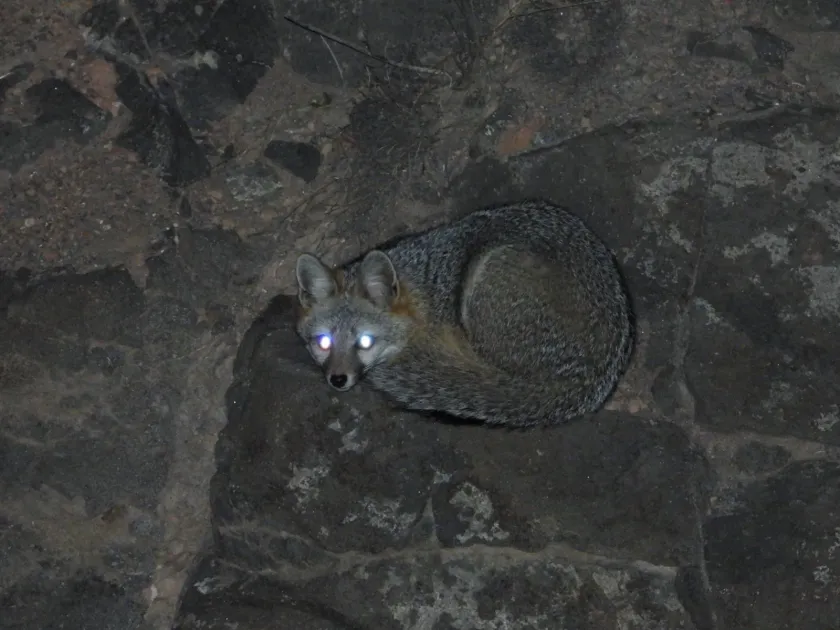
Physically, the gray fox features a grizzled gray back, a black-striped tail, and reddish patches on its neck and sides. They typically weigh between 3 and 7 kilograms, making them small enough to navigate through dense vegetation and small gaps in fencing.
These animals are primarily nocturnal, which makes observing their direct impact on crops difficult. They prefer habitats like woodlands and edge areas that border agricultural fields, providing them with cover while raiding the produce.
The gray fox exhibits territorial behavior, with family units defending established home ranges. This means if a gray fox discovers your crop as a food source, it is highly likely to continue returning until the source is depleted or protected.
Identification often relies on track analysis. Their paw prints are smaller than those of domestic dogs or red foxes, featuring four toes and a prominent central pad, which can be identified in soft soil around crop areas.
What it damages
While primarily a carnivore, the gray fox is opportunistic and highly omnivorous, frequently foraging on cultivated plants. Its impact on agriculture is both direct, through consumption, and indirect, through habitat disruption.
Orchards and vineyards are most vulnerable. Gray foxes consume berries, grapes, and various tree fruits. Because they can climb, they reach fruit in the middle and lower canopy that ground-based pests cannot, leading to significant yield loss.
Corn fields suffer damage when the foxes tear open husks on developing ears. This feeding behavior not only destroys the corn but also leaves the crop susceptible to insects and fungal pathogens, reducing the quality of the remaining harvest.
In addition to feeding, the construction of dens near irrigation canals can lead to soil erosion and damage to underground piping systems. This disruption can interfere with water delivery to essential crops.
- Consumption of grapes, berries, and orchard fruit.
- Destruction of corn ears during the milk stage.
- Suppression of beneficial bird populations that manage insect pests.
- Mechanical damage to saplings and bushes from climbing.
- Erosion caused by burrowing near farm infrastructure.
When it appears
Peak damage occurs during the ripening stage of fruits and vegetables, typically mid-summer to early autumn. During this time, foxes are actively building energy reserves and seeking nutrient-dense foods.
In winter months, the gray fox may shift its focus to stored feed or opportunistic scavenging near barns and storage sheds. While less focused on crops, their proximity to storage areas can lead to sanitation issues.
Spring is the season of birth and pup rearing, which increases the dietary requirements of the female. This period is marked by high frequency of foraging, as the mother must secure ample food to support her offspring.
The cycle of damage is closely linked to the phenology of the farm. Once crops begin to fruit, foxes monitor the fields daily, and the pressure intensifies until the final harvest is completed.
Because these animals establish semi-permanent residences, farmers should anticipate repeat activity each season, making proactive exclusion the most effective long-term strategy.
Signs of infestation
The most reliable sign of a gray fox presence is finding scats containing seeds, fruit skins, and insect remains. These are typically left along trails leading to and from the crop fields.
Teeth marks on fruits or corn husks found on branches or vines, rather than just on the ground, serve as a signature of the gray fox due to its specialized climbing ability.
Well-worn trails through vegetation are distinct indicators of a fox's commute. These paths often converge at fence lines or near the edges of orchards, highlighting their entry points into the production zone.
A strong, musty musk scent is often detectable near active dens or areas where the foxes frequently congregate to feed, especially after rain or during high humidity.
Fur snagged on wire fencing or thorny vegetation surrounding the fields confirms regular transit, allowing farmers to identify specific areas where exclusion measures should be tightened.
Control measures
Exclusion is the primary control method. Fences should be at least 1.5 meters high with an outward-angled top and buried at least 30–50 centimeters into the ground to prevent tunneling under the perimeter.
Motion-activated sound and light devices can serve as short-term deterrents. However, because gray foxes are highly intelligent, these devices should be rotated or altered in frequency to prevent habituation.
Cultural control is essential: removing fallen fruit immediately and maintaining clean borders around fields significantly reduces the attraction for the fox, making the area less hospitable for foraging.
Guardian animals, such as livestock guardian dogs, are highly effective in larger settings. Their presence and scent act as a natural deterrent, convincing the foxes to avoid the property entirely.
If predation or crop damage becomes severe, professional wildlife management services should be engaged to ensure that relocation or control methods are compliant with local environmental regulations and laws.
Taxonomy
- Latin name
- Urocyon cinereoargenteus
- Family
- Canidae
- EPPO code
- URCYCI
Discussion
No discussions yet — be the first.