
Gray fox
Urocyon
Description
How to identify
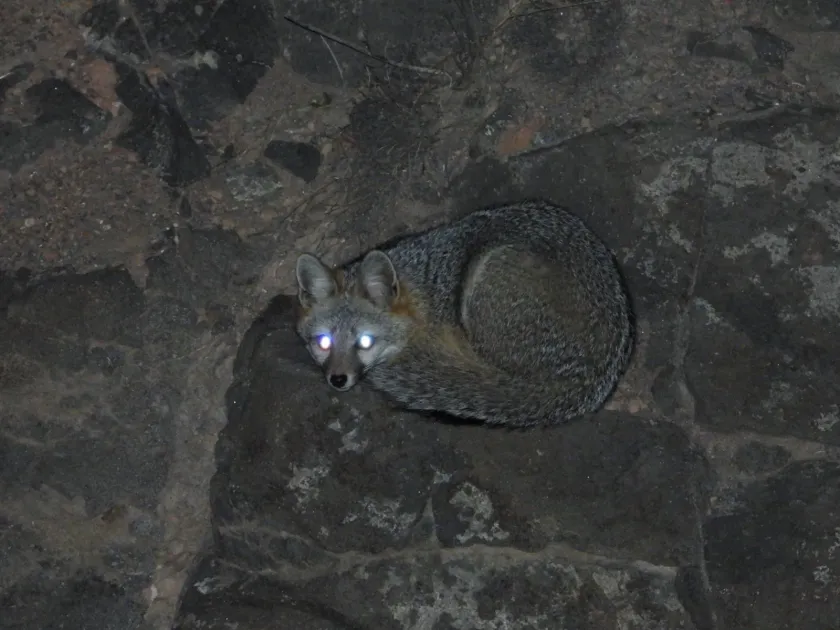
The gray fox (lat. Urocyon cinereoargenteus) is a carnivorous mammal of the Canidae family, unique for its ability to climb trees using sharp, hooked claws. It is identifiable by its grizzly-gray coat and a distinct black stripe running along the top of its tail.
Adult gray foxes typically measure 50 to 70 centimeters in body length, with a long, bushy tail. They are primarily nocturnal or crepuscular, making them elusive visitors to agricultural landscapes.
While primarily a carnivore, the gray fox is opportunistic and omnivorous, frequently feeding on fruits, nuts, and crops when small prey is scarce. This behavioral trait leads to interactions with farming operations.
Their biological cycle is synchronized with the availability of seasonal produce. During late summer and autumn, they are highly active in orchards and vineyards, seeking easily accessible carbohydrates.
Reproduction occurs in the spring, and the need to provide for kits often forces adults to broaden their foraging range, leading them to infiltrate gardens, vineyards, and small-scale crop fields.
What it damages
The damage caused by the gray fox is often centered on fruit-bearing plants. They are known to consume significant quantities of grapes, apples, berries, and melons, rendering the remaining yield unmarketable due to bite marks and contamination.
In cornfields, gray foxes can cause mechanical damage by trampling stems and breaking stalks to reach the ears. This physical disruption creates entry points for moisture, leading to mold and fungal infections in the crop.
The act of climbing trees for fruit can inflict serious damage on the bark of young orchards. The sharp claws used for climbing create deep wounds, which predispose the trees to stress, pathogens, and insect infestations.
By constantly patrolling the same paths between foraging areas, gray foxes create worn-down trails through fields, reducing the density of planted crops and affecting the uniform growth of the agricultural site.
- Consumption of grapes, berries, and soft fruits.
- Mechanical damage to corn stalks and cereal crops.
- Bark wounding on fruit trees from climbing.
- Trampling damage to ground crops.
- Disturbance of soil and ecosystem balance.
Signs of infestation
Identification of gray fox presence can be confirmed by their tracks, which are generally more rounded and lack the elongated shape of a red fox's paw prints. Look for these near the edges of wooded areas.
The presence of partially eaten fruits scattered under bushes or vines is a clear indication of a feeding animal. The teeth marks are often large and irregular, consistent with a medium-sized predator.
Scratches on the bark of tree trunks, specifically occurring at heights of up to two meters, point towards a climbing animal like the gray fox, rather than ground-dwelling predators.
Scat samples containing seeds, insect parts, or plant matter indicate that the fox is utilizing your farm as a reliable food source throughout the season.
Nocturnal vocalizations, such as a barking cry, are often heard when the animals are active near their dens or scouting the perimeter of agricultural fields during the night.
Control measures
The most effective strategy for mitigation is the installation of robust fencing. To prevent the fox from digging underneath, it is essential to bury the mesh at least 30 centimeters deep into the soil.
Motion-activated lighting is highly effective as a deterrent. Since gray foxes rely on the cover of darkness, sudden illumination causes alarm and discourages them from lingering in the garden or vineyard.
Sanitation plays a key role in farm management; ensuring that dropped or rotting fruit (windfalls) is cleared regularly reduces the attractiveness of the site as a food source.
The use of ultrasonic devices can serve as a supplemental tool, though they should be rotated or combined with other physical barriers to prevent the animals from becoming accustomed to the stimulus.
Scent-based repellents can be applied along the perimeter to create an invisible barrier. Because foxes have an acute sense of smell, substances that signal a potential threat or are simply unpleasant will often encourage them to avoid the protected area.
Taxonomy
- Latin name
- Urocyon
- Family
- Canidae
- EPPO code
- URCYSP
Discussion
No discussions yet — be the first.