
Uraba lugens
Uraba
Description
How to identify
Uraba lugens, commonly known as the gum leaf skeletonizer, is a moth species belonging to the family Nolidae. The adult moth is relatively small, with a wingspan of approximately 20 to 30 millimeters, featuring greyish-brown patterns on its wings.
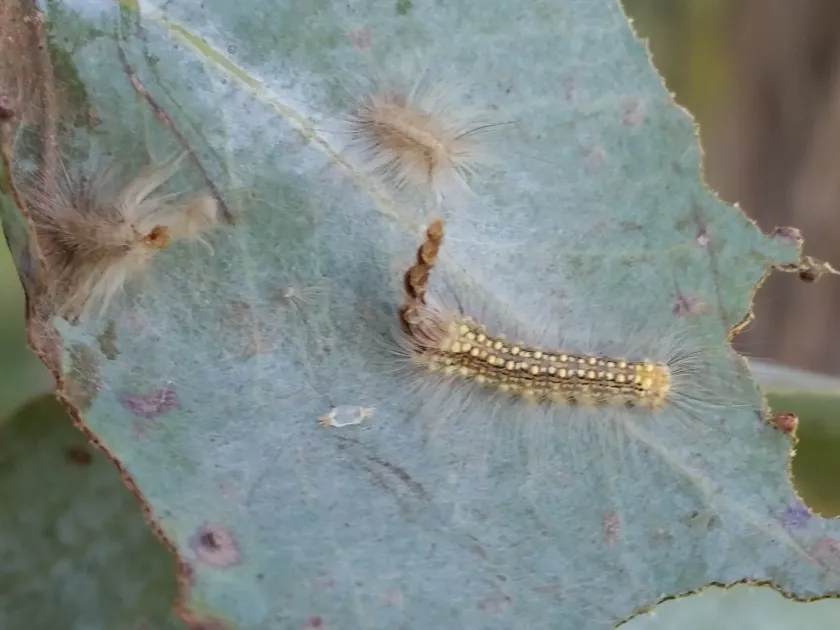
The larval stage is the most distinctive, often referred to as the "gum leaf skeletonizer." These caterpillars are easily identified by their habit of carrying a stack of their discarded head capsules from previous instars on their backs, forming a pyramid shape.
Their bodies are covered with stiff, irritating hairs which can cause dermatitis or severe skin irritation in humans upon contact. The larvae exhibit variable coloration, typically displaying bands of yellow, black, and white.
The life cycle encompasses eggs, five to six larval instars, a pupal stage within a tough, silk-lined cocoon, and the adult moth phase. The development period can vary depending on temperature, allowing for multiple generations per year.
Native to Australia, this insect has become a significant pest in various eucalyptus-growing regions, often thriving in environments where host trees are abundant and climate conditions remain mild.
##damage##The primary hosts for Uraba lugens are trees within the genus Eucalyptus. Occasionally, the larvae may feed on other members of the Myrtaceae family if their preferred food source is unavailable.
The larvae are voracious feeders capable of causing severe defoliation. In the early stages, they consume only the leaf parenchyma, leaving the veins intact, which gives the leaves a characteristic "skeletonized" appearance.
As the larvae mature, they consume the entire leaf, including the midrib. In cases of mass infestation, trees can be stripped of their foliage entirely, leading to reduced photosynthetic capacity and significant stress on the plant.
Young trees are particularly vulnerable, and repeated defoliation can lead to stunted growth or even plant mortality. Mature trees generally survive, but their vigor is significantly compromised, making them susceptible to secondary infections.
The economic impact is notable in forestry, where timber yield is reduced, and in urban settings, where infested trees become unsightly and potential health hazards due to the irritating hairs shed by the caterpillars.
##signs##The most reliable sign of an infestation is the presence of skeletonized leaves on the lower branches of the tree. This pattern is caused by the feeding habits of the younger larval stages.
As the population grows, the foliage takes on a ragged, transparent appearance as the caterpillars progress to consuming whole leaf blades. Droppings, or frass, will accumulate heavily under the tree canopy.
Pupation occurs in conspicuous, boat-shaped cocoons constructed from silk and bits of leaf debris. These can be found attached to the bark, on leaf surfaces, or in the forks of branches.
During peak outbreaks, the sound of chewing or the presence of falling debris can be audible and visible. The trees may appear as though they have been burnt due to the complete loss of leaves.
Presence of the caterpillars themselves, particularly their habit of clustering together on branches, is a clear indicator of a developing colony that requires management intervention.
##control##Biological control remains one of the most effective strategies for managing Uraba lugens. Various parasitoid wasps and predatory insects are known to attack the larvae, helping to keep population densities in check.
The use of microbial insecticides containing Bacillus thuringiensis (Bt) is highly recommended for targeted control. It is effective against the caterpillars while remaining safe for beneficial organisms and the surrounding ecosystem.
For high-value trees or nursery stock, systemic insecticides can be applied; however, their use in large-scale forest settings is often impractical and restricted by environmental guidelines regarding chemical runoff.
Cultural practices, such as ensuring adequate water and soil nutrients, can improve tree vitality, enabling the eucalyptus to recover more efficiently following a pest outbreak.
Monitoring programs utilizing pheromone traps are essential for early detection. By tracking adult moth activity, land managers can implement control measures during the initial stages of a population boom.
Taxonomy
- Latin name
- Uraba
- Order
- Lepidoptera (butterflies)
- Family
- Nolidae
- EPPO code
- URABSP
Discussion
No discussions yet — be the first.