

Pest · Hemiptera (bugs, aphids, leafhoppers) · affects Fruit crops, Tomato, Cucumber
Citrus snow scale
Unaspis citri
Description
How to identify
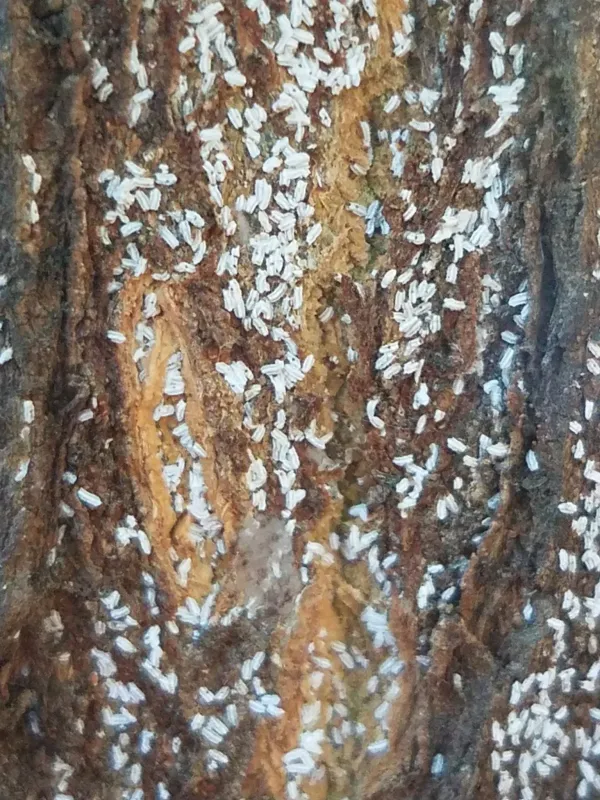
The Citrus snow scale (Unaspis citri) belongs to the Diaspididae family. This pest displays extreme sexual dimorphism, where females possess a pear-shaped, brownish shield, while males are characterized by small, elongated, white, three-keeled structures.
Adult females are sessile, remaining attached to the bark or leaves throughout their lives. Their protective covers are robust, providing significant shelter from environmental factors and chemical treatments.
The primary mobile stage is the first-instar nymph, commonly known as a "crawler." These tiny, pale yellow creatures are the main dispersal mechanism, moving across the plant to establish new feeding sites.
Heavy infestations result in dense colonies that cover the trunks and branches of citrus trees. These colonies are often referred to as "snow" because of the stark white color of the numerous male scales.
Visual identification usually focuses on the trunks, main branches, and the undersides of leaves, where these insects congregate and multiply rapidly under favorable conditions.
What it damages
The Citrus snow scale primarily attacks various citrus species, including lemons, oranges, mandarins, and grapefruits. They extract vital sap from the host tissue, leading to severe physiological stress.
Feeding by the scale insects causes yellowing and chlorosis of the leaves. As the infestation progresses, leaves may drop prematurely, and young shoots may become stunted or die back.
The damage is compounded by the injection of toxins during feeding, which causes localized tissue necrosis. This weakens the tree's overall vigor and can lead to significant fruit yield reduction.
In addition to direct feeding damage, the scale produces honeydew, which serves as a substrate for sooty mold. This black fungus covers the foliage, further reducing the tree's photosynthetic efficiency.
If left unmanaged, a heavy infestation can girdle branches and trunks, eventually leading to the death of the entire tree, especially in younger or stressed plants.
When it appears
The development of the Citrus snow scale is heavily influenced by temperature and humidity. In subtropical climates, the pest can complete multiple overlapping generations per year.
Crawler activity is most intense during periods of warm weather. Monitoring the emergence of these crawlers is essential for timing insecticide applications, as this is the most vulnerable life stage.
In greenhouses and interior settings, reproduction can occur year-round. Consistent temperatures allow the pest to thrive without the seasonal pauses observed in temperate outdoor environments.
Overwintering typically occurs in the adult stage. The females remain attached to the tree throughout the winter, surviving by continuing to feed when conditions permit.
The onset of the spring growth flush is a critical time for the pest, as the fresh, nutrient-rich sap promotes rapid population growth and expansion of the colony.
Signs of infestation
The most distinctive sign is the presence of white, elongated scale covers on the dark bark of the trunk and branches, often appearing as a white dusting or crust.
Yellowing, mottled foliage on specific branches indicates feeding activity. Close inspection of these leaves usually reveals the presence of scale insects on the undersides.
Sticky honeydew deposits on the leaves and nearby surfaces are a clear indication of a scale infestation. This secretion often attracts ants, which may protect the scales from natural predators.
The appearance of sooty mold — a black, dusty coating on leaves — confirms that the trees are heavily infested and that the pest has been present for a significant period.
Overall tree decline, characterized by dieback of the crown, reduced leaf size, and lack of new growth, serves as a late-stage warning of extensive structural damage.
Control measures
Effective management of the Citrus snow scale relies on a combination of cultural practices, biological control, and targeted chemical applications during crawler stages.
- Regular inspection and manual removal of scales using a firm brush to reduce initial population density.
- Application of systemic insecticides that are ingested by the pest during feeding, ensuring long-term control.
- Use of horticultural oils to smother the scales, which is an effective organic-friendly alternative for moderate infestations.
- Pruning and destroying highly infested branches to prevent the spread of the pest to other parts of the tree or grove.
- Encouraging natural enemies, such as lady beetles and parasitic wasps, to suppress scale populations in sustainable farming systems.
Content graph
Connections · Citrus snow scale
Most often together:
Marketplace
Products · 1
Biology
Taxonomy
- Latin name
- Unaspis citri
- Order
- Hemiptera (bugs, aphids, leafhoppers)
- Family
- Diaspididae
- EPPO code
- UNASCI
Community
Discussion
No discussions yet — be the first.