
Hairy fungus beetle
Typhaea stercorea
Description
How to identify
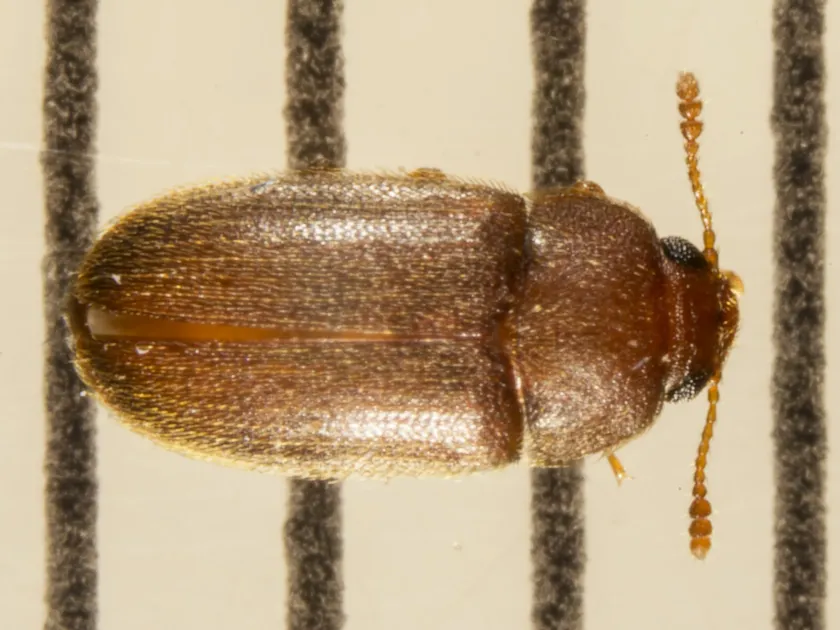
The hairy fungus beetle (Typhaea stercorea) is a small coleopteran insect belonging to the Mycetophagidae family, typically measuring about 2–3 mm in length.
The adult beetle has a reddish-brown body that is densely covered with fine, erect hairs, which gives the species its common English name.
They possess fully functional wings, allowing them to fly between fields and storage facilities, which makes them highly mobile pests in agricultural settings.
The larvae are typically creamy-white or pale yellow, cylindrical in shape, and thrive in environments where fungi and mold are present.
Identification is usually performed by observing the adult beetles in grain samples or by microscopic examination of the larval stages found in moldy organic matter.
What it damages
This beetle is primarily considered a storage pest that targets grain, seeds, nuts, and dried fruit, provided that these products are damp or moldy.
While the beetle does not typically attack healthy, dry grain, it thrives in grain masses with high moisture content where micro-fungi have already begun to develop.
In the field, it is often found in haystacks, rotting plant debris, and compost, where it serves as a scavenger, feeding on fungal spores and decaying matter.
Economic damage in warehouses occurs when beetles infest high-value seed stocks, as they can feed on the embryo, rendering the seed non-viable for planting.
Furthermore, their presence contributes to the spread of fungal contamination, accelerating the spoilage of stored commodities and reducing their overall quality.
When it appears
The activity of the hairy fungus beetle is heavily dependent on ambient temperature and moisture, with peak activity occurring during warm, humid conditions.
In heated warehouses or silos, the beetle can reproduce throughout the year, provided that the stored grain has a moisture level that supports fungal growth.
Adult beetles generally emerge from overwintering sites in the spring and are most active in dispersing during the summer and early autumn months.
They overwinter as adults, finding shelter in building crevices, under piles of agricultural waste, or in deep, undisturbed layers of stored grain.
The life cycle duration varies significantly based on the availability of moldy substrate, which acts as the primary nutritional source for the larvae.
Signs of infestation
One of the primary indicators of an infestation is a characteristic musty or moldy smell emanating from the grain pile, indicating fungal development.
Visual confirmation involves spotting the small, hairy beetles moving on the surface of the grain, particularly during inspection or mechanical movement of the mass.
The presence of fine dust, larval excrement, and partially consumed kernels confirms that the beetles have established a breeding population within the grain.
Patches of grain that appear clumped together due to fungal mycelium are often prime locations for finding dense concentrations of these insects.
Monitoring using grain probes and traps is essential for detecting early-stage infestations before they spread to larger sections of the storage facility.
Control measures
The most effective strategy for managing the hairy fungus beetle is to prevent the conditions that lead to grain moisture and subsequent mold development.
- Maintain grain moisture levels below 13% to discourage both fungal growth and beetle infestation.
- Ensure thorough sanitation of storage areas to remove old grain dust and debris before bringing in a new harvest.
- Use aeration systems in silos to regulate temperature and eliminate moisture pockets.
- Apply contact insecticides or fumigants as part of a professional pest management program if infestation levels are high.
Good agricultural practices, such as rapid drying of grain after harvest and storage in climate-controlled environments, are key to preventing damage.
Taxonomy
- Latin name
- Typhaea stercorea
- Order
- Coleoptera (beetles)
- Family
- Mycetophagidae
- EPPO code
- TYPAST
Discussion
No discussions yet — be the first.