
Foreign grain beetle
Typhaea
Description
How to identify
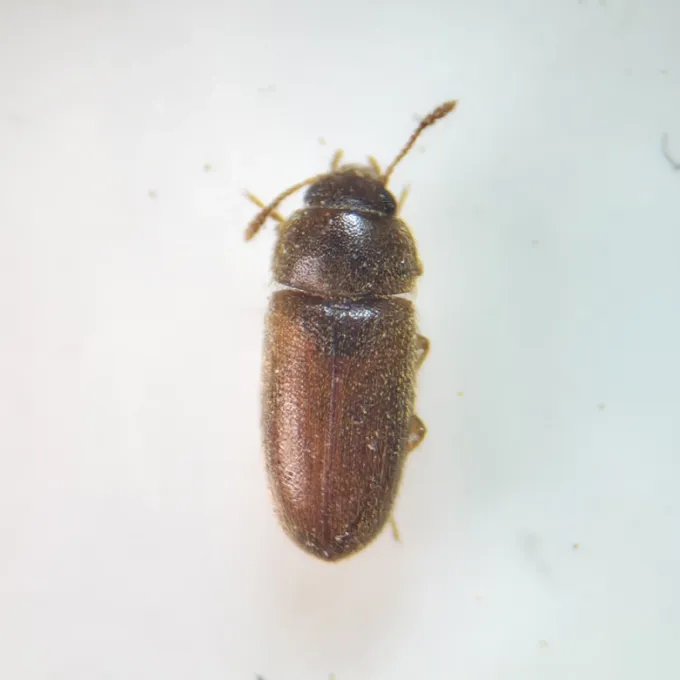
The foreign grain beetle, scientifically known as Typhaea stercorea, is a member of the Mycetophagidae family within the Coleoptera order. These beetles are small, typically measuring 2 to 3 millimeters in length, with an elongated body covered in fine hairs.
Their color ranges from reddish-brown to dark brown, allowing them to blend into their environment. They possess club-shaped antennae, which is a key identifying morphological feature when inspecting grain samples.
Larvae are elongated, yellowish-white in color, and feature well-developed legs. They progress through several growth stages, becoming increasingly mobile and destructive as they feed on their environment.
This beetle thrives in environments with high humidity where mold growth is present. It is a cosmopolitan species, frequently found in warehouses, silos, and grain storage facilities where climate control has failed.
Due to their high adaptability, these beetles are common worldwide, posing a continuous threat to the quality of stored agricultural commodities such as grain, flour, and feed.
What it damages
The foreign grain beetle is classified as a secondary pest of stored products. Its diet consists primarily of the mold and fungi that grow on damp grain or flour rather than the grain itself.
While the beetle does not typically consume dry, healthy grain, its presence is a major red flag indicating that the storage conditions are improper and humidity levels are too high. They often damage the grain germ once the mold has compromised the outer layers.
These pests infest wheat, barley, oats, and various cereal products when they become damp. They are particularly destructive in areas with poor ventilation where "hot spots" of decaying grain develop.
Beyond physical damage, their presence contaminates the grain with excrement, larval skins, and mold spores, rendering the stock unsuitable for food production or export.
In the field, these beetles inhabit piles of hay, straw, and crop residue, easily transferring into storage facilities during harvest and initial loading processes.
When it appears
In temperature-controlled storage or warehouses with high humidity, the life cycle of the foreign grain beetle can continue year-round, as they do not require a dormant phase if food remains available.
In natural conditions, adult activity begins in spring when temperatures reach +15°C to +20°C, and continues through autumn as long as mold growth conditions persist.
The development of one generation typically takes between 30 to 50 days, depending on temperature and moisture levels. At optimal temperatures of +25°C to +28°C, the population can grow rapidly.
Females lay eggs directly on the substrate or into cracks in packaging, ensuring immediate access to food for the emerging larvae.
The risk of infestation is highest during the autumn harvest period when grain is placed into storage without proper drying, creating the ideal damp conditions for this pest to multiply.
Signs of infestation
A primary indicator of a foreign grain beetle infestation is a distinct, musty or moldy odor emanating from the grain pile. The beetle is essentially attracted by the presence of mold growth.
Visual inspection often reveals the presence of small, dark beetles moving across the surface of the grain. Infested areas often show grain clumping and a noticeable increase in temperature.
Finding larval shed skins or waste products in grain samples is a definitive confirmation that a colony has successfully established itself in the grain mass.
High moisture levels in the facility accelerate mold growth, which subsequently triggers an exponential increase in the beetle population. Detecting these beetles is a signal to immediately check grain moisture.
Infested grain becomes discolored, loses germination potential due to fungal damage, and fails quality control standards for processing into high-quality food products.
Control measures
The most critical measure for protecting stored grain against the foreign grain beetle is maintaining strict moisture levels, ideally keeping grain at or below 14% moisture content.
Regular sanitation of storage facilities is essential; this involves removing dust, old grain debris, and any spilled material that serves as a reservoir for the pest.
Implementing active aeration of grain piles is highly recommended to prevent the formation of moldy hot spots. Cooling the grain to below +10°C will significantly slow or halt the beetle's development.
If an infestation occurs, professional fumigation of the warehouse or affected batches using authorized insecticides is necessary to eliminate the pest population.
Preventive maintenance includes wet insecticidal treatment of empty walls and equipment surfaces before accepting a new harvest, ensuring the facility is clear of hidden adults.
Taxonomy
- Latin name
- Typhaea
- Order
- Coleoptera (beetles)
- Family
- Mycetophagidae
- EPPO code
- TYPASP
Discussion
No discussions yet — be the first.