
Litargus balteatus
Litargus balteatus
Description
How to identify
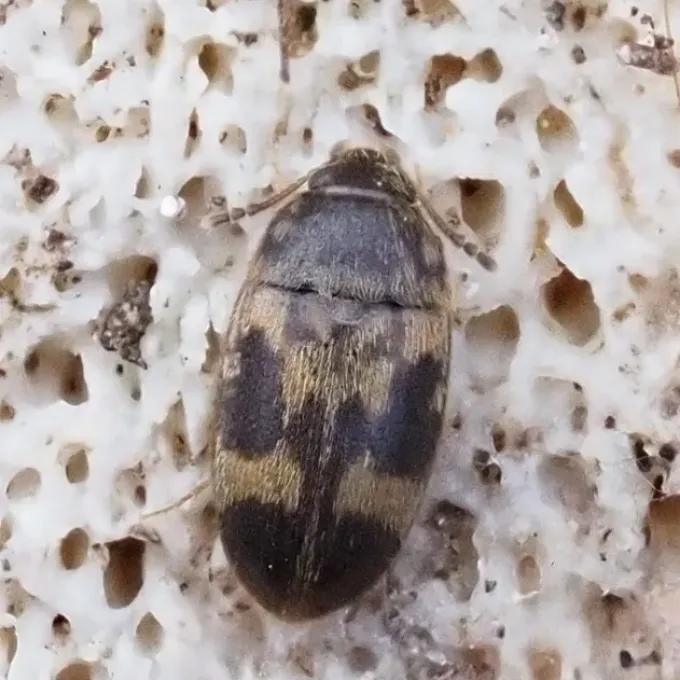
Litargus balteatus belongs to the order Coleoptera and the family Mycetophagidae, commonly known as mold beetles. These are small insects, typically measuring 2.5 to 3 millimeters in length.
The beetle has an oval, slightly convex body shape. Its coloration ranges from reddish-brown to almost black, featuring distinctive light-colored transverse bands on the elytra, which give the species its name.
The head is small and partially retracted into the pronotum, with clubbed antennae. Larvae are slender, light-colored, and possess well-developed thoracic legs, allowing them to move actively through the medium.
This species is highly moisture-dependent, typically occurring in habitats where microscopic fungi are present, as fungi serve as their primary food source.
Adult beetles are capable of flight, which facilitates their rapid dispersal across storage facilities and enables them to infest new areas where stored products are maintained under suboptimal conditions.
What it damages
Litargus balteatus is primarily a secondary pest of stored products, specifically feeding on items that have already been compromised by mold or fungal growth.
The pest is frequently found in grain silos, warehouses storing flour, animal feed, dried fruits, and vegetables. Damage typically occurs when products are stored in high-humidity environments.
Both larvae and adults feed on fungal spores and mycelium, but they also cause mechanical damage to grain kernels, which degrades the quality and reduces the viability of seeds.
Mass infestations lead to significant product contamination through excrement, cast skins, and debris, rendering the commodity unsuitable for consumption or commercial sale.
Infestation by this beetle can create entry points for other primary stored-grain pests, potentially accelerating the degradation of stored batches.
Signs of infestation
The presence of mold on stored goods is the most indicative sign of a potential infestation, as fungal growth is a prerequisite for the beetle's survival and reproduction.
Visual identification can be achieved by inspecting the surface of grain or packaging. Beetles are often active on the surface of the substrate, especially in low-light conditions.
A musty or earthy odor in a storage area is a common indicator of fungal activity, which often serves as a precursor to the colonization of the area by these beetles.
Sieve samples of the grain may reveal small boreholes in kernels and an accumulation of fine dust, consisting of frass and finely fragmented grain particles.
The use of insect monitoring traps in warehouses allows for the early detection of adult populations before they reach economic injury levels.
Control measures
The most critical management strategy is the maintenance of strict moisture control in grain storage. Keeping the product moisture content low effectively prevents fungal growth and discourages beetle colonization.
Regular warehouse sanitation, including the removal of grain debris, dust, and sweepings, is essential to eliminate breeding sites and prevent carry-over infestations between seasons.
Empty storage facilities should undergo thorough disinfestation using approved contact insecticides before the intake of new harvest to ensure a clean storage environment.
In cases of severe infestation, fumigation of the grain bulk is necessary to achieve effective control of all life stages of the beetle within the commodity.
- Managing grain moisture content
- Routine warehouse cleaning and hygiene
- Application of contact insecticides for empty stores
- Deployment of monitoring traps
- Fumigation when population thresholds are exceeded
Taxonomy
- Latin name
- Litargus balteatus
- Order
- Coleoptera (beetles)
- Family
- Mycetophagidae
- EPPO code
- LITABA
Discussion
No discussions yet — be the first.