
Tylopsis liliifolia
Tylopsis liliifolia
Description
How to identify
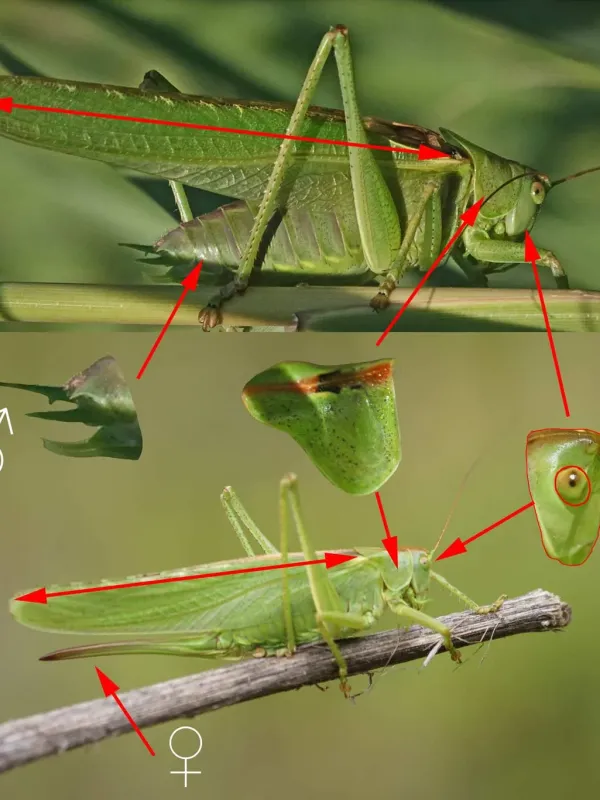
Tylopsis liliifolia is a member of the order Orthoptera, belonging to the family Tettigoniidae (bush-crickets). The adult insect is characterized by a slender, bright green body that provides excellent camouflage within dense green vegetation.
This species features long, narrow wings that extend significantly beyond the end of the abdomen. A key diagnostic feature used by entomologists for identification is the specific shape of the pronotum, which possesses distinct lateral keels.
Nymphs resemble smaller, wingless versions of the adults. Throughout several molting stages, they progressively develop adult morphological traits while maintaining their green protective coloration throughout their entire growth cycle.
The insect is primarily diurnal, showing peak activity levels during daylight. However, during periods of extreme heat, it may transition to crepuscular activity to avoid dehydration and effectively manage its metabolic processes.
Females are equipped with a well-developed ovipositor used to deposit eggs into plant tissues or the upper soil layers. This reproductive strategy ensures that the eggs remain protected from environmental fluctuations and potential predators during the winter months.
What it damages
As a generalist herbivore (polyphage), this pest targets a wide range of agricultural crops. It frequently infests cereal crops, legumes, and various vegetables grown in both large fields and smaller garden environments.
The bush-crickets cause damage by consuming vegetative parts, particularly leaves. In cases of high population density, they can completely strip a leaf, leaving only the primary veins, which severely hinders the plant's ability to photosynthesize.
Young seedlings and transplants are at the highest risk. Damage to the growing tip or the cotyledons at an early growth stage can often result in total plant loss or significant stunting, leading to major yield reductions at harvest time.
Physical injuries caused by chewing on stems and stalks often compromise the plant's structural integrity. These wounds serve as entry points for various bacterial and fungal pathogens, potentially leading to widespread secondary diseases in the field.
During dry, drought-prone seasons, the pest becomes particularly destructive. As their natural wild grass food sources desiccate, the bush-crickets migrate to irrigated farmland, concentrating their feeding on lush, water-rich crop plants.
When it appears
The lifecycle of Tylopsis liliifolia is strictly regulated by seasonal temperature changes. The species overwinters in the egg stage, which remains in diapause either within the soil or inside dry plant stalks until spring temperatures rise.
Nymph hatching typically begins in the spring when average daily temperatures reach the threshold required for embryonic development. This phase usually coincides with the emergence and rapid growth of many important agricultural crops.
There is typically one generation per year. The nymphal development stage lasts for several weeks, characterized by several molts, and the rate of this development is heavily dependent on the local temperature and food availability.
Adults typically emerge in mid-summer. The period between July and August marks the peak of their activity, which often aligns with the flowering and grain-filling stages of crops, creating the greatest economic pressure for farmers.
As autumn approaches, the adult population gradually declines. After the completion of mating and egg-laying, the adults perish, ensuring the next generation is safely embedded in the environment, ready for the cycle to begin anew the following spring.
Signs of infestation
The primary indicator of a Tylopsis liliifolia infestation is the presence of irregular, ragged holes in the leaves. Unlike many caterpillars that feed from the edges, these bush-crickets often chew larger holes directly into the center of the leaf lamina.
Identifying the pest visually can be difficult due to its excellent cryptic coloration. Using an entomological sweep net or performing inspections in the early morning hours, when the insects are less active and sitting on stems, is the most effective approach.
The presence of frass (excrement) on leaves or on the soil surface beneath the plants is a clear signal of active feeding. The frass consists of small, dense, granular pellets that are often found in areas with high insect density.
If plants show sudden wilting or drooping without apparent root problems, it may indicate that the pests are feeding on the stems or petioles, disrupting the vascular system and preventing the efficient transport of water and nutrients.
In cereal crops, damage to the grain heads can result in unfilled grains or reduced kernel weight. Observing these damaged heads at the end of the season provides proof of late-stage pest activity and indicates that control measures are necessary for the future.
Control measures
Agricultural management is fundamental in controlling this pest. Removing weeds and tall grasses from the field margins and surrounding areas is crucial, as these habitats serve as the primary reservoirs where the bush-crickets develop before invading crops.
Deep autumn tillage is a highly effective control measure. By turning the soil, many overwintering eggs are buried too deep for successful hatching, which significantly reduces the initial nymph population in the following spring.
Chemical control should be implemented only when population thresholds are exceeded. Applying contact insecticides to young nymphs is more effective than treating later instars, as younger stages are significantly more vulnerable to chemical exposure.
Rotating insecticides with different modes of action is essential to prevent the development of pesticide resistance within the population. Whenever possible, integrating biological control agents, such as entomopathogenic fungi, is recommended to lower chemical reliance.
Continuous monitoring using sticky traps and periodic population counts allows farmers to make data-driven decisions. This proactive approach ensures that treatments are applied only when necessary, saving costs and protecting beneficial insects in the field.
Taxonomy
- Latin name
- Tylopsis liliifolia
- Order
- Orthoptera (locusts)
- Family
- Phaneropteridae
- EPPO code
- TYLSLI
Discussion
No discussions yet — be the first.