
Acrometopa macropoda
Acrometopa macropoda
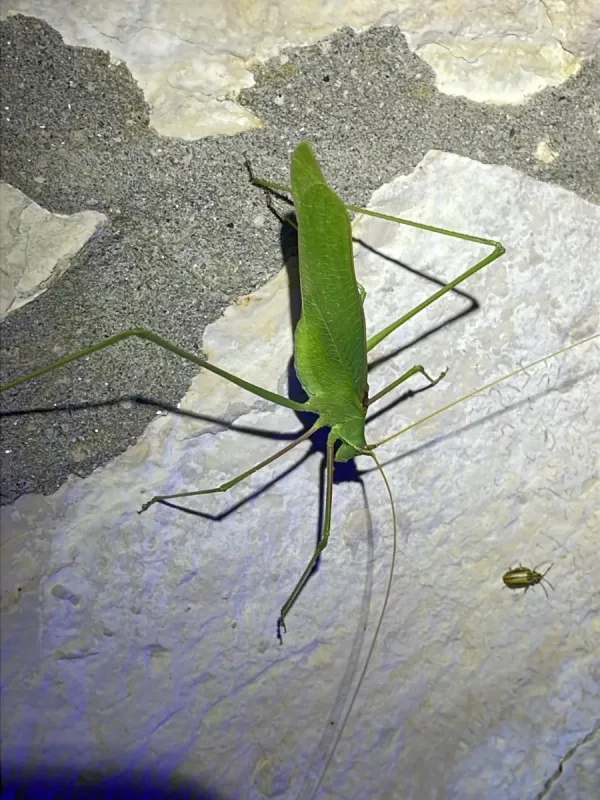
Description
How to identify
Acrometopa macropoda belongs to the order Orthoptera and the family Tettigoniidae. This insect has an elongated body typical of the subfamily Phaneropterinae, with notably long legs, which is reflected in its scientific name.
Adults are visually characterized by a green or yellowish-green color, providing excellent camouflage among foliage. The wings are well-developed, transparent or with a slight green tint, often extending beyond the abdomen.
The pest's head features a chewing mouthpart, allowing it to efficiently damage plant tissues. The antennae are thread-like and very long, frequently exceeding the length of the insect's own body.
Sexual dimorphism is evident in the structure of the female's ovipositor, which is saber-shaped and adapted for laying eggs into plant tissues or soil. Males possess a sound-producing organ on their forewings to attract females.
Nymphs resemble the adults but are smaller in size and lack developed wings. Passing through several developmental stages, they gradually increase in size, eventually acquiring the appearance of a mature bush-cricket.
What it damages
This species is a polyphage and causes significant damage to a wide range of agricultural crops. The primary impact occurs during periods of population outbreaks in favorable climatic zones.
Cereal crops are common targets, where these insects consume leaf blades, reducing the plant's photosynthetic capacity. Leguminous crops, including soybeans, alfalfa, and clover, are also frequently affected.
In orchards and vineyards, Acrometopa macropoda can damage young shoots, buds, and leaves of fruit trees. Such damage is particularly dangerous during early developmental stages when young plants are most vulnerable.
Harmfulness is expressed through the disruption of plant metabolism, leading to slowed growth rates, decreased biomass, and significant loss of crop quality. Heavily damaged plants are also prone to secondary infections.
The economic threshold of damage depends on the crop and its phenological stage. Even at moderate population densities, the impact becomes noticeable in years with a dry spring, necessitating human intervention.
When it appears
The life cycle of Acrometopa macropoda is closely tied to seasonal rhythms and temperature. The overwintering stage consists of eggs laid in the soil or plant debris, providing protection against winter temperatures.
Nymph emergence typically coincides with the onset of sustained spring warmth, usually in late April or May. During this time, nymphs begin feeding on weeds, gradually transitioning to cultivated crops.
Active development of nymphs occurs throughout the first half of summer. During this phase, population levels increase rapidly as insects undergo several molts, sequentially increasing in size.
Adults (imagos) appear in the second half of summer, usually from July to August. This period marks the peak activity of the pest, associated with mating and feeding prior to oviposition.
By autumn, the number of adults gradually declines, the egg-laying cycle concludes, and the insects die. Fertilized eggs remain in diapause until the following spring, ensuring the species' survival.
Signs of infestation
The primary sign of infestation is the presence of coarse damage to leaf blades, often referred to as "notched" or "marginal" feeding. These insects typically start eating from the leaf edge, leaving only the thick veins untouched.
The pest's presence can be detected by characteristic sounds made by males in the evening. Chirping is a reliable indicator of high population density in a field or adjacent hedgerows.
Finding insect excrement on leaves and under plants serves as additional evidence of active feeding. The droppings appear as small, hard granules, distinguishing them from the waste of lepidopteran larvae.
On affected crops, one can visually spot the bush-crickets themselves, especially during the early morning and evening hours when they are most active. During the day, they often hide in dense foliage or at the base of stems.
In cases of massive outbreaks, overall crop stunting is observed, resulting in a ragged appearance. In severe cases, damage can lead to partial defoliation of field sections or orchard branches.
Control measures
Agrotechnical control methods include deep autumn plowing, which helps destroy eggs laid in the soil. Weed management along field perimeters limits the pest's reservoir areas.
Chemical control involves the use of broad-spectrum insecticides from the pyrethroid or organophosphate groups when the economic threshold is exceeded. Applications are most effective during the nymph emergence period.
Biological control includes the use of entomopathogenic fungi or encouraging natural enemies of bush-crickets, such as birds, hedgehogs, and insectivorous mammals, whose numbers should be supported within the agroecosystem.
Regular monitoring of crop status using light or pheromone traps allows for the timely detection of the beginning of pest outbreaks and the implementation of preventive protection measures.
Implementing Integrated Pest Management (IPM) allows for minimizing pesticide use by combining gentle control methods with targeted application of chemicals only in areas with critical population densities.
Taxonomy
- Latin name
- Acrometopa macropoda
- Order
- Orthoptera (locusts)
- Family
- Phaneropteridae
- EPPO code
- AKMTMA
Discussion
No discussions yet — be the first.