
Saw-tailed bush-cricket
Barbitistes serricauda
Description
How to identify
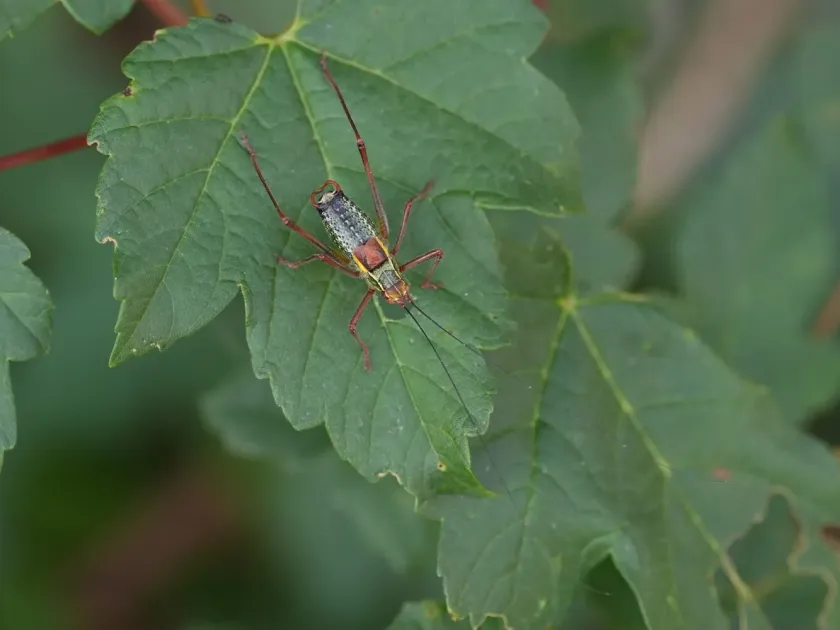
The saw-tailed bush-cricket (Barbitistes serricauda) is a member of the Tettigoniidae family. These insects are known for their vibrant green coloration, which provides excellent camouflage among foliage.
The name "saw-tailed" refers to the female's ovipositor, which features small, saw-like teeth along the edges. This adaptation is crucial for depositing eggs into various plant tissues or soil crevices.
Males are easily identified by their specialized sound-producing organs located on their wings, which create a distinctive ticking sound, often heard during late summer evenings.
Adult crickets typically reach a length of 15 to 20 mm. While they possess wings, they are not migratory and prefer to remain within the safety of shrubbery and tree canopies.
They are commonly found in forest edges, orchards, and urban gardens, where they blend perfectly into the vegetation, making them difficult to spot during daylight hours.
What it damages
The primary concern for horticulturists is the damage this insect causes to fruit trees, including apples, pears, and plums, as well as several ornamental bushes.
The nymphs and adults feed on leaves, creating irregular, scalloped edges. This feeding pattern reduces the leaf surface area available for photosynthesis, weakening the overall health of the plant.
During outbreaks, these crickets may also feed on young buds and newly formed fruits. This can cause significant deformities in the developing crop, leading to fruit drop.
Ornamental shrubs are also at risk. The aesthetic damage caused by leaf feeding can be severe in decorative garden settings, where the plant's appearance is of primary importance.
Persistent feeding by a large population can leave a tree stressed, making it more susceptible to secondary fungal pathogens and environmental factors like drought.
When it appears
The cricket follows an annual life cycle, with overwintering occurring primarily at the egg stage. Eggs deposited by females in late summer remain dormant until the spring.
Nymphs emerge in the spring, once temperatures become consistently warm. These early stages undergo several molts, progressively increasing in size and feeding on fresh spring growth.
Adults reach maturity by mid-summer, typically peaking in activity during July and August, which aligns with the period of high vegetative growth in most orchards.
Mating occurs throughout the summer months, and the females search for suitable locations to lay their eggs, ensuring the cycle continues for the following year.
The population density is highly dependent on local climatic factors. A warm, dry spring often leads to higher survival rates for nymphs, potentially causing a population surge.
Signs of infestation
The most visual sign of an infestation is the presence of eaten leaf margins. These look like distinct, curved notches cut into the edges of the leaves.
If you suspect an infestation, listen for the characteristic, rhythmic "ticking" sound produced by males in the canopy during the late afternoon or early evening.
Small quantities of fecal droppings on leaves underneath the canopy often indicate that crickets are feeding directly above, providing a clue to their location.
Early morning visual inspections are most successful. During the cooler hours, the insects are less active and may be found resting along stems or hidden behind leaves.
Fruit damage manifests as shallow, surface-level pitting or skin erosion. In more advanced stages, these wounds may turn brown or become sites for rot-causing fungi.
Control measures
Cultural control is essential. Autumn tillage of the soil around fruit trees can destroy dormant egg-laying sites, reducing the likelihood of a spring outbreak.
Applying sticky adhesive bands around the trunks of trees can physically impede the movement of nymphs that attempt to climb from the ground to the canopy.
In cases of severe infestation, biological insecticides that target Orthoptera can be used. These products are generally safer for non-target species and pollinators.
Chemical control should be reserved for periods of high infestation. Always select products approved for use on edible crops and strictly adhere to the pre-harvest interval.
- Keep orchard floors mowed to reduce the grass habitat that nymphs rely on.
- Prune trees to ensure better air circulation and reduce hiding spots.
- Encourage insectivorous birds and predatory insects, which naturally suppress cricket populations.
Taxonomy
- Latin name
- Barbitistes serricauda
- Order
- Orthoptera (locusts)
- Family
- Phaneropteridae
- EPPO code
- BARTSE
Discussion
No discussions yet — be the first.