

Description
How to identify
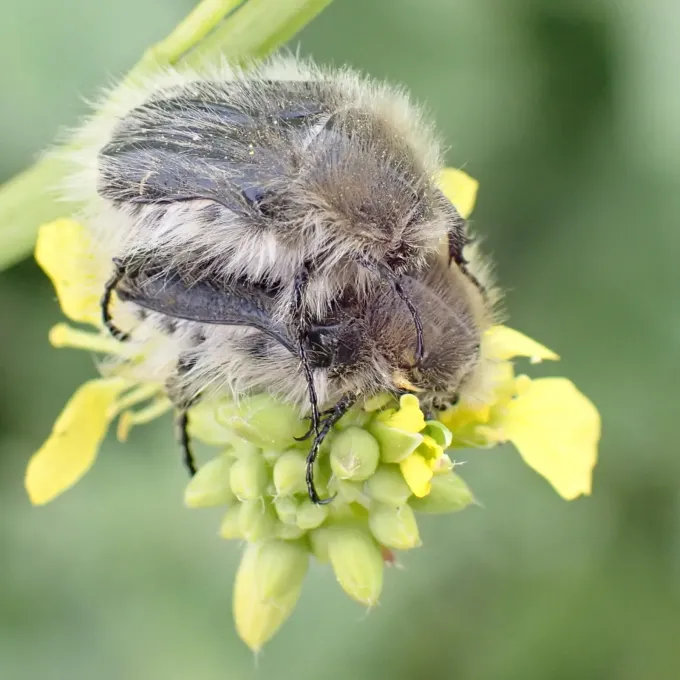
Tropinota hirta, commonly known as the fuzzy beetle or shaggy beetle, is a member of the Scarabaeidae family. The adult beetle is about 10–12 mm long, with a distinct matte black body and white spots on its elytra.
The insect is covered in dense, greyish hair, which gives it its common name. The larvae resemble those of the common cockchafer; they are white, C-shaped, and live primarily in the soil, feeding on organic matter.
The life cycle of the beetle is one year. Adults overwinter in the upper layers of the soil and emerge in early spring as soon as the weather becomes consistently warm.
Their activity is strictly linked to temperature; they thrive in sunny conditions above 18°C. During cool or overcast weather, they remain inactive, hiding in the soil or under plant debris.
This beetle is a generalist pest, which makes it a persistent threat to both home orchards and large-scale agricultural fruit production, as it can adapt to various ecosystems.
What it damages
The fuzzy beetle causes significant damage to almost all flowering plants in the garden, with a strong preference for pome and stone fruit trees, including apples, pears, cherries, and apricots.
Beyond fruit trees, the pest infests various ornamental plants, such as tulips, peonies, and strawberries, by feeding on their blossoms during the spring season.
The adult beetles feed specifically on the reproductive parts of the flower, including stamens, pistils, and petals. This prevents pollination and causes the flowers to wither and drop off prematurely.
Unlike the adults, the larvae are not harmful to crops, as they exist in the soil and feed on decaying organic material and the roots of weeds, leaving tree roots untouched.
In years with high population density, a single infestation can destroy nearly all flower buds on a tree, resulting in total crop failure for the season.
When it appears
Adult beetles typically emerge from overwintering sites in April, coinciding with the early spring blooming phase of stone fruit trees.
The peak flight and feeding season lasts from April through June, which is the most critical time for fruit tree development and early ovary formation.
The beetles are diurnal, meaning they are most active during the day. In the middle of the day, when the sun is brightest, they fly actively between trees in search of food.
Early in the morning or late in the evening, when temperatures drop, the beetles become sluggish and descend to the ground or hide within the dense foliage of the flowers.
After the main flowering season in the orchard ends, the adults continue their activity by moving to other blooming host plants before eventually laying eggs in the soil.
Signs of infestation
The most obvious sign of an infestation is the sight of black, hairy beetles nestled deep within open blossoms, actively consuming the centers of the flowers.
Damaged flowers appear ragged or completely hollowed out. One may notice premature petal drop or entire blossom clusters turning brown and failing to develop into fruit.
A noticeable decrease in fruit set, despite good weather conditions and the presence of pollinators, often indicates that Tropinota hirta has been active in the area.
If you shake a branch of a blooming tree during the peak heat of the day, you will observe the beetles flying off in large numbers, signaling a heavy infestation.
Visually inspecting the blossoms will reveal distinct bite marks on the stamens and pistils, which effectively sterilizes the flower and renders it incapable of fruit production.
Control measures
Controlling this pest is challenging because the damage occurs during the flowering stage, making the use of toxic insecticides dangerous for bees and other pollinators.
- Deploying blue-colored water traps, as the color blue is highly attractive to these beetles.
- Manually collecting and removing beetles from branches early in the morning when they are less active.
- Applying systemic insecticides well before the trees reach full bloom to reduce the adult population.
- Utilizing biological controls like entomopathogenic fungi to target larvae in the soil.
- Covering high-value individual trees with fine netting during the blooming period.
Deep autumn cultivation of the soil around the base of trees is an effective cultural practice to disrupt the beetles' overwintering sites.
Regular monitoring with traps allows gardeners to assess the population size and implement protective measures before the mass destruction of flower buds occurs.
Content graph
Connections · Tropinota hirta
Most often together:
Marketplace
Products · 7


Biology
Taxonomy
- Latin name
- Tropinota
- Order
- Coleoptera (beetles)
- Family
- Scarabaeidae
- EPPO code
- TRONSP
Community
Discussion
No discussions yet — be the first.