
Wood sandpiper
Tringa glareola
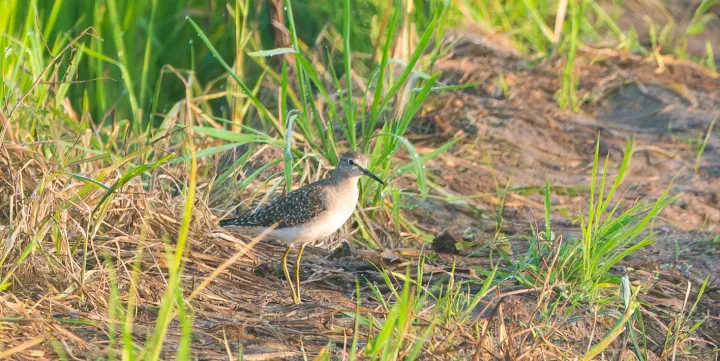
Description
How to identify
The Wood sandpiper (Tringa glareola) is a small wader species belonging to the Scolopacidae family, widely distributed across temperate regions.
It is characterized by a brownish back with distinct white spots and relatively long, greenish-yellow legs, adapted for walking in shallow water.
In flight, the species is identified by its white rump and dark wings, as well as its distinctive high-pitched, piping alarm call that sounds when flushed.
Unlike many other sandpipers, the Wood sandpiper often nests in trees, using old nests of other birds, which makes it a unique representative of the genus.
These birds are known for their migratory behavior, travelling long distances between breeding grounds in the north and wintering sites in Africa and Asia.
What it damages
From an agronomic perspective, the Wood sandpiper is not a crop pest in the traditional sense, as it does not feed on vegetative plant tissues.
However, the damage is purely mechanical, caused by the trampling of young seedlings in waterlogged fields, damp soil, or areas near drainage ditches.
Concentrated feeding behavior of large flocks can result in thinning stands of delicate crops, such as lettuce, young vegetables, or early-stage rice shoots.
In aquaculture-adjacent agriculture, these birds can reduce the yield of commercial fish ponds by predating on fingerlings, which impacts the broader farming system.
The disturbance of the soil surface in moist fields can also lead to crusting or uneven germination if the sandpipers frequent the field during the sensitive emergence stage.
When it appears
The presence of Wood sandpipers in agricultural landscapes is seasonal, strictly dictated by the spring and autumn migration patterns.
During the spring (April-May), birds stop over in fields to refuel, coinciding with the peak period of sowing and early germination of many crops.
The autumn migration, occurring between July and September, involves flocks stopping at flooded fields or wetlands to feed before continuing their flight to wintering grounds.
The frequency and duration of their stay on a specific farm are directly correlated with local rainfall and soil moisture content, as they seek invertebrates in wet soil.
Daily activity is concentrated during dawn and dusk hours, when the birds move actively across the landscape to forage for insects and small aquatic crustaceans.
Signs of infestation
Identifying Wood sandpiper activity in fields involves checking for specific footprints in soft, moist soil, which typically show three elongated toes.
Visible thinning of young crops near water bodies or irrigation channels is a common sign of bird congregation and foraging activity in that area.
Droppings found along the edges of agricultural canals or field drainage points suggest the birds have been using the location as a resting or feeding site.
The sudden, sharp, and repeated piping call upon the approach of farm machinery or workers is a primary auditory indicator of a nearby flock.
The presence of invertebrate shells or exoskeleton fragments near irrigation equipment serves as evidence of the birds’ recent diet in the area.
Control measures
Control methods for Wood sandpiper must prioritize non-lethal, deterrent-based techniques, as many migratory birds are protected by environmental laws.
- Deploying visual deterrents such as reflective tape or streamers to disrupt bird landings in sensitive crop zones.
- Utilizing sonic devices that emit distress calls of the species to effectively discourage the flock from settling.
- Improving field drainage to reduce the number of shallow puddles that serve as attractants for the birds.
- Implementing rotating deterrents, including predator-mimicking kites, to create a sense of threat and prevent habituation.
- Installing protective netting for high-value vegetable crops in areas where seasonal migration overlaps with early development stages.
Taxonomy
- Latin name
- Tringa glareola
- Family
- Scolopacidae
- EPPO code
- TNGAGL
Discussion
No discussions yet — be the first.