
Common snipe
Gallinago
Description
How to identify
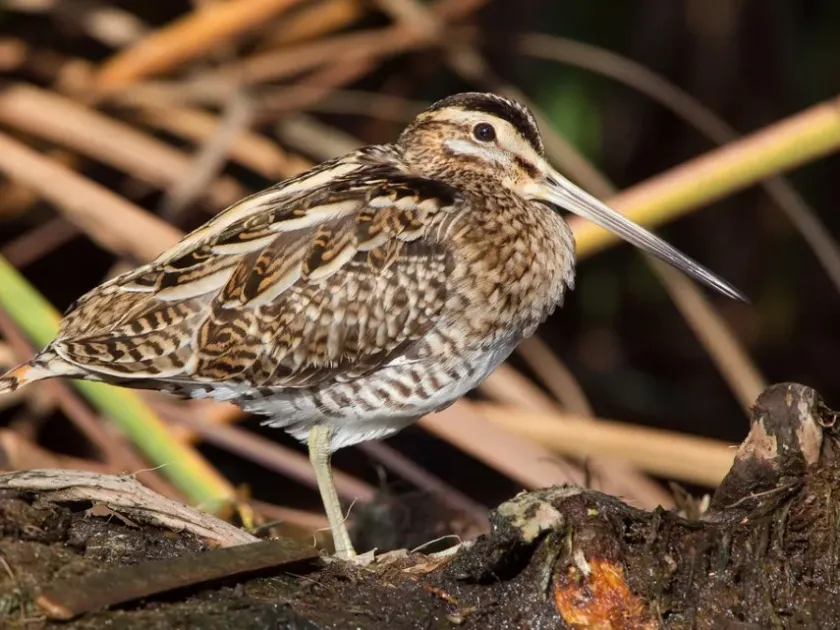
The Common Snipe (Gallinago gallinago) is a medium-sized wader from the Scolopacidae family. It is easily identified by its extremely long, straight bill, which is perfectly adapted for probing into soft mud and marshy soils.
The plumage is cryptically patterned in shades of brown, black, and buff, providing excellent camouflage against soil and dry vegetation, making the bird difficult to spot when resting.
It is well-known for its distinctive zigzag flight pattern when flushed. During breeding, males produce a unique drumming sound by vibrating their outer tail feathers during aerial dives.
These birds typically nest on damp meadows, moorlands, and marshy field margins. The nest is a simple, well-hidden scrape lined with dry grasses on the ground.
The Common Snipe is a migratory species that returns to its breeding grounds early in the spring, favoring areas with high moisture levels and soft substrates for feeding.
What it damages
In an agricultural context, the Common Snipe is not considered a crop pest. Its diet consists entirely of invertebrates, such as earthworms, insect larvae, and small crustaceans.
The bird does not consume seeds, grains, or vegetative matter from crops. Therefore, there is no direct economic damage or threat to yields from this species.
While minor soil disturbance may occur due to probing, it is usually negligible and restricted to very small, localized areas near wetland edges or waterlogged patches.
The presence of these birds is often an indicator of healthy, wet land, and they are generally viewed as a natural component of rural biodiversity rather than a threat.
Modern farming practices, including land drainage and habitat destruction, are much more detrimental to the snipe population than the bird is to modern agriculture.
Signs of infestation
The most visible sign of snipe presence is a pattern of small, deep holes in the soft soil, created by the bird's bill while foraging for subsurface invertebrates.
During the spring season, the "drumming" sound produced by males overhead is a definitive indicator of a breeding territory in or near the field.
An abrupt, noisy, and erratic takeoff from the grass is a characteristic behavior that helps distinguish the Common Snipe from other wetland birds.
Droppings left in characteristic patches, particularly along muddy margins or near drainage ditches, are another sign of recent activity in the area.
The birds are most active during dawn or dusk, often foraging in the open when they feel secure in low-light conditions near wetland borders.
Control measures
No specialized control measures are necessary, as the Common Snipe does not inflict damage on commercial crops and is not categorized as a pest species.
If habitat management is required for agricultural efficiency, improving field drainage and reducing standing water will naturally discourage these birds from frequenting the area.
Chemical control is strictly prohibited and unnecessary, given the bird's non-pest status and its role within the ecological food chain.
General field maintenance, such as regular grass mowing and weed control along boundaries, is usually sufficient to discourage the birds from nesting in specific zones.
For those looking to mitigate bird presence, non-lethal deterrents such as reflective tapes or visual scarecrows can be used, though they are rarely targeted specifically at this species.
Taxonomy
- Latin name
- Gallinago
- Family
- Scolopacidae
- EPPO code
- GLNGSP
Discussion
No discussions yet — be the first.