
Common snipe
Gallinago gallinago
Description
How to identify
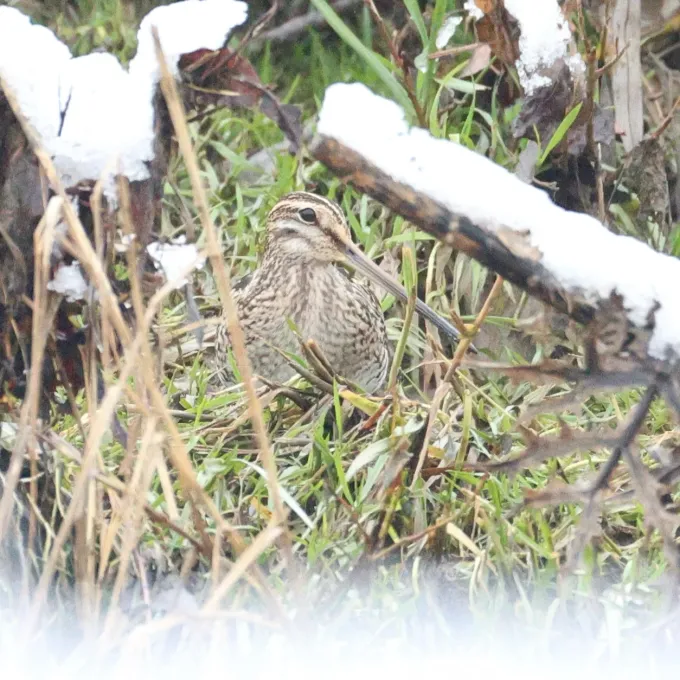
The Common Snipe (Gallinago gallinago) is a small, stocky wader belonging to the family Scolopacidae, known for its long, sensitive bill used for probing mud and soft soil.
It possesses an extremely effective cryptic plumage, characterized by dark brown, black, and light streaks, allowing it to blend perfectly into marshes or wet fields.
Taxonomically, it is classified as a shorebird that prefers habitats with high moisture, where it can easily access its primary food source using its specialized bill.
The bird is easily identified in the air by its erratic, zigzagging flight pattern, which is a defensive mechanism against potential predators.
In agricultural settings, these birds are usually encountered in low-lying, wet pastures or near the edges of marshy fields where the soil remains soft.
What it damages
It is important to clarify that the Common Snipe is not an agricultural pest; it does not consume seeds, crops, or vegetation of any kind.
Its diet consists strictly of animal prey, including earthworms, insect larvae, and small mollusks, which it extracts from the upper layers of soil.
While the birds probe the soil with their bills, the impact on agricultural land is minimal and does not cause structural damage to plant root systems.
There is no economic loss associated with the presence of snipe in cultivated areas, as they do not feed on cereals, vegetables, or fruits.
Many ecologists consider the Common Snipe a beneficial member of the ecosystem, as they play a role in regulating populations of invertebrates in wetlands.
When it appears
The activity of the Common Snipe on farmlands is closely tied to the seasonality of soil moisture and temperature, as they require unfrozen ground for feeding.
Spring migration usually brings them to wet, thawing fields where they find necessary nourishment after long migratory journeys before the breeding season starts.
Summer is primarily the nesting season, during which the birds remain in secluded, marshy areas, often adjacent to but not inside, active production fields.
Autumn migration occurs as temperatures begin to drop and the ground begins to harden, making it difficult for the birds to feed by probing.
During the winter, populations move to regions with milder climates where the soil remains soft enough for their feeding behavior throughout the season.
Signs of infestation
The most visible signs of snipe activity are clusters of small, pin-like holes in moist soil, created when the birds probe for their invertebrate prey.
During the mating season, the birds perform a display flight known as "drumming," where the air vibrating through their tail feathers produces a unique sound.
Finding a nest is quite rare as they are built on the ground, well-hidden within thick grasses or wetland vegetation, away from high-traffic agricultural zones.
- Probing marks: small, vertical indentations in the damp soil.
- Auditory sign: a distinctive "bleating" sound made during display flights.
- Flushing behavior: a sudden, rapid, and zigzagging takeoff when startled.
The presence of these signs indicates healthy, moist, and invertebrate-rich soil, which is typical for specific land types but not necessarily crop-damaging.
Control measures
No agricultural control measures are necessary for the Common Snipe because they do not threaten the yield or the health of cultivated plants.
If their presence is undesirable for specific operational reasons, soil drainage is the most effective way to make the area unsuitable for the species.
Maintaining proper field drainage and regular cultivation practices naturally reduces the availability of invertebrates, leading the birds to move to more suitable habitats.
Chemical control against this bird is prohibited and completely unnecessary, given their lack of impact on agricultural output.
Instead of control, farmers are encouraged to maintain biodiversity by keeping non-productive, marshy areas around fields, which supports a healthy ecosystem balance.
Taxonomy
- Latin name
- Gallinago gallinago
- Family
- Scolopacidae
- EPPO code
- GLNGGA
Discussion
No discussions yet — be the first.