
Trechus
Trechus
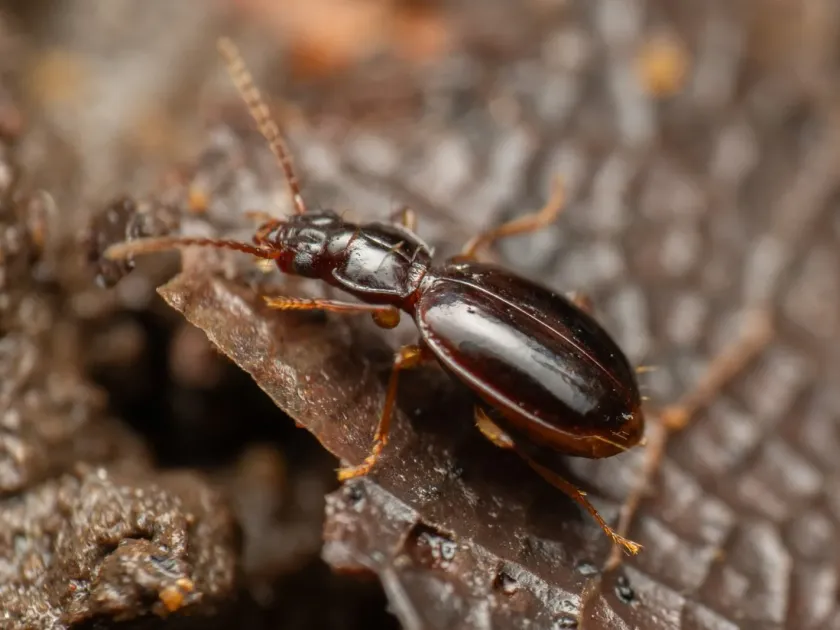
Description
How to identify
The Trechus genus belongs to the ground beetle family (Carabidae) and the order Coleoptera. These are small insects, typically measuring 3–5 millimeters in length.
Adult beetles range in color from reddish-brown to dark brown, sometimes displaying a metallic sheen. The surface of the elytra is generally smooth or marked with shallow grooves.
The head features strong mandibles typical of predatory species, although some members of the genus may feed on plant tissues under specific conditions.
Larvae are elongated and mobile, equipped with three pairs of thoracic legs. The life cycle involves several larval stages occurring within the soil layer.
These beetles are primarily inhabitants of the topsoil, leaf litter, or the lower layers of dense crop stands, where humidity remains high.
What it damages
Contrary to the common view that ground beetles are purely predatory, Trechus species can cause significant damage to young shoots of cereals and vegetable crops.
Both adults and larvae cause harm by gnawing at roots or feeding on seeds buried in the soil, leading to poor crop establishment and patchy emergence.
Crops most vulnerable to attack are early-sown winter and spring cereals, especially during prolonged, cold, and wet springs when beetle activity peaks.
Damage often manifests as the destruction of the growing point of seedlings, making the plant non-viable and requiring field reseeding.
Beyond direct tissue consumption, these insects can facilitate the spread of soil-borne diseases by compromising the epidermis of seeds and root systems.
When it appears
The peak activity period for Trechus beetles occurs in early spring and autumn, when temperature regimes are most favorable for their biological processes.
They overwinter primarily as adults in the upper soil layers, under plant debris, or within deep soil cracks.
Mass emergence from overwintering sites coincides with the germination of agricultural crops, creating a high risk of damage during the initial growth phases.
During the summer, in response to drought or high heat, beetles retreat into deeper soil horizons or become inactive.
The life cycle is univoltine, meaning one generation per year, though staggered breeding periods can create the impression of constant presence throughout the season.
Signs of infestation
Presence of the pest in the field is indicated by thin crop stands and the emergence of "bald patches," particularly in areas with higher soil moisture.
Examination of damaged plants reveals lesions near the root collar or complete excavation of the seed contents.
In the early morning hours, adult beetles or their movement traces may be visible on the soil surface, especially near accumulated plant residues.
Stunted growth is an indirect indicator, as damaged plants struggle to access nutrients due to compromised root systems.
For precise diagnosis, soil sampling in the crop rows and the use of Barber pitfall traps are recommended.
Control measures
The primary control strategy involves strict adherence to agronomic practices designed to create unfavorable conditions for beetle reproduction.
Deep autumn plowing (tillage) is highly effective, as it destroys overwintering sites and causes significant mortality to the population.
- Treatment of seeds with systemic insecticides prior to planting.
- Optimization of sowing dates to ensure rapid development through vulnerable stages.
- Elimination of weeds that serve as reservoirs for the pests.
- Use of bait stations in areas with critical infestation levels.
Chemical intervention is justified only when economic thresholds are exceeded, typically during the early seedling stages of cereal crops.
Taxonomy
- Latin name
- Trechus
- Order
- Coleoptera (beetles)
- Family
- Carabidae
- EPPO code
- TRECSP
Discussion
No discussions yet — be the first.