

Description
How to identify
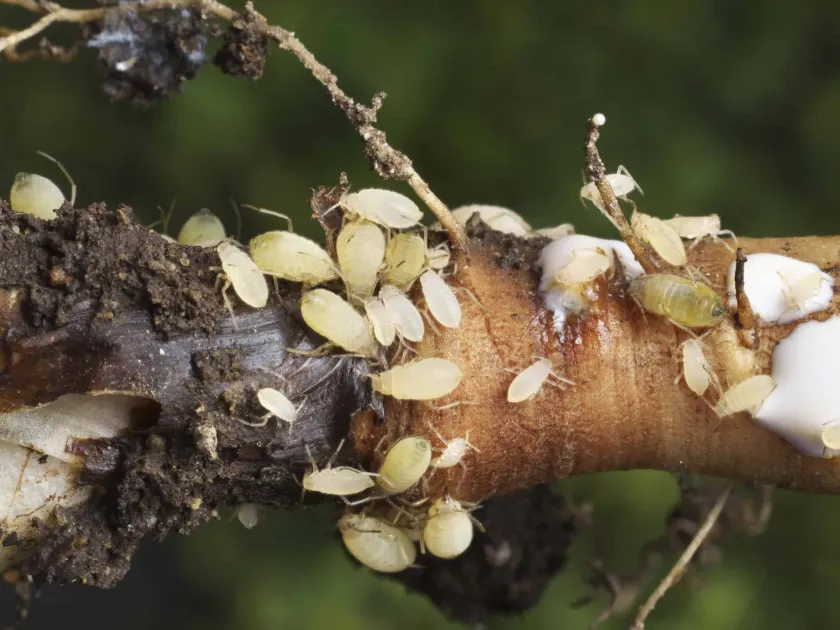
The root lettuce aphid (Trama troglodytes) is a subterranean insect species belonging to the family Aphididae. Unlike common aphids that infest leaves, this species lives permanently underground, feeding on the roots of various plants.
The adult aphids are typically 2–4 mm long and appear pale yellow or whitish, often covered with a fine waxy, mealy secretion that provides protection against moisture. They possess long legs, which are specialized for moving through soil gaps and tunnels.
This species maintains a symbiotic relationship with ants, which are responsible for transporting the aphids between roots and protecting them from soil-dwelling predators. The aphids, in turn, provide the ants with honeydew.
The life cycle involves both apterous (wingless) and alate (winged) forms. The winged forms appear when the host plant becomes overcrowded, allowing the colony to disperse and establish new infestations in nearby areas.
They overwinter in the soil, often near the base of host plants or within ant nests. Their ability to survive deep in the soil makes them particularly difficult to eradicate using conventional contact pesticides.
What it damages
Trama troglodytes primarily targets plants in the Asteraceae family. Lettuce (Lactuca sativa) is the most economically significant host, though they also infest chicory, artichokes, and wild dandelion.
The damage is caused by the aphid’s piercing-sucking mouthparts, which extract nutrients directly from the root xylem and phloem. This constant feeding weakens the plant's ability to uptake water and essential minerals from the soil.
Severe infestations manifest as stunted growth, chlorosis, and wilting, even under optimal irrigation conditions. Because the root system is compromised, the plants lack the vigor required to produce high-quality foliage.
Furthermore, the feeding punctures create entry points for soil-borne pathogens. This often leads to secondary root rot, which causes the roots to blacken and decay, eventually killing the plant entirely.
The damage is most pronounced in warm, dry weather when the plants are already under water stress, making them unable to compensate for the loss of root function caused by the aphid colony.
Signs of infestation
The first sign of an infestation is a sudden decline in plant health that does not respond to fertilization or irrigation. The leaves may look dull or slightly discolored as the plant struggles with nutrient transport.
An unmistakable indicator is the presence of ant activity around the plant base. If you see ants frequently entering cracks in the soil around your lettuce, it is highly likely that they are tending to a colony of root aphids.
Upon inspecting the roots of an affected plant, you will see a white, fluffy, or mealy substance clinging to the root hairs. This is the waxy protective secretion produced by the aphids to keep their bodies dry.
Affected plants are often loosely anchored in the soil. When pulled out, the root system will appear significantly smaller than that of healthy plants, with many fine lateral roots missing or decayed.
During the hottest part of the day, plants will show signs of severe wilting that recovers only partially at night, signaling that the roots can no longer support the plant's transpiration requirements.
Control measures
Effective management begins with strict weed control. Removing dandelions and other wild Asteraceae around your garden prevents the aphids from finding alternative hosts to survive on during the off-season.
Deep cultivation of the soil in late autumn is a crucial cultural practice. It disrupts the aphid colonies and destroys ant nests, significantly reducing the population that will emerge in the following spring.
Chemical control should rely on systemic insecticides that can be applied as a soil drench. This allows the product to move into the root zone, where the aphids are actively feeding.
Controlling the ant population is essential. If ants are present, they will actively protect the aphids from natural enemies, so managing the ants is often a prerequisite for effective aphid control.
- Incorporate biological agents like Beauveria bassiana into the soil for long-term suppression.
- Avoid continuous cropping of lettuce to prevent population buildup.
- Monitor the root health of early-season crops to detect infestations before they spread.
Content graph
Connections · Root lettuce aphid
Most often together:
Marketplace
Products · 6


Biology
Taxonomy
- Latin name
- Trama troglodytes
- Order
- Hemiptera (bugs, aphids, leafhoppers)
- Family
- Aphididae
- EPPO code
- TRAMTR
Community
Discussion
No discussions yet — be the first.