
Thyridanthrax fenestratus
Thyridanthrax fenestratus
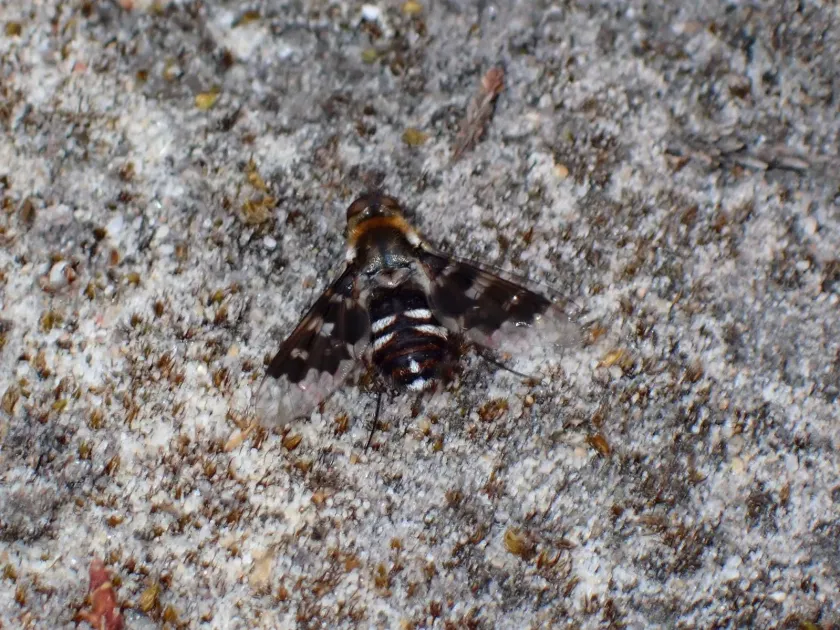
Description
How to identify
Thyridanthrax fenestratus is a species of bee fly belonging to the family Bombyliidae within the order Diptera. These flies are easily recognized by their densely haired bodies, which often mimic the appearance of bees or wasps.
The wings typically feature characteristic dark markings or patches that resemble "windows," a trait that provides the species with its specific scientific epithet.
Adult flies are diurnal and are commonly observed hovering over flowers, where they feed on nectar. Their flight pattern is agile, allowing them to remain stationary in the air for extended periods.
The larvae are specialized parasites, specifically targeting the nests of solitary bees and other Hymenoptera nesting in the ground.
The pupal stage is highly adapted, possessing structures that enable it to propel itself through the soil, a crucial behavior for emerging from subterranean nests.
What it damages
The primary economic impact of Thyridanthrax fenestratus arises from its role as a parasite of beneficial pollinating insects, such as ground-nesting bees and bumblebees.
By consuming the larvae of pollinators within their nests, these flies directly reduce the population of essential insects required for high crop yields.
Reduced pollinator activity can lead to poor fruit set and decreased seed production in various agricultural and horticultural crops.
Although they do not feed on the plant tissues themselves, the disruption of pollinator services causes significant long-term agricultural harm.
In greenhouse operations utilizing commercial bumblebee hives, the presence of these parasites can lead to the collapse of colonies if not properly managed.
When it appears
Adult activity of Thyridanthrax fenestratus is most pronounced during the summer months, particularly in June and July when warm weather facilitates flight.
The life cycle is closely timed with the nesting period of host species, as females must locate suitable nests while they are being provisioned by the bees.
In different climatic zones, the duration of the larval development can vary, often depending on the temperature and soil moisture levels in the host's nesting site.
High fly density is typically observed in open, sun-exposed areas with sandy or loose soil compositions, which are preferred nesting grounds for their host insects.
Monitoring for adult flies during early summer is an effective strategy for predicting the potential intensity of parasitism for the current season.
Signs of infestation
The most reliable sign of a Thyridanthrax fenestratus presence is observing adult flies hovering persistently over the entry holes of ground-nesting bee colonies.
Upon closer inspection of these nesting sites, one may find empty pupal cases protruding from the surface of the soil, indicating the successful completion of the fly's life cycle.
A noticeable decline in pollinator traffic around flowering crops can indicate that local nesting populations are under stress from parasitic pressure.
Inspecting individual nest cells may reveal the presence of fly larvae or larval remains, confirming the infestation of the host brood.
The presence of high numbers of these flies on local flora, combined with a reduction in pollinator efficiency, is a clear indicator of infestation.
Control measures
Managing Thyridanthrax fenestratus is challenging, as standard chemical insecticides used against agricultural pests are often toxic to the beneficial pollinators being protected.
Integrated pest management should focus on cultural and mechanical methods rather than chemical intervention to maintain pollinator health.
Mechanical exclusion, such as placing fine mesh netting over identified nesting areas, can prevent female flies from accessing the nests to lay eggs.
Maintaining a healthy habitat with diverse flora can support natural predators of the bee fly, helping to keep their population density in check.
- Install protective screening around bumblebee boxes or managed nesting sites.
- Avoid tilling the soil in areas known for significant pollinator nesting.
- Minimize broad-spectrum insecticide use during the pollinator's active season.
Taxonomy
- Latin name
- Thyridanthrax fenestratus
- Order
- Diptera (flies)
- Family
- Bombyliidae
- EPPO code
- THDXFE
Discussion
No discussions yet — be the first.