
Great green bush-cricket
Tettigonia cantans
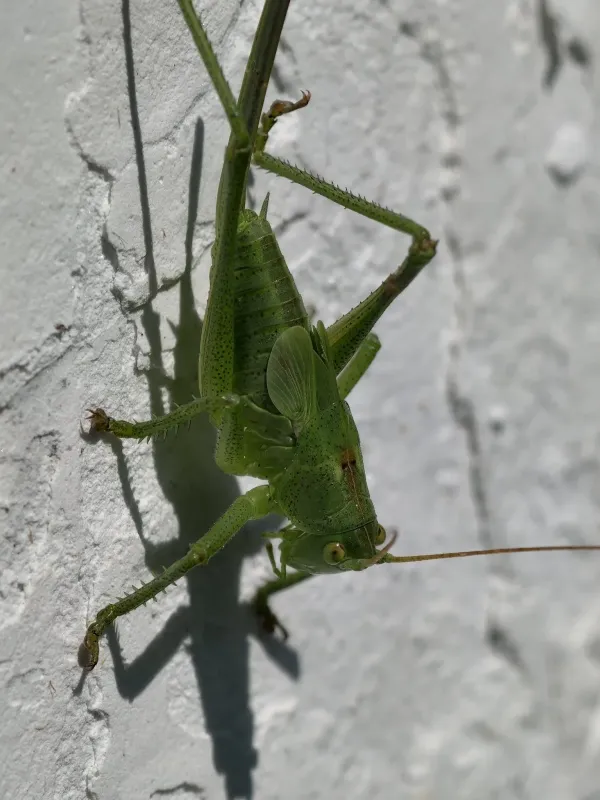
Description
How to identify
The great green bush-cricket Tettigonia cantans is a member of the family Tettigoniidae. Adult individuals typically measure between 20 and 35 mm and exhibit a distinct green or brownish body color.
A key identification feature is their long wings, which usually extend beyond the ovipositor in females. Males are well-known for their loud, rhythmic song produced by rubbing their wings together during mating periods.
The life cycle comprises three main stages: egg, nymph, and adult. Eggs are laid directly into the soil, where they possess high resistance to cold temperatures, allowing for successful overwintering.
Nymphs resemble smaller, wingless versions of the adults. As they mature, they undergo several molts, gradually increasing in size and developing fully functional wings and reproductive organs.
They prefer habitats such as tall grasslands, forest edges, and fallow fields, from which they occasionally migrate into cultivated areas when food resources in their primary habitat become scarce.
What it damages
The great green bush-cricket is technically omnivorous, often preying on smaller insects; however, during population spikes, it can become a significant agricultural pest.
Cereal crops are particularly susceptible to damage, as bush-crickets feed on the leaves and can consume the soft grains, leading to reduced overall yield and quality.
Vegetable crops such as lettuce, cabbage, and beans often suffer from severe leaf skeletonization, which weakens the plant and stunts its growth in early developmental stages.
In orchards, these insects may feed on young tender shoots, buds, and even ripening fruits if the population density is high and natural vegetation is not available.
The pest's economic impact is most notable in years with favorable climate conditions, as migration waves can rapidly defoliate sections of a field if left unchecked.
When it appears
The active development of nymphs typically begins in late spring, triggered by the warming of the soil surface, which allows the eggs to hatch.
Adult insects become highly active from July onwards and maintain their presence throughout the summer until the onset of the first heavy autumn frosts.
The peak of their activity—often identified by their singing—coincides with mid-to-late summer, which is a critical period for the maturation of many agricultural crops.
Oviposition occurs in autumn, with females using their long ovipositors to deposit eggs deep within the soil profile, ensuring protection until the next warm season.
Because the species winters in the egg stage, seasonal shifts do not eliminate the population, allowing them to remain a persistent threat in suitable agricultural landscapes.
Signs of infestation
Detection is often first realized by the loud, persistent song of the males, which is clearly audible in the vicinity of weed patches or border zones adjacent to crops.
Visual signs of damage include irregular, ragged holes in leaves and partially consumed plant tissues, which differ from the cleaner cuts made by other pests.
During evening inspections, one can observe the large green insects easily as they jump or fly short distances when disturbed by light or proximity to humans.
The presence of weeds at the field borders is a common indicator, as these areas often serve as the primary reservoir for the bush-cricket population.
On grain fields, empty or damaged husks at the milk-stage are a direct indication of bush-cricket feeding activity that necessitates immediate management intervention.
Control measures
Effective management focuses on creating unfavorable conditions for the bush-cricket through cultural practices and physical site maintenance.
- Routine weeding of field boundaries to eliminate potential shelter and secondary food sources.
- Deep autumn plowing to disturb the soil and destroy egg-laying sites.
- Installation of light traps or barriers for small, high-value areas to catch or exclude adults.
- Application of biological pesticides containing entomopathogenic fungi to reduce population density.
- Chemical control measures using approved insecticides should be reserved for scenarios where crop damage thresholds are significantly exceeded.
Taxonomy
- Latin name
- Tettigonia cantans
- Order
- Orthoptera (locusts)
- Family
- Tettigoniidae
- EPPO code
- TTTACA
Discussion
No discussions yet — be the first.