
Mormon cricket
Anabrus simplex
Description
How to identify
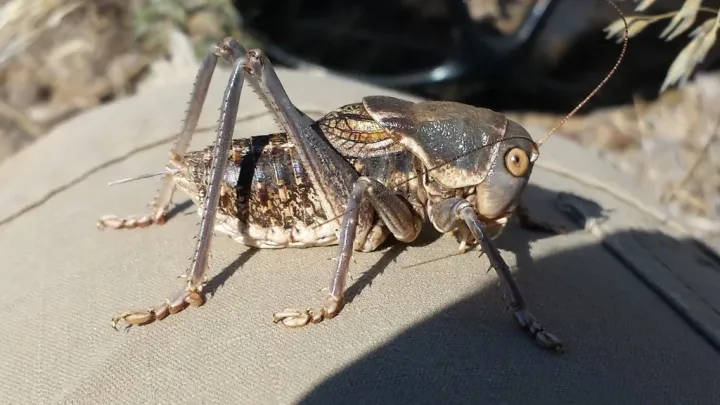
The Mormon cricket (Anabrus simplex) is a large, flightless insect belonging to the Tettigoniidae family, commonly known as shield-backed katydids.
These insects can reach lengths of 5 to 8 centimeters and possess a robust, heavy body shape adapted for both walking and endurance during their long-distance migrations.
Their color ranges from black or dark brown to green, and sometimes even reddish, allowing them to blend into various soil and vegetation types.
They are characterized by their social behavior, forming large bands that move across the landscape in search of food, often reaching thousands of individuals per square meter.
The biology of Anabrus simplex is unique because they undergo incomplete metamorphosis, and their eggs have the ability to remain dormant in the soil for one or more years.
What it damages
Mormon crickets are omnivorous pests that feed on over 400 species of plants, causing significant economic damage to cereal crops like wheat, barley, and alfalfa.
When present in large bands, they are capable of stripping entire fields of vegetation, consuming leaves, stems, flowers, and even the seeds of agricultural crops.
In addition to field crops, they cause considerable destruction in home gardens and orchards, eating fruits and vegetables, which ruins the market value of the harvest.
They pose a serious threat to rangelands by overgrazing grasses, which directly impacts the forage availability for livestock and leads to soil erosion.
Their feeding habits are indiscriminate, and they can easily defoliate entire plant populations, leaving only the toughest vascular tissues behind.
When it appears
The life cycle begins when eggs hatch in the spring, typically when soil temperatures rise, which coincides with the onset of the growing season for many crops.
Development involves seven nymphal instars, during which the insects are flightless and move primarily by walking, causing damage throughout their growth phase.
Adults emerge by mid-summer, reaching full reproductive capacity, and they continue to migrate while seeking mates and suitable soil for egg-laying.
The peak migration period occurs during the warmest part of the summer, as they move from drying natural vegetation toward lush, irrigated agricultural lands.
By late summer and early autumn, adult populations die off after laying their eggs, which then overwinter in the soil until the next season's cycle begins.
Signs of infestation
A primary sign of a Mormon cricket outbreak is the sudden appearance of large, mobile bands that can be seen crossing roads or devouring green vegetation along field edges.
Feeding damage is easily recognized by ragged holes in leaves, shredded stems, and the total destruction of seedling stands within a matter of hours.
The presence of dense piles of shed exoskeletons is another indication of a high-density population undergoing development in the area.
The noise produced by the rhythmic chirping of males during the evening and night can serve as an auditory indicator of the intensity of the infestation.
- Large-scale defoliation of crop plants.
- Visible bands of insects moving across open ground.
- Significant reduction in yield at harvest time.
Control measures
Chemical control involving the targeted application of insecticides is most effective when applied to early-instar nymphs before they begin large-scale migrations.
Cultural practices, such as deep plowing in the autumn, can disturb egg beds and reduce the number of nymphs that survive to hatch in the following spring.
Physical barriers, including plastic film fences or deep trenches, are often deployed to protect high-value plots from the advancing bands of crickets.
Biological control methods are being researched, focusing on native predators like birds and wasps, as well as pathogenic fungi that can naturally decimate cricket bands.
Early detection through systematic field scouting and the use of monitoring traps is critical to managing outbreaks before they reach uncontrollable levels.
Taxonomy
- Latin name
- Anabrus simplex
- Order
- Orthoptera (locusts)
- Family
- Tettigoniidae
- EPPO code
- ANABSI
Discussion
No discussions yet — be the first.