
Armadus
Acanthoplus armativentris
Description
How to identify
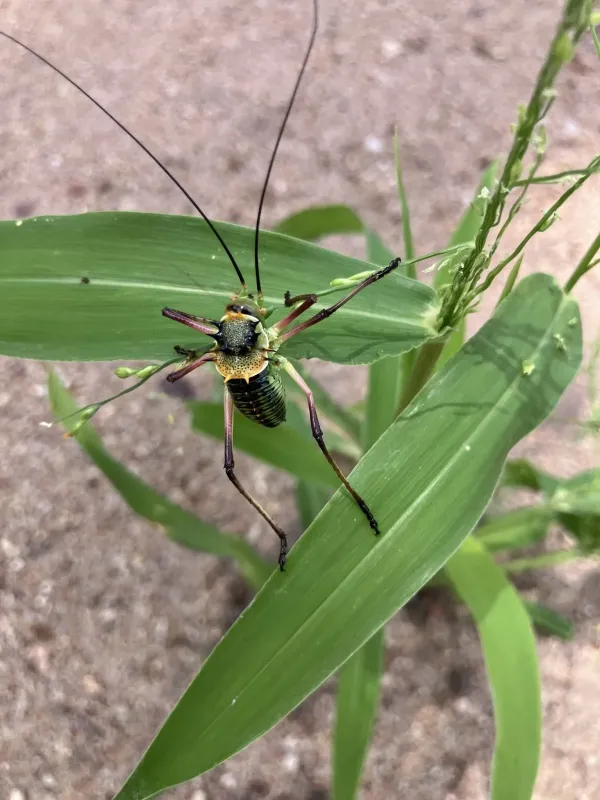
The armadus (Acanthoplus armativentris), also known as the armoured bush cricket, is a member of the Tettigoniidae family. This insect is well-adapted to the harsh, arid environments of southern Africa and possesses unique biological traits for survival.
Adult insects are characterized by their heavy, spiny exoskeletons which provide significant protection against predators. They have robust mouthparts capable of consuming tough plant matter with ease.
The life cycle is dictated by seasonal rainfall, with eggs remaining in the soil during dormant, dry periods. Once conditions become favorable, nymphs emerge and progress through several developmental stages.
These insects are primarily nocturnal, sheltering in dense vegetation or soil crevices during the heat of the day to avoid desiccation. Their coloration varies, providing effective camouflage against the dry grasses of their natural habitat.
Their ability to move across large distances allows them to rapidly invade new agricultural fields when natural vegetation dries up, making them a significant agricultural threat.
What it damages
As a polyphagous insect, the armadus causes extensive damage to a wide range of crops. It is particularly notorious for its impact on staple grains like maize, sorghum, and millet, often attacking young plants during their vulnerable early growth stages.
The feeding habits of the cricket involve stripping leaves and severing stems, which can lead to the total destruction of localized crops. In severe infestations, an entire field can be defoliated in a matter of days.
By consuming the vegetative parts of the plant, the armadus severely impairs the crop's ability to photosynthesize and produce grain. This loss of plant vigor frequently leads to stunted growth or outright mortality.
Agricultural fields situated near wild grasslands are at the highest risk, as these wild areas often act as permanent reservoirs for the insect population during non-cultivation periods.
Beyond direct crop destruction, the damage caused by the armadus results in substantial economic losses, forcing farmers to undertake costly emergency interventions and pest management strategies.
Signs of infestation
The most prominent sign of an armadus infestation is the presence of ragged leaf margins and partially consumed stems. Inspections conducted at night often reveal the insects actively feeding on the crop canopy.
Early-stage damage presents as localized leaf stripping, which rapidly progresses as the population size increases. The presence of insect frass at the base of the plants is a clear indicator of recent feeding activity.
In the daytime, although the insects are hidden, one can often find them by examining the soil surface beneath the crop rows or under debris near the edge of the field. Their presence is also marked by localized patches of cleared or damaged vegetation.
Acoustic monitoring during the evening can be a useful tool; the loud, distinctive stridulation of males provides a clear indication of a significant population density within the vicinity.
Fields showing a 'patchy' pattern of plant loss often indicate areas where the insects have migrated in from surrounding non-cultivated land, highlighting the need for perimeter management.
Control measures
Effective management of the armadus requires a multi-faceted strategy that combines cultural practices with targeted chemical control. Preventive measures during the off-season are essential for minimizing the next generation's success.
Deep plowing of fallow land after harvest is a highly effective method to disrupt the soil-dwelling eggs, significantly reducing the emergence of the subsequent nymph generation.
Chemical control should be implemented when monitoring indicates that the population has exceeded the economic threshold. Insecticides, particularly those effective against orthopteran pests, are best applied in the evening when the insects are most active.
Barrier treatments around the perimeter of the fields can prevent the migration of these insects from nearby wild areas. This localized application strategy helps to reduce overall chemical usage while protecting the crop.
- Use deep tillage to destroy overwintering egg clusters.
- Monitor field edges closely for migration signs.
- Apply insecticides in the early evening to maximize contact.
Taxonomy
- Latin name
- Acanthoplus armativentris
- Order
- Orthoptera (locusts)
- Family
- Tettigoniidae
- EPPO code
- ACAPAR
Discussion
No discussions yet — be the first.