
Mormon cricket
Anabrus
Description
How to identify
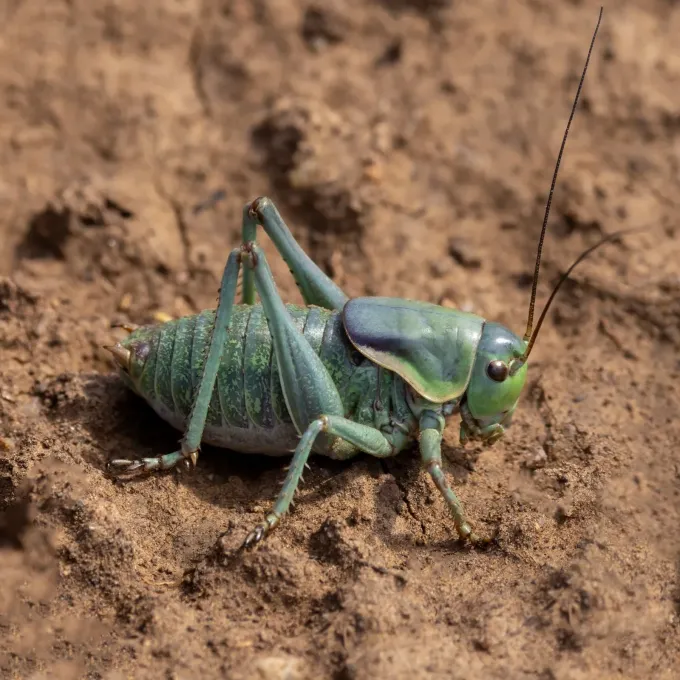
The Mormon cricket (Anabrus simplex) is a large, flightless insect belonging to the Tettigoniidae family, commonly known as shield-backed katydids.
Adult insects are robust and can grow up to 5-8 centimeters in length, often possessing a distinct, shield-like structure covering their thorax.
Their color ranges from dark brown to green, with variations in pigmentation that help them blend into the local environment where they congregate.
Despite their common name, they are not true crickets but are closely related to bush-crickets, sharing similar morphological features and behaviors.
Females are equipped with a long, sword-like ovipositor designed for laying eggs deep into the soil to ensure survival through winter conditions.
What it damages
These insects are aggressive polyphagous feeders, meaning they consume a wide variety of plant species, causing significant damage to agriculture.
Grain crops such as wheat, barley, and oats are highly susceptible to destruction during their growth phase when swarms migrate through fields.
Pasture lands and hay fields suffer heavily, as massive swarms can strip all available forage, causing economic losses for the livestock industry.
Vegetable gardens and orchards are also frequent targets, where the insects destroy leaves, stems, and fruits, often rendering the crop unmarketable.
During outbreak years, the sheer density of a swarm can completely denude an area, leaving behind only debris and causing long-term damage to vegetation.
When it appears
The life cycle of the Mormon cricket is dictated by environmental temperature, which influences the timing of egg hatch and nymphal development.
Hatching usually occurs in early spring, triggered by rising soil temperatures, which marks the beginning of the insect's active feeding phase.
Throughout the late spring and early summer, nymphs undergo several molts, rapidly increasing in size and moving in large, coordinated groups.
By mid-summer, adults reach reproductive maturity, mate, and females lay eggs in the soil, which enter a state of diapause until the following year.
The entire seasonal development is well-synchronized with the climate of the American West, allowing the species to persist in harsh landscapes.
Signs of infestation
One of the most obvious signs is the sight of large, moving bands of insects that act as a single, devastating unit crawling across the landscape.
Field damage is characterized by jagged, uneven consumption of leaves and stems, often moving from the field's edge inward as the swarm migrates.
The presence of large amounts of frass and the sound of chewing and movement in dense vegetation are clear indicators of a major infestation.
An increased number of avian and small mammal predators congregating in a specific area is often a biological sign of high insect density.
Significant gaps in rows of crops appearing overnight are a classic sign that a swarm has passed through or is actively feeding nearby.
Control measures
Successful management of these pests relies on early detection and intervention before the insects reach the adult, flightless-but-mobile stage.
- Monitor nymph populations early in the season to identify potential outbreak areas before migration begins.
- Apply registered contact insecticides in areas where nymphs congregate to significantly reduce swarm numbers.
- Use physical barriers like specialized trenches to stop the migration of dense bands of insects toward valuable crops.
- Encourage natural predator populations that can help maintain insect density below the economic injury level.
- Practice landscape management, including reducing suitable egg-laying sites in rangelands adjacent to agricultural fields.
Proactive monitoring programs are essential, as waiting until the swarm reaches the crop often makes control efforts less effective and more costly.
Taxonomy
- Latin name
- Anabrus
- Order
- Orthoptera (locusts)
- Family
- Tettigoniidae
- EPPO code
- ANABSP
Discussion
No discussions yet — be the first.