
Acanthoplus
Acanthoplus
Description
How to identify
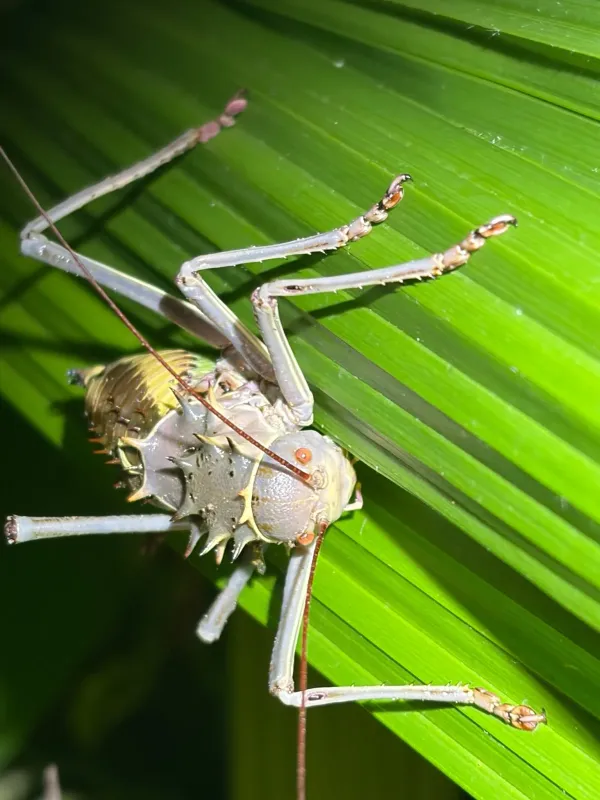
Acanthoplus is a genus of large, flightless grasshoppers belonging to the Tettigoniidae family, order Orthoptera. The most widely recognized species is the armored ground cricket (Acanthoplus discoidalis).
Physically, the insect features a robust body covered in a hard, chitinous exoskeleton with distinctive spines, providing a natural defense against predators. Their coloration ranges from brown to yellowish-green, facilitating camouflage within dry vegetation.
Wings in this genus are entirely vestigial or significantly shortened, meaning these insects rely exclusively on jumping or crawling for movement. When threatened, they are capable of a defensive reflex called reflex bleeding, where they exude toxic hemolymph from body pores.
Acanthoplus species possess powerful chewing mouthparts adapted for grinding tough plant tissues. Adults can grow between 5 to 7 centimeters in length, making them easily identifiable pests in agricultural fields.
The reproductive biology involves depositing eggs into the soil. The life cycle comprises an egg stage, a larval development period, and an adult stage, with larvae appearing as smaller, wingless versions of the adults.
What it damages
This pest is a polyphage, meaning it is capable of feeding on a wide variety of agricultural crops. Significant damage occurs primarily in arid regions of Africa, where the insect actively consumes large amounts of vegetative biomass.
Cereal crops like millet and sorghum are particularly vulnerable. Acanthoplus larvae and adults feed on young seedlings, stems, and developing inflorescences, severely reducing the potential yield during critical growth stages.
The list of host plants also includes various vegetable crops and wild grasses, which the insects exploit when primary food sources are scarce. During outbreaks, they are capable of stripping fields of their foliage.
Beyond consuming green mass, these insects damage the generative organs of plants. This interference disrupts grain or fruit formation, which significantly degrades the quality and marketability of the produce.
The damage potential is magnified by the insect's tendency to congregate in groups, creating localized areas of intense crop destruction. High population densities make them difficult to manage without systematic intervention.
When it appears
The activity level of Acanthoplus is directly correlated with seasonal rainfall patterns in their native habitats. The most intense life cycle progression occurs during warm, humid periods, which trigger mass hatching of larvae.
At the onset of the rainy season, larvae emerge from the soil and begin active feeding. This is the period when agronomists report the first signs of damage on young crop seedlings.
Adult populations typically reach their peak density toward the middle of the growing season. At this stage, the risk to crops is highest due to the insects' high nutritional demands for reproduction.
As the dry season approaches or temperatures drop, the metabolic activity of the pests declines significantly. A portion of the population enters a dormant state or completes its life cycle after depositing eggs deep within the soil.
Consequently, the critical window for plant protection is the first half of the growing season. During this time, monitoring insect density in fields should be conducted on a weekly basis.
Signs of infestation
The first sign of an Acanthoplus infestation is the discovery of characteristic feeding damage on leaf edges, which appear as large, jagged gaps. Often, this damage follows a stepped pattern along the leaf margin.
In the fields, the presence of large, elongated fecal pellets is a strong indicator of pest activity. These droppings are often the most reliable clue for confirming the presence of these insects during nighttime hours.
A specific sign includes the presence of fluid marks from the "armored cricket" on foliage, which can leave persistent stains on the plant surface. Visual inspections near the base of the plants often reveal the insects themselves hiding during the day.
Mass disappearance of seedlings on certain sections of the field indicates high pest density. Plants may look grazed down to the soil level, which is particularly evident in dense cereal plantings.
- Presence of large, irregular feeding holes on leaves.
- Severed stems of young crop plants.
- Evidence of insect presence (fecal matter) observed during early morning.
- Localized wilting or lodging of damaged plants.
- Specific unpleasant odor in areas where insects congregate in high numbers.
Control measures
Effective management of Acanthoplus relies on integrated pest management (IPM) strategies. Agrotechnical controls, such as deep plowing of soil after the harvest, are crucial to destroying egg clutches.
Monitoring population levels using light traps or visual counts on sample plots helps agronomists decide when intervention is necessary. When economic thresholds are exceeded, chemical control via insecticides is utilized.
For chemical control, products with contact and stomach-action properties are effective. Spraying should ideally be conducted during the insect's peak activity period, which is typically during twilight hours.
Biological control methods, such as preserving local populations of natural predators like birds and small mammals, can help suppress Acanthoplus numbers without the need for intensive chemical use.
Adopting proper crop rotation and clearing weeds from field boundaries removes alternative food sources during the off-season, which significantly reduces the risk of mass migration into primary crop fields.
Taxonomy
- Latin name
- Acanthoplus
- Order
- Orthoptera (locusts)
- Family
- Tettigoniidae
- EPPO code
- ACAPSP
Discussion
No discussions yet — be the first.