
Great green bush-cricket
Tettigonia
Description
How to identify
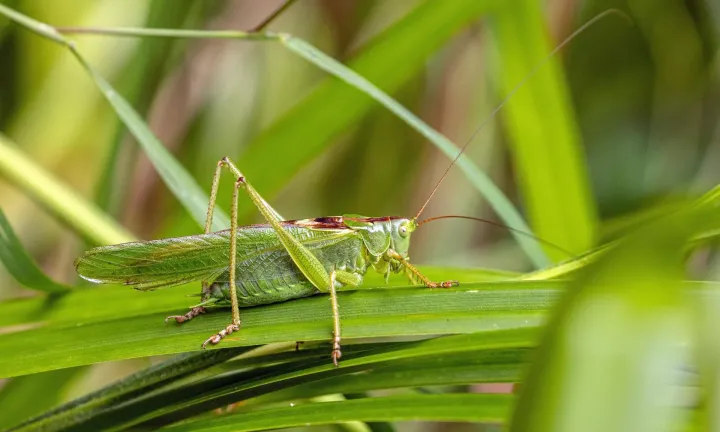
The great green bush-cricket (Tettigonia viridissima) is a member of the Tettigoniidae family in the order Orthoptera. Adults grow to 28–36 mm and have a bright green coloration with a brown stripe on the back, providing excellent camouflage.
These insects possess auditory organs located on their front tibiae, a key morphological feature. Females are equipped with a long, sword-like ovipositor used to deposit eggs into the soil or plant tissues, ensuring their survival through the season.
Their wings are well-developed and extend well beyond the abdomen, allowing for significant mobility. Nymphs closely resemble adults but lack functional wings and are generally smaller in size.
The species is primarily nocturnal, though it can remain active during hot days. The characteristic chirping of the males is produced by rubbing their forewings together, which serves to attract females during the mating season.
The lifecycle involves incomplete metamorphosis consisting of egg, nymph, and adult stages. They overwinter as eggs, which the female deposits in the topsoil in late summer or autumn, protecting them from winter cold.
What it damages
The great green bush-cricket is omnivorous, but it can become a significant agricultural pest when populations reach high densities. They feed on leaves, young shoots, and the reproductive parts of various vegetable and fruit crops.
Vineyards are particularly susceptible, as these insects damage young leaves and developing fruit clusters. Crops such as corn, cereals, and various vegetables often suffer from the grazing of these insects along the leaf margins.
Although they often act as predators of other smaller insects, in an agricultural context, they are classified as pests because they readily switch to crop foliage when natural food sources are limited.
Damage becomes critical during drought years when natural grasses wither, forcing bush-crickets to migrate into irrigated fields and gardens in search of succulent plant tissue.
Significant damage is frequently reported in nurseries, where the consumption of young leaves stunts seedling growth and reduces their overall resistance to secondary diseases.
When it appears
Nymphs typically emerge in May as soil temperatures rise. The developmental phase lasts roughly two months, making adults most visible and active from July through September.
Signs of infestation
The most common sign of a bush-cricket infestation is the presence of irregular, ragged-edged leaves. Unlike caterpillars, they leave large, jagged holes, often skeletonizing the leaf and leaving only the larger veins behind.
The loud, repetitive chirping in the evening is a clear indicator of their presence. A visual inspection of the lower foliage or base of the plants early in the morning can often reveal the insects themselves.
Wilting of young shoots and the presence of frass on the leaves are further indications of activity. Damage is typically concentrated on shaded or protected parts of the plant canopy.
Detecting eggs in the soil is difficult without specialized knowledge, so monitoring efforts should focus on observing adult activity and documenting foliage damage throughout the summer.
In cases of high infestation, plants may show a loss of turgor pressure and overall thinning of the canopy, which hampers photosynthesis and affects the quality of the final harvest.
Control measures
Primary control methods include cultural practices such as regular mowing of weeds and grass around the plot, which eliminates breeding grounds and potential overwintering sites for the eggs.
Deep autumn tilling of the soil helps destroy eggs residing in the upper soil layers, significantly reducing the nymph population for the following year. This is particularly effective in orchard plots and vegetable patches.
If population density reaches critical levels, the application of broad-spectrum insecticides may be necessary; however, they should be applied judiciously to avoid killing beneficial predatory insects that naturally limit cricket populations.
Using light traps at night can help reduce the number of adults in smaller garden plots or greenhouses where the crickets pose a high risk to sensitive crops.
- Regular monitoring of crop health and population density.
- Encouraging natural bird predators in the area to control adult insects.
- Ensuring optimal irrigation to boost plant vigor and speed up recovery from grazing.
Taxonomy
- Latin name
- Tettigonia
- Order
- Orthoptera (locusts)
- Family
- Tettigoniidae
- EPPO code
- TTTASP
Discussion
No discussions yet — be the first.