
Teretrius
Teretrius
Description
How to identify
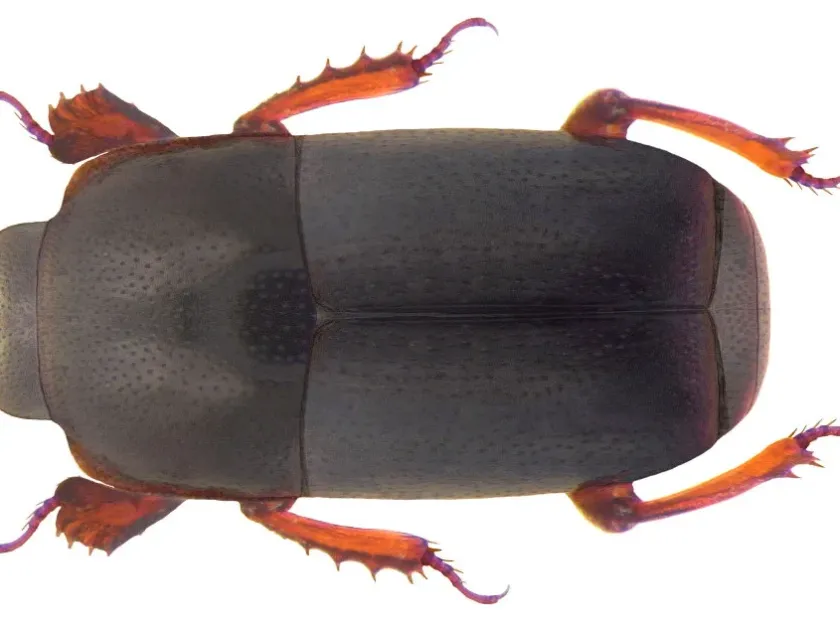
Teretrius is a genus of beetles belonging to the family Histeridae (hister beetles) within the order Coleoptera. Adult beetles are small, typically measuring between 2 to 4 mm, with an elongated, cylindrical, or slightly flattened body shape adapted for living in narrow spaces.
Their coloration typically ranges from dark brown to black, often featuring a metallic sheen. The elytra are smooth or characterized by fine puncture lines, which are critical morphological features for identifying specific species within the genus.
A distinctive trait of these beetles is their short antennae with a clubbed tip, which can be folded tightly against the head, and powerful mandibles evolved for navigating through narrow wooden galleries.
The larvae possess a whitish or yellowish body, typical of coleopteran larvae that develop within wooden substrates. They grow inside tunnels originally excavated by other wood-boring pests or by the adult females themselves.
While many hister beetles are known predators, some species of the genus Teretrius are closely associated with timber and can cause economic losses when mass infestations occur in stored lumber or wood products.
What it damages
The primary targets for this pest include seasoned wood of various species, timber, wooden structures, and furniture that have already been compromised by primary wood-boring insects.
These beetles often colonize wood that has been weakened by the activity of powderpost beetles or longhorn beetles, using existing galleries to penetrate deeper into the material.
Although Teretrius individuals often act as entomophagous predators, consuming the eggs and larvae of other wood pests, their own boring activity further expands the gallery network, accelerating the structural degradation of the wood.
The greatest economic impact is observed in long-term wood storage facilities, antique warehouses, and residential buildings with untreated wooden floor beams or structural elements.
Wood infested by Teretrius gradually loses its integrity, resulting in the appearance of numerous small exit holes on the surface and the eventual transformation of the interior into dust.
When it appears
Adult activity of Teretrius usually coincides with warmer months, when ambient temperatures favor rapid flight and mating behavior.
In temperature-controlled environments such as heated warehouses or indoor residential spaces, the life cycle can continue year-round, irrespective of seasonal weather changes.
The life cycle encompasses egg, larval, pupal, and adult stages, with the total duration of a generation heavily dependent on wood moisture content and ambient temperature.
In natural environments, the peak of reproduction typically occurs in late spring and summer, providing optimal conditions for oviposition in cracks and crevices within wooden material.
Insects most frequently overwinter as larvae or adults deep inside the infested material, which provides sufficient protection against harsh weather conditions.
Signs of infestation
The primary indicator of an infestation is the appearance of small, circular exit holes, approximately 1–2 mm in diameter, on the surface of wooden elements.
Near the exit holes, one can observe fine wood dust, commonly known as frass, which is pushed out of the galleries and matches the color of the infested timber.
A characteristic auditory sign is the faint, dry crunching sound that may be heard in quiet environments, produced by the larvae tunneling inside the wood.
Visual inspections often reveal evidence of egg-laying in old cracks, which, over time, develop into a complex and extensive maze of internal tunnels.
An indirect sign of an active infestation is the attraction of adult beetles to light sources within a building, particularly during the evening hours when mass emergence occurs.
Control measures
The most effective strategy for managing Teretrius is the deep penetration of timber with modern antiseptic and insecticidal solutions to prevent re-infestation.
- Utilizing professional fumigation for severe warehouse infestations.
- Applying thermal treatments by heating wood to temperatures above 60 degrees Celsius.
- Removing and disposing of heavily infested structural elements to prevent spread.
- Maintaining wood moisture content below 15-18% to inhibit larval development.
Proactive protection involves regular treatment of stored lumber with wood preservatives to ensure the material remains unappealing to colonizing adults.
For localized infestations, the method of injecting insecticides directly into identified flight holes followed by sealing is often employed.
Chemical control requires a comprehensive approach, as the larvae are often protected deep within the wood mass, making it difficult for contact poisons to reach the pests effectively.
Taxonomy
- Latin name
- Teretrius
- Order
- Coleoptera (beetles)
- Family
- Histeridae
- EPPO code
- TRTZSP
Discussion
No discussions yet — be the first.