
Hister cadaverinus
Hister cadaverinus
Description
How to identify
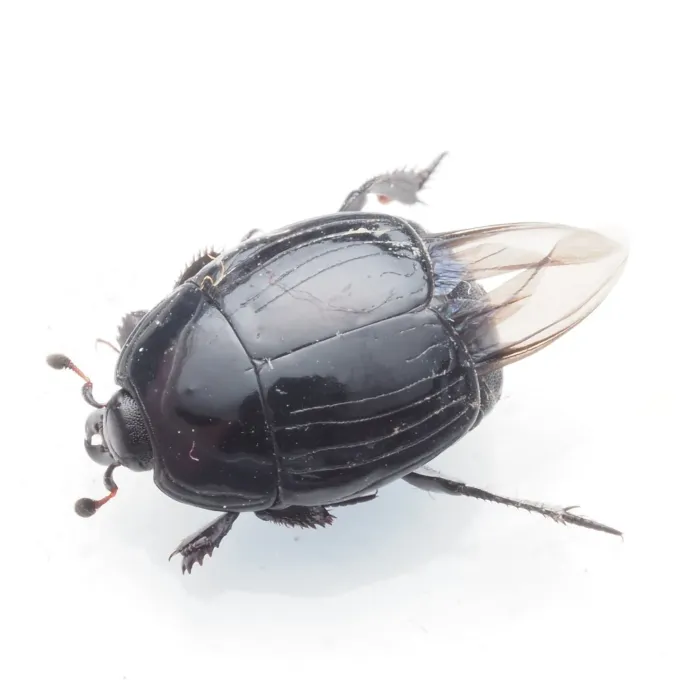
Hister cadaverinus, commonly known as a type of clown beetle, belongs to the Histeridae family. These insects are easily identified by their compact, glossy, and black-colored oval bodies, which they can retract when threatened.
Adult beetles typically measure between 5 and 9 millimeters in length. Their wing covers (elytra) feature distinct longitudinal striae, which are a characteristic morphological trait used for accurate species identification in professional entomology.
The larvae are whitish, elongated, and possess a well-developed head with powerful mandibles adapted for a carnivorous diet, typically consuming other small insects found in organic debris.
These beetles are primarily active in dark or dimly lit environments and are highly sensitive to the moisture levels of their habitat, often preferring locations where decomposition occurs.
While they are not traditional crop-destroying beetles, their presence is a clear indicator of suboptimal sanitary conditions within agricultural or storage facilities.
What it damages
Hister cadaverinus acts primarily as a facultative pest in grain storage environments. While their main food source consists of larvae of other insect species, they can cause damage to stored products under specific conditions.
The economic impact arises from the contamination of grain with feces, cast larval skins, and dead insect debris, which lowers the quality grade of the harvested grain and makes it unsuitable for sale.
In cases of high population density, these beetles may facilitate the spread of fungi and bacteria, as they frequent areas where stored grain has begun to spoil due to moisture infiltration.
They do not typically consume grain directly, but their presence indicates an ecosystem where other more aggressive pests (such as weevils or moths) are likely already established.
The damage is effectively a result of poor management practices, where accumulated waste and poor aeration provide the necessary environment for the beetle's life cycle to persist.
When it appears
The activity of these beetles is heavily dependent on temperature. They are most active during the warmer months, although they can breed continuously in temperature-controlled grain storage facilities.
The lifecycle includes a complete transformation from egg to larva, pupa, and adult. In ideal storage conditions, several generations can develop within a single calendar year.
Adults are known for their resilience and can overwinter in cracks, crevices, and deep piles of organic matter, waiting for temperatures to rise before resuming their active phase.
Migration typically peaks during the late spring and summer nights, when adults actively seek new environments with sufficient organic matter to sustain their predatory needs.
Humidity is a critical factor for successful reproduction; low-moisture environments generally discourage population growth, whereas damp storage conditions provide an optimal environment for development.
Signs of infestation
Early identification is essential for effective pest management. The primary sign of infestation is the discovery of adult beetles on the surface of grain heaps or near warehouse walls.
A musty or decaying odor in the grain mass is often an indication that moisture levels are high enough to attract various insects, including Hister cadaverinus.
- Presence of glossy black beetles near storage floors.
- Accumulation of larval excreta and empty skins within the grain dust.
- Increased activity of other insects which serve as a primary food source.
Using monitoring traps, such as sticky boards or light-based insect lures, is an effective way to detect early activity in warehouse corridors and under loading equipment.
Regular inspection of grain moisture levels and warehouse hygiene is mandatory to prevent the establishment of significant populations.
Control measures
Effective control is achieved primarily through rigorous sanitary practices. Regular cleaning of storage facilities to remove all grain dust and debris is the most important preventative measure.
Maintaining low humidity and proper aeration in storage areas helps preserve grain quality and prevents the mold growth that attracts the beetle's food source.
Physical exclusion measures, such as sealing doors and windows with mesh screens, are necessary to prevent the migration of beetles into storage areas during the summer months.
If an infestation occurs, chemical control via professional fumigation using approved insecticides may be required to eliminate the entire complex of stored-product pests.
Implementing a strict inventory rotation policy, where old grain is removed before new shipments arrive, prevents the long-term buildup of organic matter that sustains the pest population.
Taxonomy
- Latin name
- Hister cadaverinus
- Order
- Coleoptera (beetles)
- Family
- Histeridae
- EPPO code
- HSTRCA
Discussion
No discussions yet — be the first.