
Cactus flat mite
Tenuipalpus cactorum
Description
How to identify
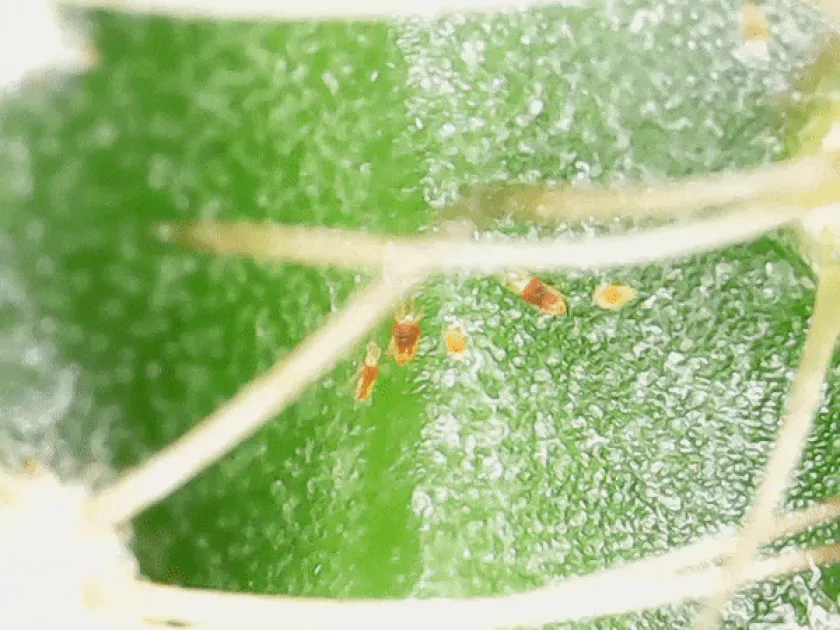
The cactus flat mite (Tenuipalpus cactorum) belongs to the Tenuipalpidae family, known as false spider mites. These are microscopic pests, rarely exceeding 0.3 mm in length, making them nearly invisible to the naked eye.
The mite has a flattened body shape, which gives the group its common name. Their coloration ranges from light yellow to reddish-brown, allowing them to blend seamlessly with the cactus epidermis.
Unlike common spider mites, flat mites do not produce dense webbing on the plant surface, meaning their presence is often only detected after visible damage has already occurred.
The life cycle includes the egg stage, larvae, two nymphal phases (protonymph and deutonymph), and the adult stage, with the entire cycle occurring directly on the plant host.
Warm, dry environments, such as greenhouses or indoor window sills during summer, provide optimal conditions for rapid population growth of these mites.
What it damages
This pest primarily attacks a wide range of succulents, including popular cactus genera such as Mammillaria, Echinocactus, Opuntia, and others within the Cactaceae family.
Flat mites feed by piercing the plant's surface cells with their specialized mouthparts and sucking the sap, which leads to significant nutrient depletion and stress.
The primary damage includes loss of aesthetic value and growth retardation, as the feeding sites quickly lose their photosynthetic capacity.
Without proper control, mite colonies can cause the death of young specimens or create extensive necrotic lesions that remain as permanent scars on the plant body.
Damaged tissues serve as entry points for secondary fungal and bacterial infections, which can accelerate the rotting process of the succulent.
Signs of infestation
Early symptoms appear as tiny light-colored or brownish dots on the cactus stem, which eventually coalesce into large patches of rusty or grayish, dry crusting.
The epidermis at feeding sites becomes dehydrated, corky, and acquires a characteristic matte finish, losing its healthy luster and natural color.
Using a strong magnifying glass, one can observe slow-moving individuals or tiny, bright-colored eggs deposited in the folds, ribs, or areoles of the cactus.
Plant growth slows down significantly, and in cases of heavy infestation, the stem may start to shrivel due to the loss of turgor and moisture from internal tissues.
In advanced cases, wide areas of necrosis are clearly visible on the surface, eventually spreading across larger portions of the succulent.
Control measures
Management of the cactus flat mite requires the use of systemic or contact acaricides specifically formulated to target false spider mites.
Effective active ingredients typically include abamectin, pyridaben, or spirodiclofen, all of which require strict adherence to application dosages and safety protocols.
A crucial strategy is to perform repeated treatments every 7 to 10 days to target hatching larvae, as most acaricides are not effective against the egg stage.
- Isolate infested plants from the rest of the collection immediately.
- Sanitize all tools and surfaces that come into contact with the plants.
- Increase air humidity to create an environment less favorable for mite reproduction.
Proactive inspection of new plants before adding them to your collection remains the most reliable method for preventing the spread of this pest.
Taxonomy
- Latin name
- Tenuipalpus cactorum
- Order
- Mites
- Family
- Tenuipalpidae
- EPPO code
- TENUCA
Discussion
No discussions yet — be the first.