
Flat mites
Brevipalpus
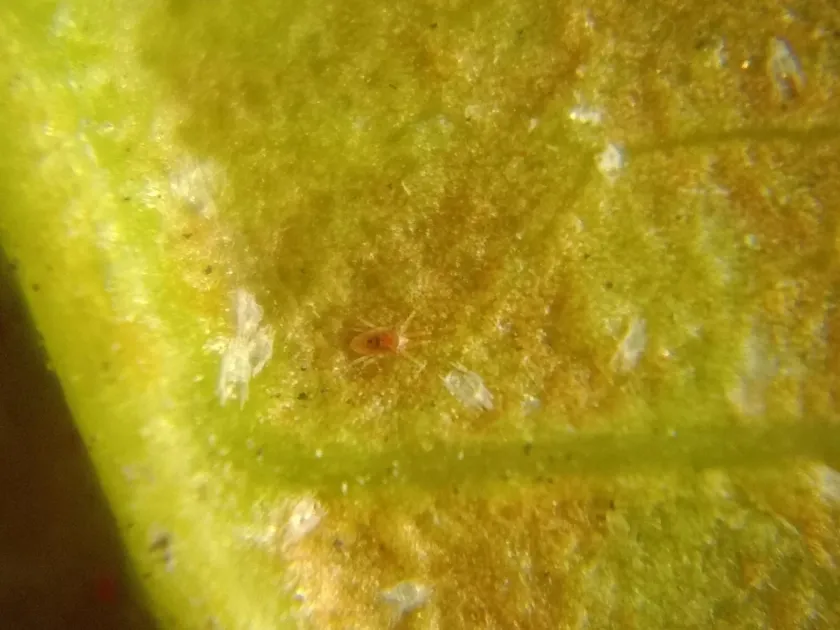
Description
How to identify
Flat mites, belonging to the family Tenuipalpidae, are microscopic pests known for their extremely flattened bodies. Unlike spider mites, they do not produce silk webs, which makes their presence less obvious to the untrained eye.
Adult mites typically measure between 0.2 and 0.3 mm in length. Their coloration ranges from reddish to brownish, providing excellent camouflage against the bark or leaf surfaces where they congregate.
Their life cycle consists of an egg stage, followed by larval, protonymph, deutonymph, and adult stages. Under favorable warm and dry conditions, the population can grow explosively within a short period.
Many Brevipalpus species are well-known as significant vectors of plant viruses. They transmit dangerous pathogens such as citrus leprosis virus, causing major losses in fruit-growing industries globally.
Due to their tiny size and habit of living in crevices or along leaf veins, identification usually requires a magnifying glass or a microscope to confirm the presence of eggs and mobile stages.
What it damages
These mites have a wide host range, attacking citrus trees, ornamental plants like orchids, grapevines, tea bushes, and various greenhouse vegetables. They feed primarily on the epidermal cells of the leaves and fruit.
As they consume plant juices, they inject toxic saliva, leading to the formation of chlorotic spots. These lesions eventually turn into necrotic areas that can cause premature leaf drop and fruit scarring.
In ornamental horticulture, the feeding damage results in deformed flowers and stunted plant growth, which destroys the aesthetic and commercial value of the crops significantly.
The damage to the fruit surface, often described as corking or russeting, reduces the quality and storage life of the harvest. This makes the affected produce unsalable in premium markets.
Persistent infestations weaken the plant's overall health, rendering it more susceptible to environmental stressors, drought, and secondary infections, ultimately leading to branch dieback.
Signs of infestation
Symptoms begin as tiny, pale, or brownish stippling on the leaves. As the infestation progresses, these stipples coalesce, causing large sections of the leaf tissue to wither and turn necrotic.
A hallmark sign of Brevipalpus is the absence of webbing. Instead, look for minute reddish eggs tucked into the grooves of the leaf veins or along the stems of the host plant.
Twisted, curled, or stunted new growth is a common indicator of a severe mite attack. In many cases, the damage is localized around the midrib of the leaves, where the mites prefer to feed.
On fruit, early signs appear as small discolored spots that gradually enlarge, often causing the skin to harden or crack as the fruit continues to expand during its growth phase.
General loss of vigor and vitality in plants that are otherwise well-irrigated is a strong hint that sap-sucking pests are present and draining the plant's resources.
Control measures
Effective control requires an integrated approach starting with strict sanitation. Removing infested plant material is crucial to prevent the spread of the mite population to healthy plants.
Chemical control involves the application of specific acaricides. Growers should choose products that target eggs and nymphs to break the life cycle effectively, ensuring thorough coverage of the underside of leaves.
Resistance management is key. Rotating between different chemical classes, such as METI-inhibitors and growth regulators, helps maintain the efficacy of treatments over several growing seasons.
Biological control using predatory mites is a sustainable alternative for greenhouse settings. These beneficial organisms can successfully keep flat mite populations below the economic damage threshold.
- Use of targeted acaricide sprays.
- Monitoring with sticky cards.
- Quarantine protocols for new plant stock.
- Promotion of natural predatory mite populations.
Taxonomy
- Latin name
- Brevipalpus
- Order
- Mites
- Family
- Tenuipalpidae
- EPPO code
- BRVPSP
Discussion
No discussions yet — be the first.