
California flat mite
Brevipalpus californicus
Description
How to identify
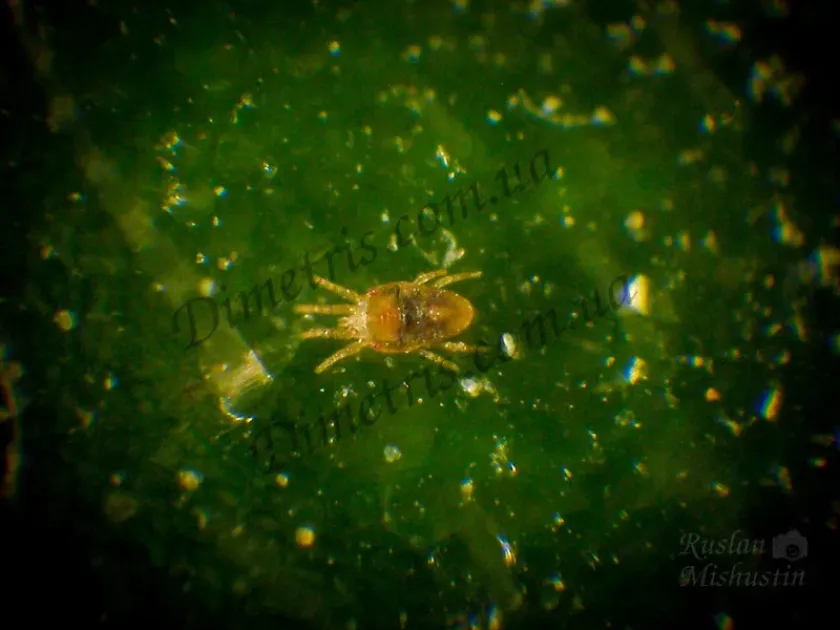
The California flat mite (Brevipalpus californicus) belongs to the Tenuipalpidae family. These mites are extremely small, characterized by a flattened, oval-shaped body and a reddish or brownish coloration.
Unlike common spider mites, this species does not produce silk webbing, which often causes growers to overlook early infestations. They are barely visible to the naked eye, usually requiring a 10x magnification lens for accurate field identification.
The life cycle encompasses several distinct stages: egg, larva, protonymph, deutonymph, and adult. Each stage requires feeding on plant sap to progress through development.
Females are highly prolific and capable of parthenogenetic reproduction, which allows a single individual to initiate a new colony without the need for mating.
Their physical structure allows them to hide effectively in tight spaces, such as crevices in tree bark or the narrow junctions where leaves meet the stem.
What it damages
As a polyphagous pest, the California flat mite infests a wide range of horticultural crops, with citrus, tea, and various ornamental plants being the primary targets.
The mites feed by piercing the plant epidermis and extracting cell contents. This mechanical damage causes a systemic response in the plant, weakening its defense mechanisms.
In citrus, feeding activity on fruits causes distinct skin disfiguration, often described as brown, corky patches or blemishes that severely devalue the commercial harvest.
On leaves, the damage appears as irregular chlorotic spots or bronzing. Severe infestations lead to premature leaf drop, stunted shoot development, and overall tree decline.
While direct damage is significant, the wounds created by these mites also provide entry points for various secondary pathogens, increasing the risk of fruit rot and tissue decay.
When it appears
Population dynamics are highly responsive to environmental temperature. Peak activity is typically observed during warm, dry summer months when the reproductive rate is at its highest.
In greenhouses and interior landscapes, these mites thrive year-round. The lack of seasonal fluctuations in controlled environments enables continuous breeding cycles.
In orchard settings, populations often begin to build up in early spring as temperatures rise, reaching maximum density by mid-to-late summer.
As autumn approaches and temperatures drop, mite activity declines, and they seek protected niches on the plant to survive the cooler period.
High relative humidity and moderate temperatures can also contribute to sudden population surges, making consistent monitoring vital throughout the growing season.
Signs of infestation
The primary symptom is the loss of natural leaf luster, turning foliage matte and dull. Over time, distinct light-colored stippling or bronzing becomes visible on the upper leaf surface.
Fruit damage is a diagnostic hallmark, specifically the appearance of dark, leathery, or corky lesions on the rind of citrus fruits, which do not disappear as the fruit matures.
Affected plants exhibit a generalized stressed appearance, characterized by reduced vigor, smaller fruit size, and, in severe cases, dieback of terminal branches.
Inspection for the presence of the mite itself should focus on the underside of leaves along the veins and in the stem axis, where they typically cluster.
Since they do not weave webs, the absence of silk is a crucial factor in distinguishing this pest from the common spider mite (Tetranychidae family).
Control measures
Effective management requires a combination of chemical control and sound cultural practices to mitigate the risk of population explosion.
Chemical intervention should utilize registered acaricides. Rotating between different modes of action is critical to prevent the development of resistant mite populations.
- Applying narrow-range horticultural oils to physically disrupt the mites and smother eggs.
- Encouraging biological control agents, such as predatory phytoseiid mites, which can suppress pest numbers.
- Pruning infested branches to reduce the overall mite load within the canopy.
- Maintaining optimal irrigation to keep plants healthy and more resilient to mite feeding.
- Implementing strict quarantine protocols for incoming plant stock to prevent introduction into clean areas.
Regular scouting using a hand lens is the most important step in early detection, allowing for spot treatments before a widespread infestation occurs.
Taxonomy
- Latin name
- Brevipalpus californicus
- Order
- Mites
- Family
- Tenuipalpidae
- EPPO code
- BRVPAU
Discussion
No discussions yet — be the first.