
Flat mite
Brevipalpus cuneatus
Description
How to identify
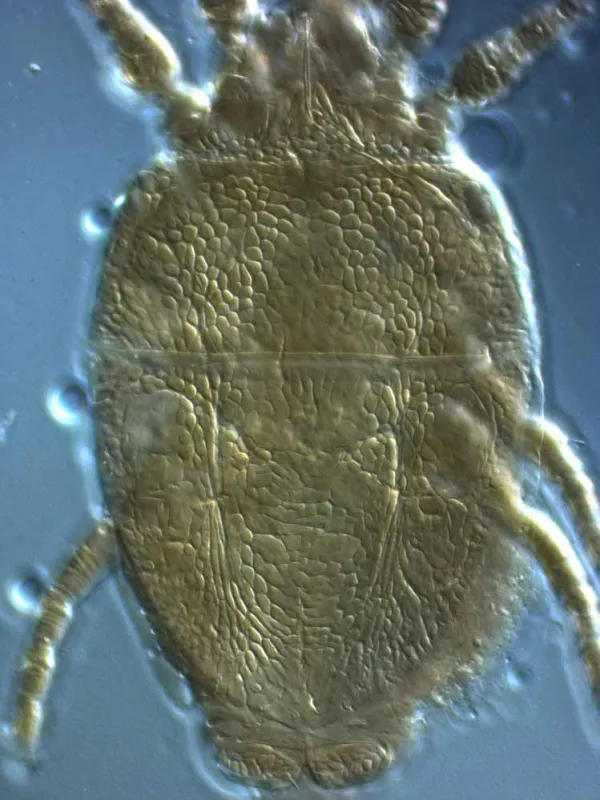
The flat mite (Brevipalpus cuneatus) belongs to the family Tenuipalpidae. These mites are microscopically small and characterized by a flattened body shape, which allows them to hide efficiently in the crevices of bark or leaf surfaces.
Unlike common spider mites, the flat mite does not produce visible webbing. This lack of silk makes early detection difficult for growers without the use of magnification tools, often delaying necessary intervention.
Adult mites are typically reddish-brown, camouflaging well with the plant tissues they inhabit. Their life cycle consists of egg, larva, protonymph, deutonymph, and adult stages, occurring rapidly in warm, dry environments.
Reproduction in this species is primarily parthenogenetic, meaning females can produce offspring without mating. This trait enables a single individual to rapidly establish a significant infestation on a host plant.
These mites are most frequently found on the underside of leaves, particularly along the veins, where they find protection from environmental factors and predators.
What it damages
This species is a polyphagous pest, affecting a wide range of ornamental plants, fruit trees, and citrus species. It feeds by piercing the epidermal cells and extracting plant sap.
Initial damage appears as localized discoloration, which eventually merges into larger necrotic spots or patches. This impairs the plant's ability to photosynthesize effectively, leading to stunted growth.
Heavily infested plants may experience premature leaf drop, weakening the overall plant vigor. In cases of severe infection, young shoots can become distorted or fail to develop properly.
Beyond direct physical damage, these mites act as vectors for various plant viruses, which are transmitted during the feeding process, leading to long-term systemic infections in the host plant.
The reduction in plant quality caused by these mites can be devastating for commercial nurseries, as infested plants often lose their marketability due to yellowing and foliage loss.
When it appears
The mites are most active during the spring and summer months when temperatures rise, favoring their metabolic rate and reducing the duration of their generation cycles.
In greenhouses and indoor settings, flat mites can maintain year-round activity if climate control maintains warmth and low humidity, effectively eliminating any seasonal dormancy.
Outdoors, the population peaks during hot, dry spells. Rainfall and high humidity can naturally suppress population growth, whereas drought acts as a catalyst for outbreaks.
As temperatures begin to drop in the autumn, adult females move to protected areas, such as bark fissures or debris, to undergo a dormant phase until the next growing season.
Growers should initiate monitoring programs early in the spring, focusing on new growth, which is highly attractive to the mites as they colonize the host plant.
Signs of infestation
The earliest signs of an infestation are small, light-colored stippling marks on the leaves. These often go unnoticed until they coalesce into yellow or bronzed blotches.
Inspecting the underside of leaves with a hand lens may reveal small shed skins (exuviae) and dark fecal deposits, confirming the presence of an active mite population.
Foliage may lose its turgor, looking dull or chlorotic despite adequate watering. In more advanced stages, the leaf margins may dry out, curl, or become brittle.
A general decrease in plant growth rate and a decline in flowering or fruiting are systemic indicators that the mite population has reached an damaging threshold.
If left unmanaged, the foliage may fall away entirely starting from the base of the plant, leaving the plant skeletal and highly susceptible to secondary pathogens.
Control measures
Effective management requires the use of specific acaricides, as many broad-spectrum insecticides fail to control mite populations. It is crucial to rotate chemical classes to prevent the development of pesticide resistance.
Application should be performed in two cycles with a 7–10 day interval to ensure that any eggs that hatch after the initial treatment are eliminated before they reach maturity.
Cultural control includes maintaining appropriate humidity levels, as these mites thrive in dry conditions. Regular leaf misting can help deter colonization.
- Regular inspection of incoming plant materials to prevent introducing the pest.
- Sanitation, including the removal of infested leaves and debris.
- Using biological control agents like predatory phytoseiid mites in greenhouse settings.
- Maintaining healthy plant nutrition to improve the host plant's tolerance to feeding.
- Sanitizing tools and surfaces to avoid cross-contamination between plants.
Integrated Pest Management (IPM) strategies, which balance chemical applications with biological controls, provide the most sustainable long-term solution for managing flat mite outbreaks.
Taxonomy
- Latin name
- Brevipalpus cuneatus
- Order
- Mites
- Family
- Tenuipalpidae
- EPPO code
- BRVPCU
Discussion
No discussions yet — be the first.