
Essig's flat mite
Brevipalpus essigi
Description
How to identify
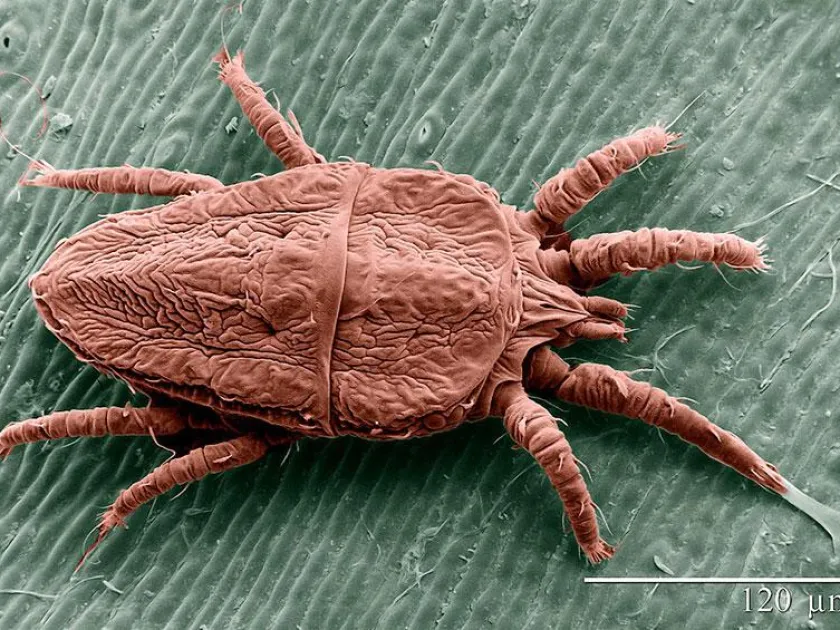
Essig's flat mite (Brevipalpus essigi) belongs to the family Tenuipalpidae, within the order Trombidiformes. It is a microscopic pest that is nearly invisible to the naked eye.
The adult mites are characterized by a flattened body shape, which is a distinctive feature of the family. Their color ranges from reddish to brown, blending in with plant tissues.
The life cycle encompasses several stages: egg, larva, protonymph, deutonymph, and adult. Development is highly sensitive to environmental temperature and humidity.
Females lay eggs in small clusters, often within leaf crevices or along leaf veins, making them difficult to detect during routine inspections.
Unlike spider mites, they do not produce webbing, which often delays the discovery of an infestation until significant damage has already occurred.
What it damages
This mite is a polyphagous pest, known to affect a wide range of hosts including citrus, ornamental shrubs, and various greenhouse crops.
The mites feed by piercing plant cells and extracting the sap. This process causes cellular death and interferes with the plant's ability to perform photosynthesis.
Heavy infestations lead to stunted growth, reduced vigor, and in severe cases, the death of individual leaves or young terminal shoots.
The weakening of the plant's physiological state often predisposes the host to secondary fungal or bacterial pathogens.
Economic losses are primarily associated with the degradation of ornamental plant quality and significant yield loss in sensitive fruit-bearing cultivars.
Signs of infestation
Early symptoms include the appearance of small chlorotic spots or stippling on the leaves, where the mites have extracted cellular contents.
As the infestation progresses, leaves may turn yellow, exhibit curling or distortion, and eventually drop prematurely from the plant.
Upon careful inspection, especially on the underside of leaves and along the veins, one may observe tiny, moving specks indicative of an active colony.
Stunted development of young growth and internodes is a common indicator of a chronic, long-term infestation that has drained the plant's energy.
- Chlorotic spotting on leaves.
- Leaf curling and deformation.
- Premature leaf drop.
- Overall stunting of plant growth.
Control measures
Effective control requires the use of specialized acaricides, as conventional insecticides are generally ineffective against flat mites.
Resistance management is crucial; therefore, growers should rotate products with different modes of action to ensure long-term population suppression.
Biological control using predatory phytoseiid mites is highly recommended, especially in greenhouse environments where chemicals may be restricted.
Good agricultural practices, such as the removal and destruction of heavily infested plant material, contribute significantly to lowering mite pressure.
Regular scouting using a hand lens is essential for early detection, allowing for targeted interventions before the pest population reaches damaging levels.
Taxonomy
- Latin name
- Brevipalpus essigi
- Order
- Mites
- Family
- Tenuipalpidae
- EPPO code
- BRVPES
Discussion
No discussions yet — be the first.