
Feresi flat mite
Brevipalpus feresi
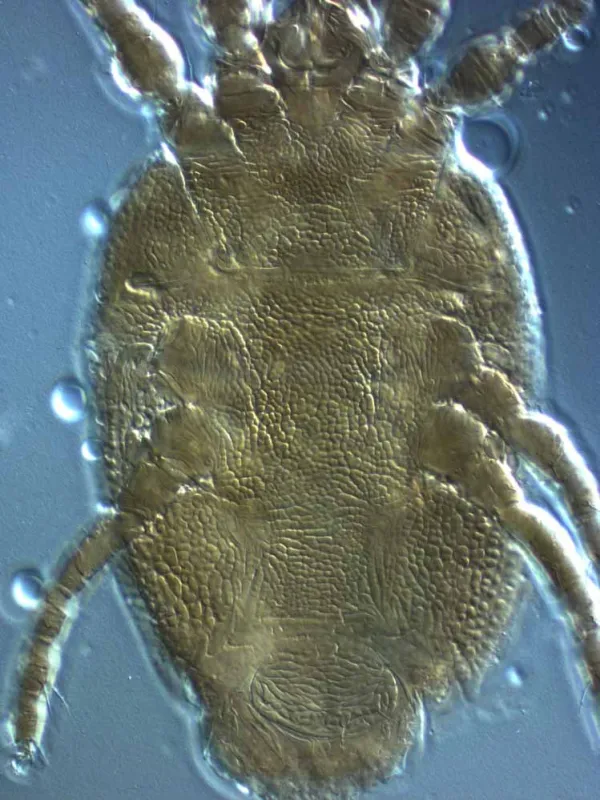
Description
How to identify
The Feresi flat mite (Brevipalpus feresi) is a member of the Tenuipalpidae family, commonly known as flat mites. Unlike spider mites, these tiny arthropods do not produce any webbing, making them harder to detect.
Adult mites have a flattened body shape and a reddish-brown color. They are extremely small, typically under 0.3 mm in length, requiring a magnifying glass for proper identification in the field.
The life cycle involves egg, larva, and nymph stages. The development rate is highly dependent on ambient temperature and humidity, allowing for rapid population growth in warm weather.
Females lay their eggs on plant surfaces, often hiding them along leaf veins or within small crevices in the bark, which provides a high degree of protection against environmental stressors.
Because they can complete multiple generations in a single season, the Feresi flat mite can quickly reach damaging population densities if not monitored correctly.
What it damages
This mite is a polyphagous pest capable of attacking a wide range of trees, shrubs, and ornamental plants. Citrus and fruit-bearing species are particularly susceptible to severe infestations.
The damage is caused by the mite piercing plant cells and extracting sap. This disrupts the plant's photosynthetic ability and drains energy, leading to overall physiological decline.
Affected leaves initially show small chlorotic spots. As the infestation progresses, these spots coalesce, causing the leaf tissue to bronze, curl, and eventually drop prematurely.
The Feresi flat mite is also recognized as a potential vector for various plant viruses and phytoplasmas, which can cause long-term irreversible damage to plant health.
Economic losses in nurseries and orchards are significant, often resulting in reduced fruit quality, stunted plant growth, and sometimes total loss of the decorative value of the plants.
Signs of infestation
Early symptoms of infestation include a dull, dusty appearance on the leaves. The foliage may lose its natural luster and take on a bronze or greyish cast.
Deformation of young shoots and curling of leaf edges are common indicators. In many cases, the plants appear stressed or wilted despite proper irrigation and soil care.
Upon closer inspection with a hand lens, one can find the mites situated quietly along the midribs or veins of the leaves, where they are protected from direct sun and wind.
The absence of silk webs is the primary reason why this mite is often overlooked during initial scouting compared to typical spider mite outbreaks.
Severe infestations lead to a crusty texture on the leaf surface and significant defoliation, indicating that the mite colony has been active for an extended period.
Control measures
Effective management requires a combination of cultural practices and the use of targeted acaricides. Monitoring is the key to preventing population explosions.
Cultural control involves removing and destroying infested plant material, particularly during dormant periods, to reduce the number of overwintering mites.
- Application of acaricides with ovicidal properties to target both adults and eggs.
- Use of biological control agents to manage populations in an environmentally friendly way.
- Pruning to ensure good airflow and light penetration, which makes the environment less favorable for mites.
During chemical treatment, it is vital to spray thoroughly, covering the undersides of the leaves where these mites predominantly reside and feed.
To avoid the development of pesticide resistance, it is crucial to rotate products with different modes of action throughout the growing season.
Taxonomy
- Latin name
- Brevipalpus feresi
- Order
- Mites
- Family
- Tenuipalpidae
- EPPO code
- BRVPFE
Discussion
No discussions yet — be the first.