
American badger
Taxidea
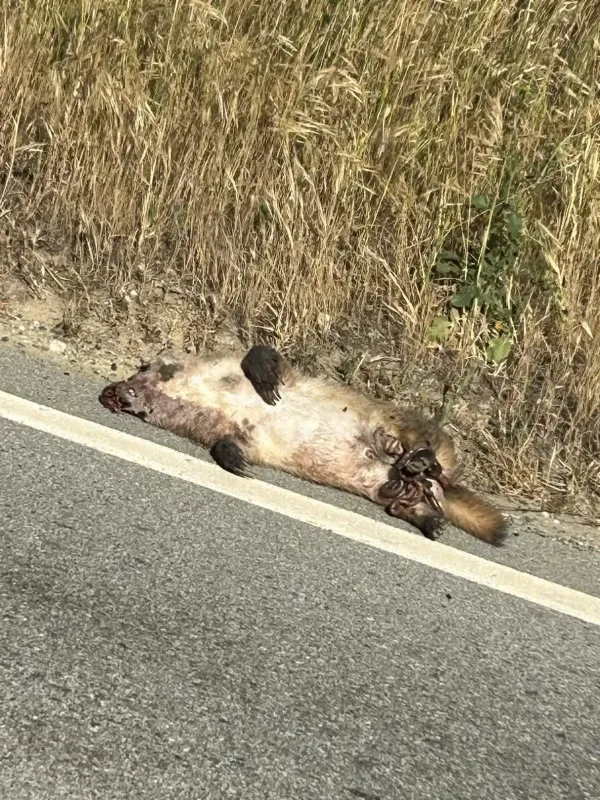
Description
How to identify
The American badger (Taxidea taxus) is a stout, fossorial mammal belonging to the Mustelidae family, perfectly adapted for digging. It has a squat build, dense grayish-brown fur, and a distinctive white stripe running from its nose to its nape.
Adult individuals reach 50–70 centimeters in length and weigh between 4 and 12 kilograms. Their forelimbs are equipped with exceptionally long, strong claws designed for rapid excavation of soil while hunting for burrowing rodents.
This animal is primarily nocturnal, making it difficult to spot in fields during the day. They inhabit open prairies and steppe regions of North America, where they construct complex and deep underground burrow systems.
It is important to distinguish this species from other Mustelids, as its ecological impact is closely tied to the modification of soil structure. Badgers are highly territorial and aggressive when protecting their nesting areas.
Although biologically a predator, in agroecosystems, its activity is considered destructive due to the disruption of land integrity and the creation of dangerous hazards for farm machinery.
What it damages
The primary damage to agricultural land is not caused by the consumption of crops, but by mechanical damage to soil and root systems. Badgers dig deep burrows near cereal and forage crop fields.
During excavation, the animal casts large volumes of soil onto the surface, leading to the destruction of plants in the discharge area. This creates barren patches where crops are entirely lost due to root disruption.
Heavy farm machinery often sinks into these burrows, leading to damage to seeders, combines, and cultivators, which results in significant economic losses for farming operations.
Badger activity contributes to soil erosion, especially on slopes where burrow exits are located. The disruption of the top fertile layer negatively affects the long-term productivity of the field.
While badgers hunt rodents, the indirect damage caused to field infrastructure and the costs of soil remediation usually outweigh the benefits of pest control provided by their hunting activity.
When it appears
The activity of the American badger increases significantly during spring and summer, when animals are busy maintaining burrows and raising offspring. During this time, they frequently encroach upon agricultural lands.
In autumn, badgers actively build up fat reserves for the winter season. Increased foraging activity during this period also encourages the digging of new burrows along the edges of fields where the soil is easier to work.
The breeding cycle directly influences the intensity of digging. The birth of young in the spring requires females to expand their tunnels, which leads to the appearance of new damage hotspots.
During winter thaws, badgers may remain temporarily active. However, the peak of danger for crops falls within the active growing season, from April to September.
Agronomists are advised to survey fields at the beginning of the growing season when signs of animal activity are most visible against the backdrop of young crop seedlings.
Signs of infestation
The primary indicator of a badger's presence in a field is the burrow entrance, which has an oval or semi-oval shape and reaches 20–30 centimeters in width.
Fresh mounds of soil next to crops are direct evidence of recent activity. These mounds consist of a mixture of soil and plant debris removed from the tunnel.
Along the edges of the field, one can find claw marks on hard soil or trails leading from shelterbelts to the crops. Badger footprints are large, with distinct impressions of long claws.
Damaged sections of fields appear as trampled or soil-covered areas. If a burrow is located under a cultivated field, plants in the area may wilt due to the creation of air pockets in the soil.
Near the burrows, one can sometimes find prey remains, which further confirms the permanent residence of the pest in that specific section of the land.
Control measures
The most effective method of field protection is installing mesh fencing buried in the ground to prevent animals from entering the cropping area.
The use of deterrents, such as ultrasonic devices or strong-smelling repellents, provides only a temporary effect, as animals quickly become accustomed to these stressors.
Regular leveling of the ground and filling in burrows after the harvest season helps minimize the risk of machinery damage. When filling, it is recommended to use gravel or stones, which makes re-digging in the same spot more difficult.
Improving agricultural practices, specifically deep tilling of field edges, helps destroy old tunnels and creates unfavorable conditions for establishing new permanent dens.
In cases of high population density, it is necessary to contact wildlife management agencies for population control according to local regulations, as independent hunting of badgers is often restricted or prohibited.
Taxonomy
- Latin name
- Taxidea
- Family
- Mustelidae
- EPPO code
- TAXISP
Discussion
No discussions yet — be the first.