
European otter
Lutra lutra
Description
How to identify
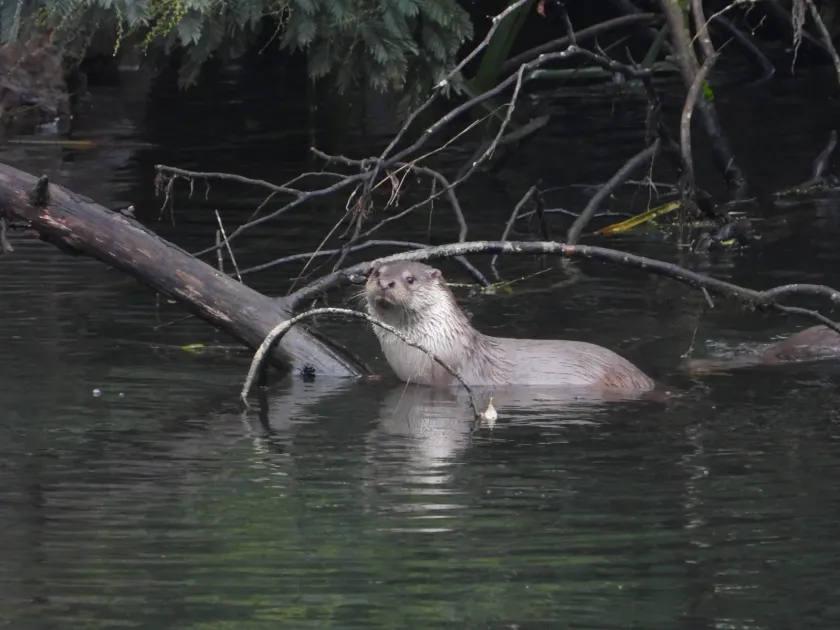
The European otter (Lutra lutra) is a semi-aquatic carnivore belonging to the Mustelidae family and Carnivora order. It has a streamlined body up to 90 cm long, perfectly adapted for life in water.
The animal features a powerful tail used for steering while swimming and short limbs equipped with webbed feet. Its fur is dense, waterproof, and dark brown, providing excellent insulation in cold water.
Adult otters typically weigh between 6 and 10 kilograms. They possess highly developed senses, including keen vision under water and sensitive whiskers that help detect movement in murky conditions.
On land, otters move with a distinctive gait, often leaving clear footprints with webbed marks and a tail drag mark on soft soil or snow. They are highly intelligent and notoriously elusive animals.
Otters construct complex dens, often with entrances located below the water level, which provide safe shelter and access to feeding grounds, making them difficult to detect until damage has occurred.
What it damages
The primary economic impact of otters is the predation on valuable fish stocks in aquaculture ponds, fish farms, and commercial fisheries, where they hunt species like carp, trout, and pike.
An otter can decimate a pond population, consuming large quantities of fish daily. Beyond direct consumption, they often kill or injure more fish than they eat, leading to significant losses for farmers.
Injured fish that survive otter attacks are highly susceptible to fungal and bacterial infections, which can spread throughout the entire pond, potentially causing mass mortality of the remaining stock.
Winter predation is especially critical when cold water slows down fish activity, making them easier targets for otters. In such conditions, otters can clear a smaller pond of its entire fish population.
Otters also inflict structural damage to fish farms by digging burrows into dams and pond banks. This destabilizes the integrity of embankments, leading to leaks, water loss, and potential pond collapse.
Signs of infestation
Signs of otter presence include characteristic tracks on muddy or sandy banks, showing webbed paw prints and a smooth line left by the tail between the prints.
Observation of 'spraints' or droppings, which are often deposited on prominent rocks or mounds near the water, serves as a key indicator. These contain fish scales, bones, and crustacean shells.
'Feeding sites' or 'larders' are common signs, where piles of fish remains, particularly heads and spines, are found on the banks, showing clear marks of the otter's teeth.
Slick slides, where otters repeatedly enter the water, are visible on steep banks. These paths are usually worn clear of vegetation and become very smooth over time due to constant use.
Injuries to live fish in cages, such as deep bite marks on the back or flanks, are clear evidence of attempted predation, indicating that the otter is actively hunting in the immediate vicinity.
Control measures
Installing robust, high-quality perimeter fencing is the most effective deterrent. The fence should be buried at the base to prevent the animal from digging underneath to enter the area.
Electric fencing (electric 'shepherds') set up along the water's edge can successfully repel otters by delivering a mild, harmless shock, teaching the animal to avoid the restricted area.
Visual and acoustic deterrents, such as motion-activated lights or sound generators, may provide temporary protection, although otters are known to be intelligent and can adapt to these stimuli over time.
Clearing bank-side vegetation and shrubs reduces natural cover, making the area less attractive for otters to establish dens or approach the water undetected, which encourages them to move elsewhere.
Since the European otter is a protected species in many jurisdictions, any control measures must comply with local wildlife protection laws; always consult with environmental authorities before taking action.
Taxonomy
- Latin name
- Lutra lutra
- Family
- Mustelidae
- EPPO code
- LUTRLU
Discussion
No discussions yet — be the first.