
American marten
Martes americana
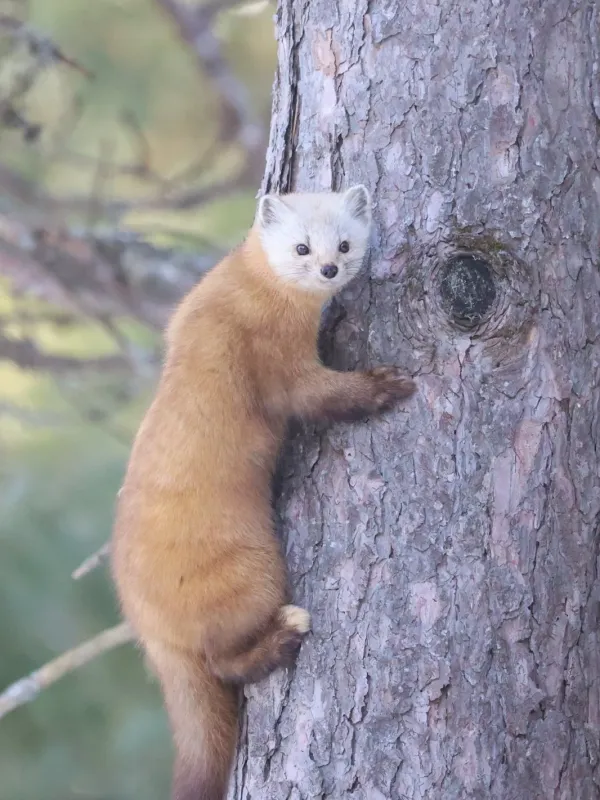
Description
How to identify
The American marten (Martes americana) is a member of the Carnivora order and the Mustelidae family. It is a small, agile mammal with a slender body, dense fur ranging from light to dark brown, and a bushy tail.
Adult martens typically measure 32 to 45 centimeters in length and weigh between 0.5 and 1.3 kilograms. They possess sharp, semi-retractable claws that make them excellent climbers, essential for navigating forests.
These animals are primarily solitary and elusive, preferring dense forest environments. Their biology is adapted for high-energy expenditure, requiring a consistent intake of nutrient-dense prey.
While they are not phytophagous and do not directly attack crops, their presence near agricultural lands is driven by their role as opportunistic predators searching for livestock.
The species is native to North American coniferous and mixed forests, where they occupy specific home ranges that occasionally overlap with rural agricultural boundaries.
What it damages
The primary concern for farmers regarding the American marten is its potential to prey on small livestock, specifically chickens, ducks, and rabbits. They can inflict heavy losses on small-scale poultry operations.
Beyond direct predation, martens often disrupt farm infrastructure. Their tendency to gnaw on materials can damage storage buildings, ventilation systems, and electrical wiring.
The constant threat posed by their presence leads to significant stress in poultry, which often results in decreased egg production and growth rates in young livestock.
Martens are known to invade feed storage facilities, where they contaminate stored grains with excrement or physically destroy the packaging, leading to spoilage of animal feed.
Their efficiency as hunters means they can quickly eliminate a flock if proper security measures are not in place, making them a significant concern for backyard farmers.
When it appears
Marten activity near human settlements often peaks during the fall and winter months when their natural forest prey becomes more difficult to capture due to snow and cold.
During the spring breeding season, the increased nutritional demands of lactating females can lead to more frequent incursions into farmyards to secure easy food sources.
As nocturnal animals, martens are most active under the cover of darkness, which is when they typically attempt to infiltrate farm structures for hunting or scavenging.
Seasonal shifts in the local ecosystem, such as migration patterns or changes in prey populations, directly correlate with the likelihood of martens wandering into agricultural zones.
Harvesting periods can draw rodents to grain stores; since rodents are a natural prey item for martens, the predators may follow the food source into farm buildings.
Signs of infestation
Visual identification of tracks in snow or soft soil is the most reliable sign of a marten's presence. They leave distinct paired footprints often arranged in a zig-zag pattern.
Loss of livestock, especially poultry found dead with neck injuries or missing parts, is a definitive indicator of a predator attack from a mustelid species.
Physical damage to poultry house doors, vents, or feed containers, showing signs of teeth marks or scratching, suggests an intruder trying to force entry.
Nocturnal noises in barns, such as thumping or rustling in roof spaces, are frequent indicators that a marten has attempted to establish a temporary den or hunting path.
The discovery of droppings near storage areas or poultry runs, combined with scattered feed or disturbed bedding, confirms the activity of a persistent intruder.
Control measures
Exclusion is the most effective control strategy. All potential entry points in barns and chicken coops, including gaps as small as a few centimeters, should be reinforced with hardware cloth or metal mesh.
Securing animal feed in metal bins prevents the attraction of rodents, thereby removing the primary reason for martens to visit the property in the first place.
Motion-activated lights and sound-based deterrents can prove effective in startling the nocturnal predator and discouraging it from returning to the vicinity of the farm.
Implementing a strict maintenance schedule for farm buildings ensures that structural integrity is kept, preventing the mustelids from gnawing their way into storage areas.
- Reinforce all vents and windows with heavy-duty metal screening.
- Ensure poultry housing is tightly sealed during the night.
- Use live traps in accordance with local wildlife regulations.
- Clear brush and debris around barns to eliminate hiding spots.
Taxonomy
- Latin name
- Martes americana
- Family
- Mustelidae
- EPPO code
- MRTSAM
Discussion
No discussions yet — be the first.